Mitra MCP: Let Your AI Agent Make Calls From Your Personal Number

Mitra MCP lets AI agents make outbound calls from personal numbers, with real-time voice interaction and human takeover design.
Mitra MCP is an MCP tool that lets AI agents place calls from users' personal numbers, borrowing established number trust to avoid rejected or spam-flagged unknown calls. It emphasizes real-time voice conversation design and supports pulling users into calls when conversations exceed the agent's capabilities. Developed by Sai Mandava, it ranked 13th on Product Hunt with 77 votes and 3 comments. Privacy compliance, call recording, and data storage methods are undisclosed, and real-time quality lacks verifiable metrics, making it more suitable as an observation sample than a production tool.
When AI Agents Learn to "Make Phone Calls"
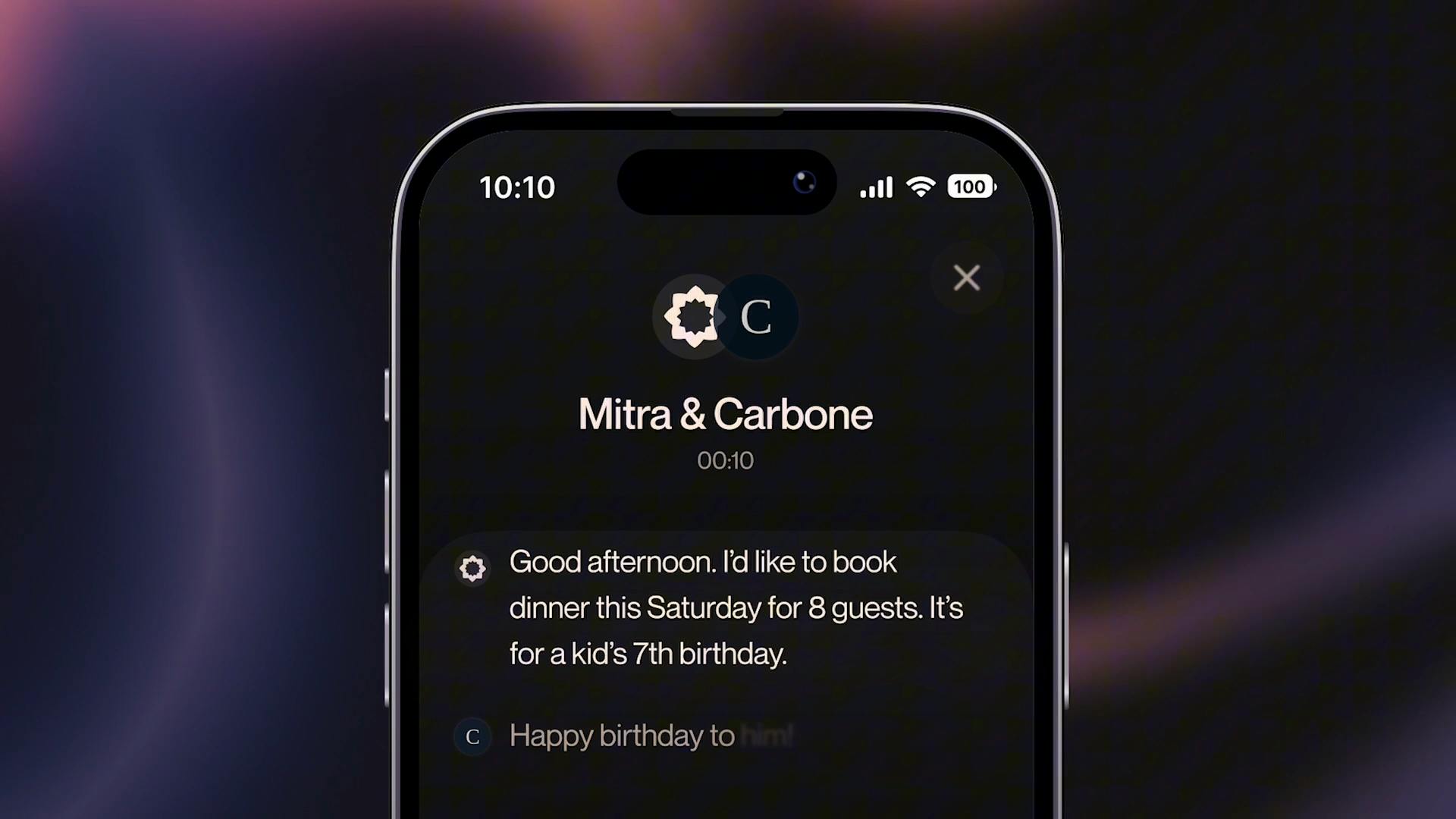
Most AI agents still can't make phone calls. The few that can dial usually use unfamiliar numbers, which are easily rejected or flagged as spam. Even when the other party answers, the contextual handling required for voice conversations is completely different from text chat. Mitra MCP attempts to solve this contradiction: letting AI agents place calls from your personal number, designing the experience around real-time conversation, and pulling you into the call when necessary.
According to its Product Hunt page, the project was developed by Sai Mandava and is positioned as an MCP tool that "gives your AI agent access to a personal phone line." It ranked 13th on the day's product list, receiving 77 upvotes and 3 comments.
Why the Personal Number Matters
Based on the product's own description, Mitra MCP's core selling point isn't complicated: number identity. When an AI agent makes outbound calls from an unfamiliar number, the answer rate is naturally low because the recipient sees an unknown caller—and it may even be directly flagged as spam by the carrier or phone system. Calling from a personal number means borrowing the trust relationship the user has already established.
Behind this lies an often-overlooked reality: "identity" is far more sensitive on the voice channel than on the text channel. A user might glance at an email from an unknown address, but many people simply won't pick up a call from an unknown number. By using the personal number as the agent's outbound identity, Mitra MCP is effectively addressing the first barrier of voice automation.
An Experience Designed for Real-Time Conversation
The product description specifically mentions that "successful voice conversations require contextual handling different from text chat." This points to a technical challenge: text agents can generate replies slowly, but voice conversations must respond in milliseconds while also handling interruptions, pauses, tone, and context switching.
Mitra MCP claims its call experience is built for real-time conversation, which means it doesn't just chain together TTS (text-to-speech) and STT (speech-to-text), but has designed an interaction layer specifically for call scenarios. However, the original material doesn't disclose specific technical implementation details such as latency levels, voice model selection, or mechanisms for handling conversation interruptions—these remain to be revealed by the product.
Another notable capability is "bringing you into the call when needed." This is essentially a human takeover entry point for the AI agent: when a conversation exceeds the agent's capabilities or involves matters requiring personal confirmation, the user can join in real time. This design has practical value in customer service, appointments, business communication, and other scenarios—the agent handles screening and initial communication, while the human handles key decisions.
The difference between voice and text conversations is essentially a difference in latency budgets. In text scenarios, a model generating replies in hundreds of milliseconds or even several seconds usually goes unnoticed by users; but on a phone call, silence exceeding about 300 milliseconds is perceived as "lag," and beyond one second the other party often starts asking "Hello, are you there?" Therefore, real-time voice agents typically use streaming pipelines: STT transcribes while listening, the language model generates incrementally, and TTS speaks while generating—three stages running in parallel to compress end-to-end latency. At the same time, they must handle "barge-in"—when the other party interjects while the agent is speaking, the system must immediately stop speaking and switch to listening. These mechanisms are completely different from the request-response pattern of text agents, and this is the technical core behind "different contextual handling" mentioned in the article.
Position in the MCP Ecosystem
Mitra MCP is provided in the form of MCP (Model Context Protocol), meaning it can be invoked by AI clients or agent frameworks that support MCP. MCP is gradually becoming an interface method for connecting AI models with external tools and data sources, and packaging phone capabilities as an MCP tool aligns with the current trend of agent tooling.
Judging from its Product Hunt categorization, it falls under the "Artificial Intelligence" category. With 77 upvotes, 3 comments, and a rank of 13th, the product has gained some attention, but community discussion remains limited and large-scale feedback has yet to form. For a tool involving phone communications, privacy and compliance issues will be a key concern for users, yet the original material doesn't mention how these are handled.
MCP (Model Context Protocol) is an open protocol proposed by Anthropic in late 2024, aimed at establishing a unified invocation interface between AI models and external tools and data sources. Previously, each AI client connecting to an external service often required custom integration code; MCP abstracts these integrations into standardized "servers" that clients discover and invoke according to the protocol, accessing the tools, resources, and prompt templates they expose. For developers, one implementation can be reused by multiple MCP-supporting clients; for users, this means agent capabilities can be assembled on demand like plugins. Mitra MCP packaging phone capabilities as an MCP tool leverages this layer of composability: any agent framework that supports MCP can treat "dialing, conversing, transferring" as ordinary tool calls.
Observations on an Early-Stage Product and Unresolved Questions
Mitra MCP captures a real pain point: AI agents need a channel to "reach out" and need a trustworthy number identity. Combining personal numbers with agent calls has imaginative potential in scenarios like appointments, follow-ups, and call screening.
But as an early-stage product, several questions remain unclear. First, outbound calls using personal numbers involve carrier rules and local regulations—how the product ensures compliance is not explained in the material. Second, the recording, transcription, and data storage methods for agent calls are not disclosed, leaving the privacy boundary unclear. Third, the quality of the real-time conversation experience lacks verifiable metrics or user feedback.
For those following the deployment of AI agents, Mitra MCP is worth watching, but until privacy and compliance details are made public, it's better suited as an observation sample than a tool for direct production use.
Related articles

Inside Honey Trap Training: Emotional Dissociation and Anchoring Techniques
How are spies trained for honey trap missions? A trainee reveals emotional dissociation, perfume and keyword anchoring, and target photo binding—psychological techniques that condition reflexes for intelligence work.

Frontier AI Risk Management: Full-Pipeline Practices from Training to Deployment
OpenAI outlines a frontier AI risk management framework: from training-stage model alignment to deployment-stage sandboxing and blocking safeguards, plus post-deployment monitoring—a layered risk control system across the model lifecycle.
DaisyRose-27B: 1,200-Task RL Boosts Qwen3.8 from 5.6% to 12% on Terminal-Bench 4.1
DaisyRose-27B uses RL training on 1,200 tasks to boost Qwen3.8's Terminal-Bench 4.1 score from 5.6% to 12%, showing lightweight RL can more than double terminal task performance.