Mixture-of-Loops Transformer: A New Take on the Efficiency of Recurrent Transformers

MoLT redefines inter-loop information passing via selective KV reuse, boosting expressiveness while keeping inference efficient.
This article introduces Mixture-of-Loops Transformer (MoLT), a new architecture that better balances efficiency and expressiveness in Recurrent Transformers. Its core, Mixture-of-Loops Attention (MoLA), treats KV as memory selectively reused across depth and loops. Variants include MoLT-R and MoLT-KV, and U-MoLT separates memory construction from prediction readout. U-MoLT achieves 1.7x validation CE token efficiency on a 700M model and +2.1 points on 3B MoE tasks, with latency on par with non-recurrent OLMo3.
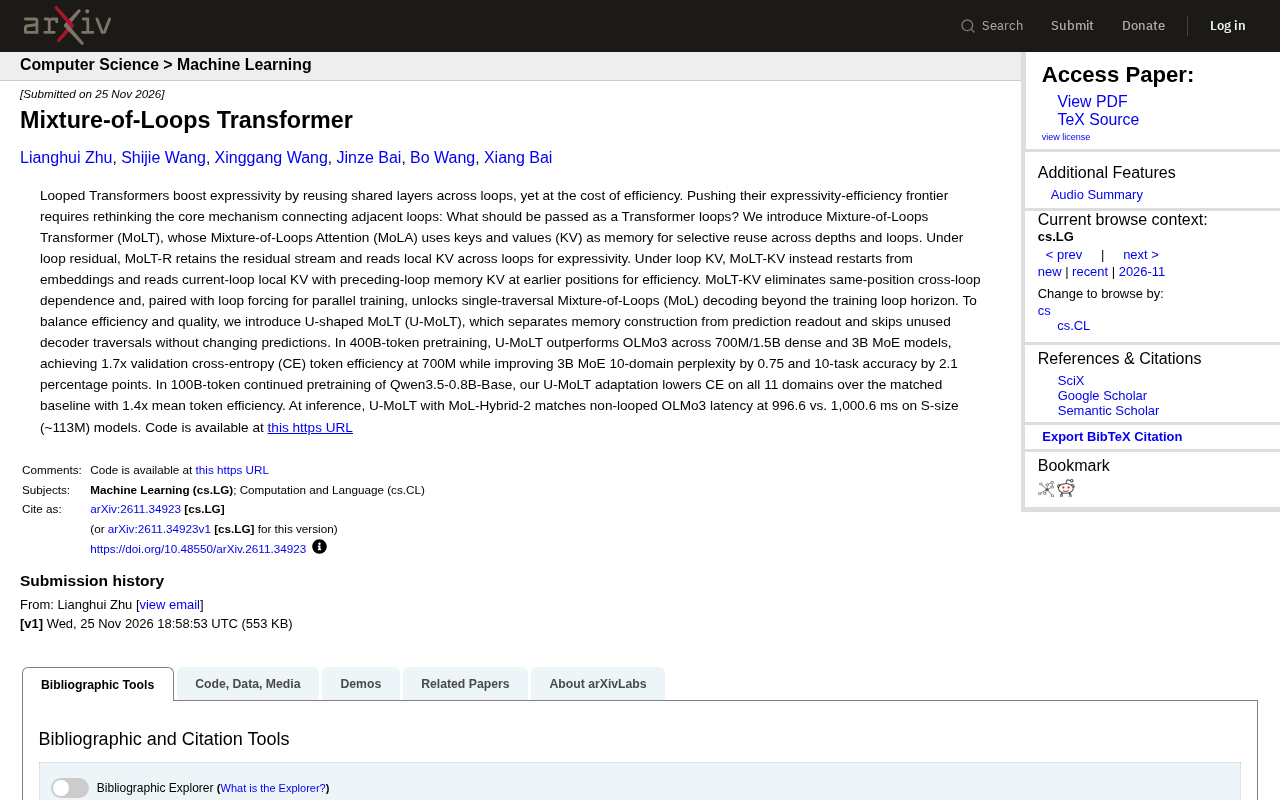
Recurrent Transformers improve expressive power by reusing shared layers across loops, but at the cost of efficiency. How can we find a better balance between expressive power and efficiency? The key lies in rethinking the core mechanism that connects adjacent loops: what should a Transformer pass between loops? This article introduces a new architecture called Mixture-of-Loops Transformer (MoLT), whose core is Mixture-of-Loops Attention (MoLA), which uses keys and values (KV) as memory to enable selective reuse across depth and loops.
The Bottleneck of Recurrent Transformers and MoLT's Entry Point
The core idea of a Recurrent Transformer is to let the model reuse the same set of layers across multiple loops, thereby improving expressive power without increasing the number of parameters. However, this reuse also brings efficiency problems: each loop requires a full computation, causing inference latency to grow linearly with the number of loops. Existing methods often make simple trade-offs between expressive power and efficiency, whereas MoLT attempts to improve both simultaneously by redesigning the information-passing mechanism between loops.
The key innovation of MoLT is Mixture-of-Loops Attention (MoLA). Traditional Recurrent Transformers typically pass the entire hidden state to the next loop, whereas MoLA treats keys and values (KV) as a kind of memory, allowing the model to selectively reuse these KVs across different depths and loops. This selective reuse provides the model with a more flexible way of information flow.
Recurrent Transformer is a class of architectures that repeatedly applies the same set of Transformer layers multiple times along the depth direction. Unlike standard Transformers, where each layer has independent parameters, Recurrent Transformers have the model "loop" through the same computation block, thereby increasing effective depth and computation without increasing the parameter count. This design stems from discussions on the expressive power of Transformers: deep networks generally have stronger representation capabilities, but parameter and computation costs grow accordingly. Recurrent structures attempt to decouple "depth" from "parameter count" through parameter sharing, enabling the model to obtain a deeper computation graph within a smaller parameter budget. However, because each loop must perform a full forward computation, inference latency increases linearly with the number of loops, which becomes the main bottleneck in practical deployment. MoLT is an improved solution proposed precisely against this backdrop.
Two Variants of MoLT: MoLT-R and MoLT-KV
Depending on what is passed between loops, MoLT has two main variants.
MoLT-R: Preserving the Residual Stream and Reading Local KV
MoLT-R works in recurrent residual mode. It preserves the residual stream and reads local KV between loops to enhance expressive power. This approach is closer to traditional Recurrent Transformer designs, but achieves finer-grained KV reuse through MoLA.
MoLT-KV: Restarting from Embeddings and Reading the Current Loop's Local KV and the Previous Loop's Memory KV
MoLT-KV adopts a different strategy: it restarts from the embeddings, reads the local KV of the current loop, and at the same time utilizes the memory KV from the previous loop at earlier positions. This design eliminates cross-loop dependencies at the same position, enabling the model to train in parallel (with loop forcing) and supporting single-pass Mixture-of-Loops (MoL) decoding, thereby breaking through the loop horizon limitation during training.
Loop forcing is a technique for training recurrent architectures. Its core idea is to expose the model to varying numbers of loop steps during training rather than a fixed number of loops. Specifically, during training, loop steps are sampled randomly or according to a schedule, so that the model learns to produce reasonable outputs at different loop depths. This is similar to the role of Teacher Forcing in sequence generation, but operates along the depth dimension rather than the time dimension. Loop forcing enables MoLT-KV to train in parallel: since the model has already seen various loop lengths during training, it does not over-rely on the intermediate state of a fixed loop step, thereby eliminating strict cross-loop dependencies at the same position. With this technique, the model can flexibly choose the number of loops during inference and support single-pass MoL decoding, breaking through the fixed loop horizon limitation during training.
U-MoLT: Balancing Efficiency and Quality
To further balance efficiency and quality, the researchers propose U-shaped MoLT (U-MoLT). U-MoLT separates memory construction from prediction readout and can skip unused decoder traversals without changing the prediction results. This U-shaped structure allows the model to dynamically skip certain computation steps during inference, thereby reducing computation while maintaining prediction quality.
The design philosophy of U-MoLT is similar to the encoder-decoder structure of U-Net: first build memory representations through several layers, then perform prediction through subsequent layers. By separating these two stages, the model can allocate computational resources more flexibly.
U-Net is a classic encoder-decoder architecture, originally used for biomedical image segmentation. Its structure consists of a contracting path (encoder) and an expanding path (decoder). The encoder progressively downsamples to extract multi-scale features, while the decoder progressively upsamples to restore spatial resolution, and skip connections fuse the encoder's high-resolution features with the corresponding decoder layers. The key advantage of this U-shaped design is that the encoder is responsible for building rich semantic representations, while the decoder performs fine-grained prediction based on these representations, with a clear division of labor between the two. U-MoLT borrows this idea by dividing the computation process of the Recurrent Transformer into two stages: "memory construction" and "prediction readout." The first several loops focus on building KV memory representations, while subsequent loops use these memories for prediction. By separating these two stages, the model can skip unused decoder traversals during inference without affecting the output, thereby achieving dynamic allocation of computational resources.
Experimental Performance: Validation Across Multiple Scales
In 400B-token pretraining, U-MoLT outperforms OLMo3 on 700M and 1.5B dense models as well as a 3B MoE model. Specifically, on the 700M model, U-MoLT achieves 1.7x validation cross-entropy (CE) token efficiency; on the 3B MoE model, 10-domain perplexity improves by 0.75 and 10-task accuracy improves by 2.1 percentage points.
In 100B-token continued pretraining on Qwen3.5-0.8B-Base, the U-MoLT adapted version reduces CE across all 11 domains compared with the matched baseline, achieving an average token efficiency of 1.4x.
In terms of inference latency, on the S-size (approximately 113M) model, U-MoLT with MoL-Hybrid-2 has latency comparable to the non-recurrent OLMo3 (996.6 ms vs. 1,000.6 ms). This means that MoLT retains the expressive power advantages of a recurrent architecture while maintaining efficient inference.
Validation cross-entropy (CE) token efficiency is a metric for measuring the pretraining efficiency of language models, usually defined as the ratio of the number of training tokens consumed by different models to reach the same validation-set cross-entropy loss. For example, if model A uses 1.7x as many tokens as model B to reach the same validation CE as B, then A's token efficiency is said to be 1.7x that of B (or B is 1.7x that of A, depending on the reference basis). This metric reflects the model's ability to extract useful information from each training token. Higher token efficiency means the model can learn more under the same data budget, or reach equivalent performance with less data. In the MoLT experiments, 1.7x validation CE token efficiency means that U-MoLT reaches the same validation loss level as the OLMo3 baseline with fewer tokens, directly demonstrating the architecture's advantage in data efficiency.
Significance and Outlook
The core contribution of MoLT lies in redefining what is passed between loops in a Recurrent Transformer. By treating KV as selectively reusable memory, MoLA provides a more efficient information-passing mechanism for recurrent architectures. U-MoLT further achieves a balance between efficiency and quality through structural design.
From the experimental results, MoLT demonstrates performance superior to baseline models at multiple scales, especially in token efficiency and downstream task accuracy. Inference latency is comparable to that of non-recurrent models, indicating that this architecture is feasible for practical deployment. The code has been open-sourced on GitHub, providing a foundation for future research.
Recurrent architectures have long been an important direction for improving model expressive power, and MoLT offers a new approach to this direction through fine-grained KV reuse and flexible loop design. In the future, how to further optimize information passing between loops and explore more efficient training strategies remain questions worthy of attention.
One-line Summary
MoLT redefines inter-loop information passing through selective KV reuse, improving expressive power while maintaining inference efficiency.
Paragraph Summary
This article introduces Mixture-of-Loops Transformer (MoLT), a new architecture that improves the balance between efficiency and expressive power in Recurrent Transformers. Its core is Mixture-of-Loops Attention (MoLA), which treats keys and values (KV) as memory that is selectively reused across depth and loops. MoLT has two variants: MoLT-R preserves the residual stream and reads local KV; MoLT-KV restarts from embeddings and leverages the previous loop's memory KV, eliminating same-position cross-loop dependencies and enabling parallel training and single-pass decoding. U-MoLT further separates memory construction from prediction readout and can skip unused decoder traversals. In 400B-token pretraining, U-MoLT achieves 1.7x validation CE token efficiency on the 700M model, and improves 10-task accuracy on the 3B MoE model by 2.1 percentage points; inference latency is comparable to non-recurrent OLMo3 (996.6 ms vs. 1,000.6 ms).
Related articles

Nothing CMF Buds 2A Drops to $17.89 on Black Friday: A New Low for ANC Earbuds
Nothing CMF Buds 2A wireless earbuds Black Friday deal: just $17.89 on Amazon, about $11 off retail and a record low. ANC earbuds at an entry-level price.

When AI Creation Gets Accused of "Spitting": Hacker News Heats Up Over the Glaude Controversy
A Hacker News post, "Spitting in the Face of Glaude," sparks debate on AI creation transparency and attribution ethics. This analysis examines the blurred creator identity behind the controversy and offers practical advice for AI content production.

Akai Embraces Custom Firmware: MPC Sample 1.4 Lets Users AI-Program Their Sampler
Akai embraces the modding community with MPC Sample 1.4 firmware, supporting vibe-coded custom firmware and effects. We analyze the impact of this open strategy on music hardware and AI-assisted programming.