ML Engineer of Four Years Wants to Quit and Pursue a PhD: Struggling to Escape AI Fatigue

ML engineer torn over quitting for a PhD as work drifts from deep research and AI fatigue grows.
A four-year ML engineer at a startup posted on Reddit asking whether to quit for a PhD. His role is nominally ML Engineer but mostly software development, client communication, and operations, with shallow modeling and stagnant knowledge growth. He criticizes the flood of AI 'slop,' finds his only improving skill is 'collaborating with agents,' and nears burnout from AI fatigue. Returning to academia brings concerns about a four-year research gap, saturation, low-quality AI content, and long economic returns. His core driver is fear of future regret over losing the PhD opportunity, not short-term calculation. The post's human-written disclaimer reflects broader anxiety about deep learning space in the AI acceleration era.
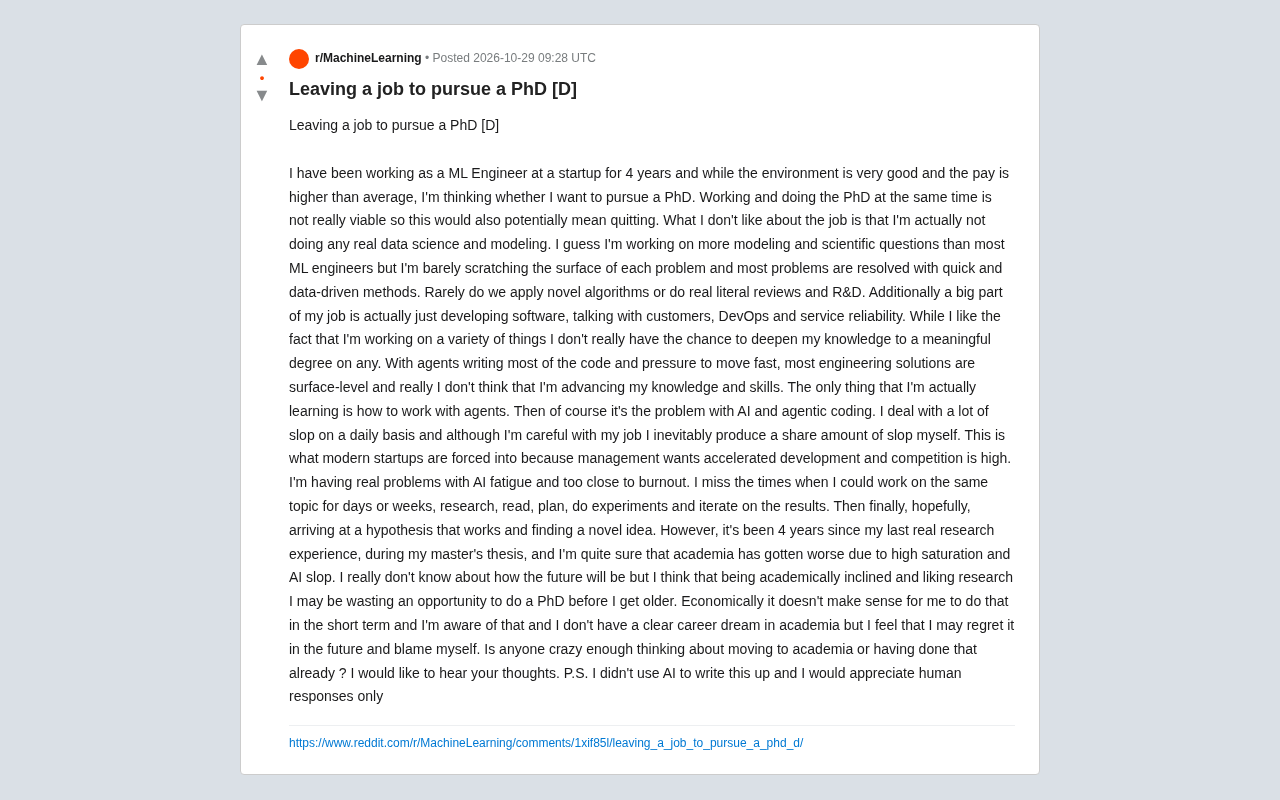
A machine learning engineer with four years of experience at a startup posted on Reddit asking whether he should quit his job to pursue a PhD. His confusion isn't about salary or environment—both are above average—but about how the nature of his work is drifting away from what he originally loved.
The Seemingly Glamorous ML Engineer: What Is He Actually Doing?
The poster's daily work is quite representative: although his title is ML Engineer, the time he actually spends on data science and modeling is pitifully small. Most of his energy is consumed by software development, client communication, DevOps, and service reliability. He admits that he encounters more modeling and scientific problems than most ML engineers, but he only skims the surface of each problem—a quick data-driven approach is enough to deliver, and he rarely has the opportunity to apply novel algorithms or conduct genuine literature reviews and R&D.
This state of "touching a bit of everything but going deep into nothing" makes him feel that his knowledge accumulation has stagnated. He misses the rhythm during his master's thesis when he could spend days or even weeks delving into the same topic: reading, planning, experimenting, iterating, and finally approaching a valid hypothesis. Now, four years of engineering practice have not made him an expert in any field.
ML Engineer and Data Scientist are often used interchangeably in the industry, but the boundaries of their responsibilities differ significantly. ML Engineer leans more toward the engineering side: deploying models to production environments, building training/inference pipelines, and ensuring service SLAs, involving a lot of software engineering and DevOps work; Data Scientist focuses more on data analysis, statistical modeling, and experimental design. The poster's description of "little modeling time, lots of ops and communication" is exactly the typical form of many ML Engineer positions at startups—small company size, coarse division of labor, one person covering the entire chain from data to launch, so depth is naturally diluted. Understanding this role positioning helps determine whether his predicament is a matter of personal choice or a structural feature of the position.
AI Fatigue and the Flood of "Slop": The Hidden Cost of Modern Startups
The poster's reflection on AI-assisted programming is particularly sharp. He candidly admits that in his daily work he has to deal with a large amount of low-quality AI-generated content (he uses the word "slop"), and despite being cautious enough, he inevitably produces some of this content himself. Management pursues accelerated development, and under competitive pressure startups are forced into this.
The deeper problem is the shift in learning direction. He finds that the only skill he is truly improving at work is "how to collaborate with agents." Code is written by agents, engineering solutions remain superficial, and his core abilities as an engineer have not grown substantially. Along with this comes severe AI fatigue; he is already close to the brink of burnout.
"AI slop" refers to low-quality content generated in bulk by large language models that lacks substantive information or has not been carefully verified, including code, documentation, PR descriptions, and even ticket replies. It is two sides of the same coin with the efficiency gains brought by "AI-assisted programming": the cost of generation approaches zero, causing review and cleanup costs to be transferred to downstream engineers. In industry discussions, slop is seen as a new form of technical debt—short-term it accelerates delivery, but long-term it erodes codebase maintainability and team trust. The poster's mention that "despite being cautious enough, I inevitably produce some" precisely shows that the problem does not depend entirely on personal discipline, but is driven by the incentive structure of management pursuing accelerated development.
The Realistic Concerns of Academia: Four-Year Gap and Saturation Anxiety
After four years away from a research environment, the poster is not optimistic about returning to academia. He explicitly states that academia has become worse due to high saturation and the impact of low-quality AI content. Economically, it is also unprofitable in the short term—giving up an above-average salary to pursue a PhD means a long return cycle. He also has no clear dream of an academic career.
The driving force comes from another kind of fear: as he grows older, he may permanently lose the opportunity to do a PhD. As someone who considers himself "academically inclined and fond of research," he worries that he will regret it in the future and blame himself for not acting now.
A "four-year gap" is not an absolute obstacle in the context of PhD applications, but it does bring practical friction: recommendation letters require contacting mentors from years ago, research skills need to be warmed up again, and application materials need to explain the motivation for the career shift. More critically, there is the saturation pressure of academia itself—the number of PhD applicants in the AI field has surged in recent years, the faculty job market is oversupplied, and many PhD graduates ultimately flow into industry. Therefore, "whether a PhD is worth it" cannot be measured solely by an academic career; it also requires considering the improvement in research ability and problem-definition ability that PhD training itself brings—abilities that are equally scarce in industry. The poster's economic calculation (giving up an above-average salary, long return cycle) is rational, but what he is truly struggling with is the "regret cost" beyond the opportunity cost.
This Is Not an Isolated Case: The Common Predicament of Engineers
This post touches on a broader industry sentiment: when AI tools push development efficiency to the extreme, is the space for engineers' deep thinking being squeezed? The poster specifically states that he did not use AI to write the post and only wants human replies—this detail itself illustrates how exhausted he is with the current flood of AI.
His question has no standard answer. The tension between short-term economic rationality and long-term career regret is exactly the choice many tech professionals must face in the AI era. Rather than "whether to pursue a PhD," the more worthwhile question is: in an accelerating engineering system, how can one preserve a space for deep learning that is not eroded by agents?
Key Points
- On the surface an ML engineer, but the actual work is mainly software development, client communication, and operations, with severely insufficient modeling depth
- AI-assisted programming brings efficiency while causing stagnation in knowledge accumulation and obvious AI fatigue
- After four years away from research, returning to academia faces multiple concerns: saturation, low-quality AI content, and economic returns
- The core anxiety is long-term career regret, not short-term benefit calculation
- The post specifically states it was written by a human, reflecting genuine resistance to the flood of AI
One-line Summary
ML engineer struggles with whether to quit and pursue a PhD as work drifts from deep research and AI fatigue intensifies.
Paragraph Summary
A machine learning engineer with four years at a startup posted on Reddit asking whether he should quit to pursue a PhD. His position is nominally ML Engineer, but much of his time is consumed by software development, client communication, and operations; modeling work is superficial and knowledge accumulation has stagnated. He sharply criticizes the flood of "slop" brought by AI-assisted programming, finds that the only skill he is improving is "collaborating with agents," and is nearing burnout from AI fatigue. Returning to academia brings concerns about a four-year research gap, academic saturation, the impact of low-quality AI content, and long economic returns. His core motivation is not short-term benefit calculation but the fear of permanently losing the opportunity to pursue a PhD as he ages and regretting it in the future. The post specifically states it was written by a human, reflecting the widespread anxiety among tech professionals about the space for deep learning in an era of AI acceleration.
Related articles
AWS AgentCore Gateway: Connecting AI A…
AWS AgentCore Gateway: Connecting AI Agents to Enterprise Backends with MCP
How AWS AgentCore Gateway acts as a primary MCP server to aggregate REST APIs, Lambda, and existing MCP services? Analyzing its AST real-time mapping, zero cold start, semantic search for tool overload, session isolation, and key injection security design, plus the architectural approach to decoupling enterprise AI agents from backends.

One Link Gives Figma AI a New Skill: Hands-On with MCP Connectors
Paste one MCP server link and the AI Agent in Figma gains new tool capabilities. We break down the setup flow, 20+ one-click apps, read/write permissions and execution policies, and the public HTTPS requirement.

Cognition SWE-2 in Practice: One Prompt to Handle the Whole Product Launch Process
Analyzing a YouTube creator's prompt for using Cognition SWE-2 to launch a product: a landing page, seven-email sequence, and non-buyer follow-up tool, plus how the 'test and report' constraint changes AI delivery quality.