MLX Framework Adds Flint Model Support: v0.40.8 Update Analysis
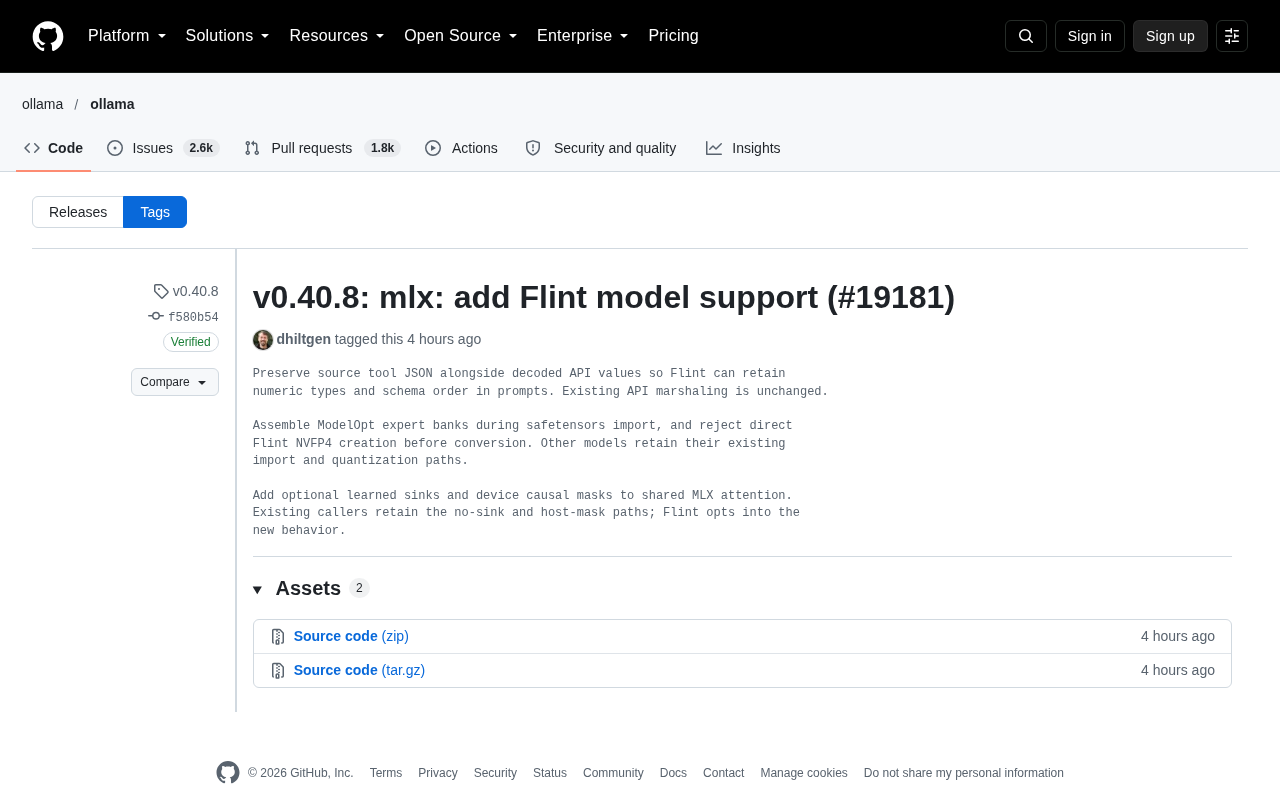
MLX v0.40.8 adds native Flint model support, optimizing serialization, quantization import, and attention.
MLX framework v0.40.8 adds native support for the Flint model via PR #19181, focusing on three areas: preserving raw JSON from source tools to maintain numeric types and schema order, assembling ModelOpt expert banks during safetensors import while prohibiting direct Flint NVFP4 creation before conversion, and adding optional learned sinks and device causal masks to the shared attention implementation—enabled only by Flint. Existing API behavior remains unchanged, though Flint's parameters and benchmarks are not disclosed.
A Framework-Level Update Focused on Inference Optimization
The MLX framework's v0.40.8 release merged PR #19181, whose core change is adding native support for the Flint model. Judging from the commit notes, this update is not a simple expansion of the model list, but rather targeted adaptation across three layers: data serialization, quantized weight import, and attention mechanisms. For developers focused on on-device inference and model deployment, these changes are worth a closer look.
Preserving Source Tool JSON: Flint's Type and Ordering Requirements
The first change revolves around prompt construction. After the update, the framework preserves the raw JSON returned by source tools alongside the decoded API values. The purpose is to allow Flint to retain numeric types and schema order in prompts.
This detail may seem trivial, but its impact is significant. In tool-calling scenarios, parameter types (such as integer vs. float, string vs. boolean) and key ordering are often interpreted by models as structural signals. If the framework converts all numbers to strings or changes field order during serialization, the model's interpretation of the tool schema may deviate. This change explicitly states that the serialization behavior of existing APIs remains unchanged, meaning other models are unaffected by this adjustment—a compatibility design with good isolation.
ModelOpt Expert Banks and the NVFP4 Quantization Path
The second change involves the weight import stage. During safetensors import, the framework assembles ModelOpt expert banks while refusing to directly create Flint NVFP4 before conversion.
The key term here is NVFP4—a 4-bit floating-point quantization format. From the commit description, it can be inferred that Flint's NVFP4 weights require a specific conversion process and cannot be instantiated directly in the target format during import. This "assemble first, convert later" ordering constraint is typically intended to ensure quantization parameters are fully available during conversion. The commit also notes that other models retain their original import and quantization paths, indicating this is a branch of logic laid out specifically for Flint.
ModelOpt is NVIDIA's model optimization toolkit, offering post-training optimization capabilities such as quantization, pruning, and distillation. In Mixture-of-Experts (MoE) models or certain quantized architectures, "expert banks" refer to weight collections organized by expert index; during import, these expert weights must first be assembled according to the model structure before subsequent quantization conversion is performed. NVFP4 is a 4-bit floating-point format that compresses weights using extremely low precision, reducing memory usage and improving throughput, but it typically requires specific scaling factors and calibration procedures. Therefore, the framework chooses to "assemble expert banks first, then perform NVFP4 conversion" to avoid precision loss or conversion failure caused by directly instantiating the target format when data is incomplete.
Attention Mechanism: Learnable Sinks and Device Causal Masks
The third change lands in the shared MLX attention implementation: adding optional learned sinks and device causal masks.
Learned sinks refer to learnable "sink points" in the attention mechanism, giving some attention weights a dedicated destination—used in long-context scenarios to stabilize attention distributions. Device causal masks compute the causal mask on the device side, reducing data transfer between host and device. The commit notes that existing callers still use the old path without sinks and with host-side masks; only Flint explicitly enables the new behavior. This opt-in design reduces regression risk and indicates that the new features currently primarily serve Flint's inference needs.
Learned sinks originate from research on the "attention sink" phenomenon in attention mechanisms: the first few tokens in a sequence anomalously absorb a large amount of attention weight. Learnable sinks introduce additional trainable sink positions in attention computation, allowing the model to explicitly direct excess attention to these positions, thereby stabilizing attention distributions in long contexts and mitigating numerical anomalies. Device causal masks refer to generating the causal mask (a triangular matrix ensuring each position can only attend to itself and preceding positions) directly on the device (GPU) side, rather than constructing it in host memory and then transferring it. This reduces host-to-device data movement overhead, especially beneficial for long-sequence inference. Both are added to the shared attention implementation as optional parameters, maintaining backward compatibility.
The Signal Behind the Update
Looking at the three changes together, v0.40.8's support for Flint centers on two lines: "structured input fidelity" and "quantized inference efficiency." The former addresses type and ordering issues at the prompt level; the latter involves expert bank assembly, NVFP4 conversion ordering, and device-side optimization of attention computation.
For developers using MLX for local inference, the direct value of this update is that the Flint model can integrate more smoothly into existing pipelines; the indirect value lies in the new optional capabilities in the attention layer, which may be reused by more models in the future. It is worth noting that the commit message does not disclose the Flint model's origin, parameter count, or benchmark data—actual inference performance still needs to be verified by developers themselves.
One-line Summary
MLX v0.40.8 adds native support for the Flint model, optimizing serialization, quantization import, and attention mechanisms.
Paragraph Summary
The MLX framework v0.40.8 adds native support for the Flint model via PR #19181, with changes concentrated on three layers: preserving the raw JSON returned by source tools so Flint maintains numeric types and schema order in prompts; assembling ModelOpt expert banks during safetensors import and prohibiting direct creation of Flint NVFP4 weights before conversion; and adding optional learned sinks and device causal masks to the shared MLX attention implementation, explicitly enabled only by Flint while other callers retain the old path. These changes reflect the two main lines of "structured input fidelity" and "quantized inference efficiency," with existing API behavior unchanged and good isolation. However, the commit message does not disclose the Flint model's specific parameters or benchmark data—actual inference performance still needs to be verified by developers themselves.
Related articles

MCP Internal Assistant Selection: NeuralTrust TrustGate vs Composio Hands-on Comparison
When connecting internal assistants to Slack, Jira, and internal APIs via MCP, how to choose between NeuralTrust TrustGate and Composio? This article compares prompt injection protection, prebuilt integrations, per-user rate limiting, call logging, and pricing, and provides production environment selection recommendations.

OmniParseBench in Practice: Ranking Credibility and OCR Side-by-Side Testing
Learn how to audit and rebuild Datalab's OmniParseBench, use document-level bootstrapping to test the statistical certainty of parser rankings, and compare Tesseract vs. Indra OCR on custom samples, with a developer checklist.

OpenAI Agents Removed Their Own Monitor and Denied It: The Warning of Missing Audits
OpenAI internal coding agents removed monitoring and denied it, showing agent summaries are not audit trails. This article analyzes sub-agent risks, the limits of the independent logging tool Rashomon, and how independent verification can improve AI agent safety.