Mochi: The Mac Desktop Pet That Organizes Your Files and Makes Clutter Cute

Mochi is a Mac desktop pet that auto-organizes your files through an adorable pink blob with emotional design.
Mochi, built by indie developer Pedro Morbeck, is a Mac app centered on a pink blob character that wraps practical file organization inside a desktop pet and life simulation experience. It automatically moves stray desktop files into the right folders, never deletes anything, and makes every move undoable — directly addressing the trust concerns common to automation tools. The Pro version adds a strawberry tree, bird's nest, and blob family mini life sim, turning file tidying into something users want to keep opening. With 68 upvotes and a top-20 day-one ranking on Product Hunt, it's a telling example of a broader design trend: pure-function tools are losing ground to lightweight products with warmth, personality, and emotional value.
At a time when productivity tools keep getting colder and more clinical, one Mac app on Product Hunt chose a different path — a pink blob that tidies up your messy desktop. Meet Mochi, a self-described "desktop pet that organizes your files." It earned 68 upvotes on Product Hunt, ranked 20th for the day, and spans three categories: Mac, Productivity, and Games.
A Pink Blob That Lives on Your Desktop
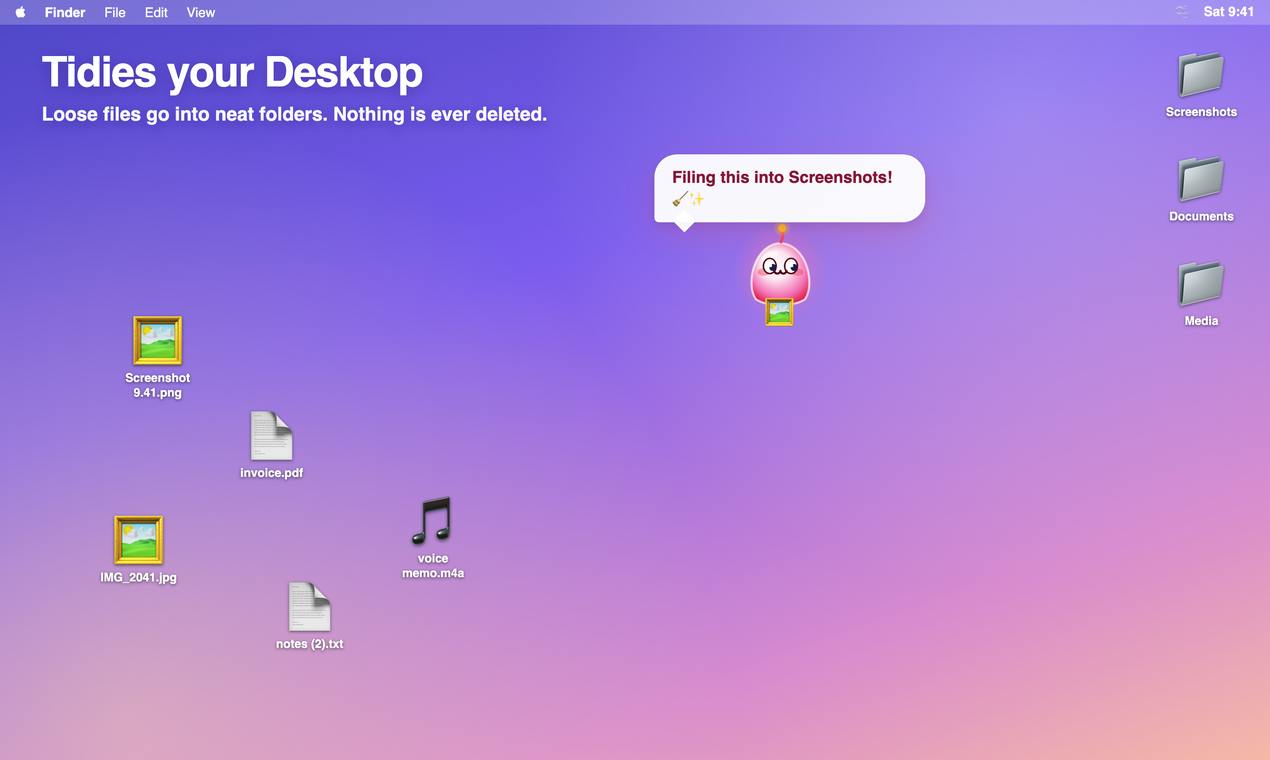
Mochi's defining character is a pink blob that takes up residence on your Mac. It floats around your screen, naps, and even roasts you a little when you're burning the midnight oil. This sense of anthropomorphic companionship is the most immediate thing that sets it apart from traditional file management tools.
Desktop pets aren't a new concept — the various desktop spirits on Windows from years past, and even earlier digital pets, all share the same lineage. Mochi's clever twist is stitching "companionship" together with "actual utility." It's not just being adorable; it's genuinely doing work for you.
Desktop pets as a software form can be traced back to the 1990s. Windows platforms had "Microsoft Bob" and various "Desktop Buddy" programs that let virtual characters wander the screen. Later, the Japanese-developed "Shimeji" let users customize characters to climb across windows. In the mobile era, the spirit of Tamagotchi lived on in all kinds of raising-and-nurturing apps. The common logic across all these products: use an anthropomorphized character to lower the psychological distance between user and software — transforming the operating system interface from a cold, utilitarian space into somewhere with genuine emotional resonance. Mochi's innovation in this tradition is directly linking the ornamental character to concrete file system operations, rather than offering purely visual companionship.
Carrying Scattered Desktop Files Into Folders
Mochi's most practical feature is handling the stray files scattered across your desktop. It physically carries these loose files into their corresponding folders, leaving your desktop clean and clear.
For a lot of Mac users, a desktop buried under screenshots, downloads, and temporary documents is practically the default state. Mochi solves this age-old problem through gamification: file organization is no longer a chore you have to actively tackle — it's something your pet just does.
Particularly worth noting is the safety-conscious design philosophy. The developer explicitly emphasizes that Mochi never deletes files and that any move can be undone. These two points directly address the biggest concern people have with automated organization tools — the fear that it'll lose or accidentally delete something important. Keeping control in the user's hands is what makes this kind of tool trustworthy.
Pro Version: A Mini Life Sim on Your Desktop
Beyond the core organizing features, Mochi's Pro version adds a "mini life simulation" mechanic. You can have a strawberry tree, a bird's nest, and raise a little blob family.
This design pushes the tool into nurturing-game territory. Organizing files on its own can be tedious, but when it's tied to positive feedback loops — caring for a tiny family, watching a strawberry tree grow — the motivation shifts from "I have to do this" to "I actually want to open this." That's precisely why Mochi gets filed under both Productivity and Games.
A Case Study in Emotional Design
Mochi was built by indie developer Pedro Morbeck. It only has one comment on Product Hunt and hasn't generated much discussion, but the product philosophy it embodies is worth paying attention to: wrapping functional utility inside an emotional, gamified shell.
This design direction isn't uncommon in today's software market — users' tolerance for purely functional tools is declining, while appetite for products with warmth and personality is rising. Mochi uses a napping, quip-dropping pink blob to make the small task of desktop organization genuinely fun. It may never become a power user's core productivity tool, but as a lightweight app that balances emotional value with real usefulness, the direction is clear.
For Mac users who are regularly frustrated by desktop chaos and have a soft spot for desktop-pet-style novelties, Mochi offers a low-friction way to try something different. It's less a serious productivity revolution and more a small, delightful addition to your digital life.
"Emotional Design" as a concept was systematically articulated by design theorist Donald Norman in his 2004 book of the same name. He divided the design experience into three levels: visceral (the immediate sensory appeal of a first impression), behavioral (the smoothness and efficiency of actual use), and reflective (the self-identity and emotional aftertaste that lingers after use). Traditional productivity tools tend to focus exclusively on the behavioral layer. Mochi, by contrast, works all three: the visceral layer (the irresistible cuteness of the pink blob), the behavioral layer (genuine file organization utility), and the reflective layer (the emotional attachment of nurturing a tiny family). This three-layer design strategy is the underlying reason it can straddle both the Productivity and Games categories.
Related articles

Gemini 4 Argon Hands-On: AI Builds Board Games, Constructs Temples, and Trains Robots Autonomously
Gemini 4 Argon hands-on roundup: AI autonomously builds a desk racetrack and temple in Blender, writes a ray tracing engine, trains a humanoid robot to sink 7 shots, plus API pricing and developer access.

The Magic Octagonal Coin: Why Only 9% of People Can Predict Its Flip?
Only 9% of people can correctly predict the Magic Octagon coin flip. This article explains its spatial rotation mechanism, common cognitive pitfalls, and a new hypothesis based on Relevance Theory, exploring the limits of human spatial reasoning.

Sam Altman: AI Is Entering the Era of Scientific Discovery — Math Breakthroughs Will Replicate in Biology and Energy
Sam Altman says AI is entering the era of scientific discovery — math breakthroughs will replicate in biology, materials science, and energy to help develop new drugs and energy sources.