monolog: The AI Note-Taking App That Requires No Organization — Semantic Search Finds Everything

monolog replaces folders and tags with AI semantic search, letting you just talk to yourself to capture and find notes.
monolog is a new AI-powered note-taking app that eliminates traditional organizational structures like titles, folders, and tags. Users simply record thoughts as if chatting to themselves, while AI quietly understands the content, recognizes tasks and schedules, and enables semantic search that finds information by meaning rather than exact keywords. Available across iOS, Android, Web, desktop, and Chrome extension with full sync, it represents the emerging "structureless + semantic retrieval" approach to personal knowledge management.
When Note-Taking Apps No Longer Need "Organization"
We've grown accustomed to a certain note-taking logic: create a document, give it a title, sort it into a folder, add tags — and then, when the time comes, struggle to remember where we put it. The act of organizing becomes a burden in itself, and that burden often kills our desire to record anything at all.
Traditional note-taking tools like Evernote (launched in 2008) and Notion (launched in 2016) inherited the hierarchical thinking of computer file systems — folders nested within folders, tags cross-referencing other tags. This design originates from library science's taxonomy approach, built on a core assumption: information must be assigned a definitive location at the moment of storage. However, cognitive science research shows that human memory isn't organized in tree structures but rather retrieved through semantic associations and contextual cues. This mismatch between the "organizational cost at storage time" and "cognitive habits at retrieval time" is the fundamental reason why so many users' note-taking systems eventually fall into disuse.
Recently launched on Product Hunt, monolog proposes a radically different approach: eliminate all organizational structure — just "talk to yourself" and let AI handle the rest. It ranked #13 on Product Hunt on its launch day, received 79 upvotes, and was categorized under Productivity, Notes, and Artificial Intelligence.
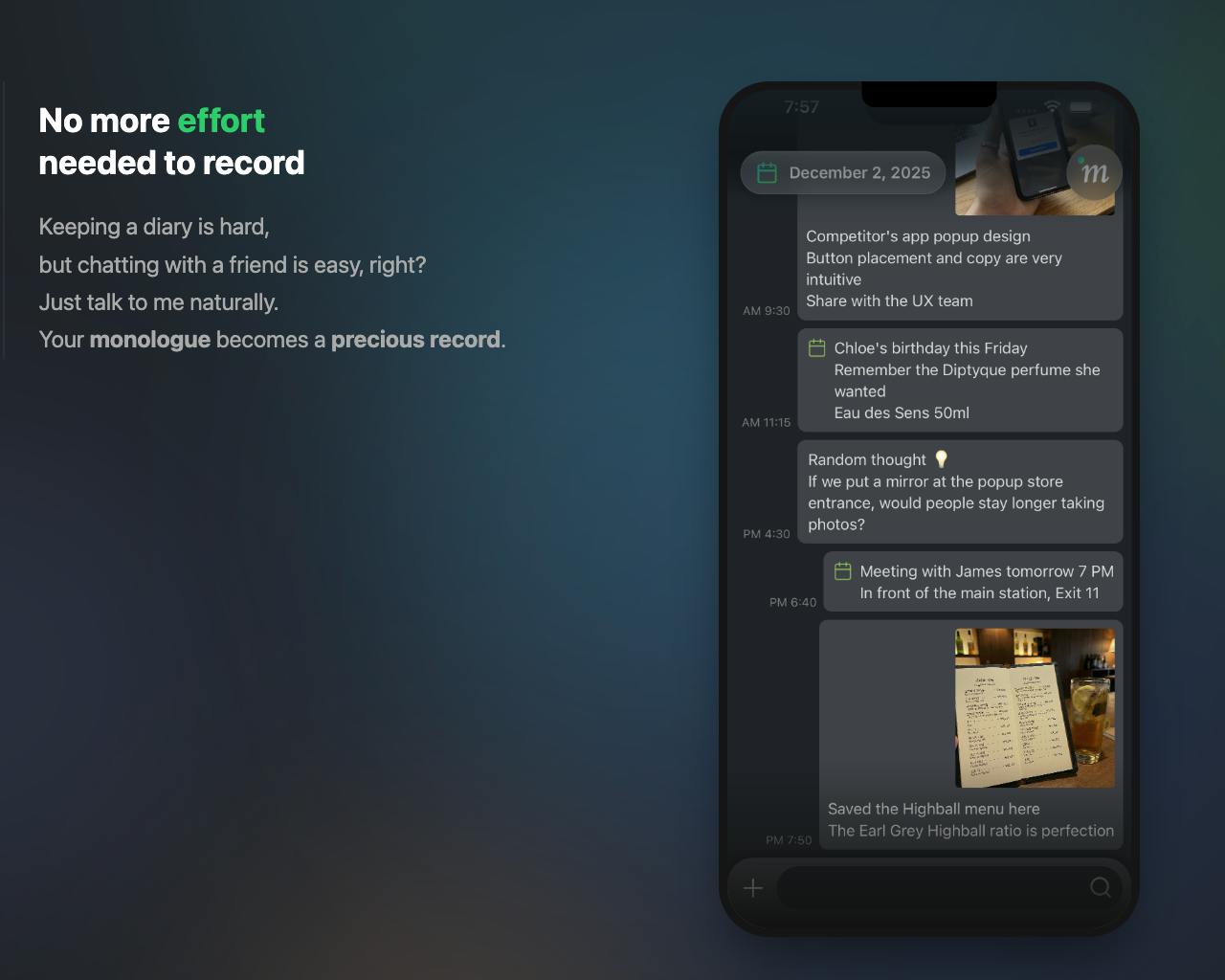
monolog's core manifesto is straightforward: "Chat to yourself and find anything by what you remember." This statement pinpoints the two pain points it aims to solve — the psychological barrier to recording and memory bias during retrieval.
monolog's "Structureless" Product Philosophy
No Titles, Folders, or Tags
monolog's most radical design decision is the complete removal of traditional note-taking organizational elements. The official description explicitly states: "No titles, folders, or tags to manage." Users don't need to think about which category a thought belongs to before writing it down, nor do they need to build complex file trees for fleeting moments of inspiration.
The product logic behind this is worth pondering. Traditional note-taking tools (like Notion and Evernote) essentially encourage users to become "information architects," but the vast majority of people neither excel at nor want to maintain such architecture. As AI semantic understanding capabilities mature, the premise of "categorize first, then store" is being dismantled — since machines can understand the content itself, human-assigned tags become redundant.
AI Works Quietly in the Background
monolog emphasizes that AI "quietly understands what you write." The key word here is "quietly" — it doesn't try to be a chatty chatbot, but rather acts like an invisible secretary, completing understanding, recognition, and filing while you write naturally.
The AI semantic understanding capability that monolog relies on benefits from the rapid development of large language models (LLM) and natural language processing (NLP) technologies in recent years. Particularly after Google introduced the Transformer architecture in 2017, machine understanding of natural language achieved a qualitative leap. These models can capture deep semantic relationships in text rather than merely matching keywords. For note-taking scenarios, this means AI can understand that "meet client next Wednesday" contains temporal information (next Wednesday), event attributes (meeting/to-do), and implied priority judgments — this kind of multi-layered semantic parsing was difficult to achieve just five years ago.
Furthermore, it automatically recognizes schedules and tasks, reminding you at the appropriate time. This means when you casually write "meet client next Wednesday," the system can identify it as a to-do item rather than plain text, without you having to manually create a reminder.
Semantic Search: Finding Information by "Impression"
If structureless recording lowers the input barrier, then semantic search is the key to solving the output problem.
monolog's search capability is described as one that "finds records by what they were about — even if you forgot the exact words you used."
This is a fundamental departure from traditional keyword search. In the past, retrieving notes required remembering the precise words we originally used — once memory became fuzzy, we were stuck. Semantic search, based on vectorized content understanding, can match content that is "similar in meaning" rather than "literally identical." You only need to remember "something about a travel plan idea," and the system can locate it for you — this perfectly echoes the "by what you remember" in the product tagline.
This capability essentially relies on today's mature embedding technology and vector retrieval. The core principle of embedding technology is transforming text into mathematical representations in high-dimensional vector space — each piece of text is mapped to a vector of hundreds to thousands of dimensions, with semantically similar content being closer together in vector space. For example, "visit Kyoto to see cherry blossoms this weekend" and "spring travel plan to Japan" share no overlapping words, but their vector representations would be very close. Vector Search uses approximate nearest neighbor algorithms (such as HNSW, IVF, etc.) to quickly find the most similar results among massive vectors. Current mainstream vector databases like Pinecone, Weaviate, and Milvus can already complete similarity retrieval across millions of vectors in milliseconds, making real-time semantic search entirely feasible for personal note-taking scenarios.
For personal knowledge management — a scenario with massive information volumes and abundant fuzzy memories — the value of semantic search is particularly pronounced.
Cross-Platform Sync, Record Anytime
For a tool that emphasizes "record anytime," cross-platform availability is practically a must-have. monolog covers iOS, Android, Web, desktop, and Chrome browser extension, with guaranteed content synchronization across all platforms (everything stays synced).
This coverage means that whether users are recording sudden inspiration on their phone, organizing work thoughts at their computer, or casually saving content while browsing the web, everything flows into the same memory bank. For a product centered on "capturing thoughts," reducing friction between devices and ensuring seamless content flow is a crucial prerequisite for maintaining user habits.
Challenges and Prospects for monolog
monolog represents a typical evolutionary direction for note-taking tools in the AI era: shifting from "users organize information" to "AI organizes information." This type of product doesn't pursue feature overload but rather reshapes the act of recording itself by reducing friction.
However, such "fully automated" products also face inherent challenges:
- Trust issues: When both organization and retrieval are completed by an AI black box, users inevitably worry "what if it can't find what I want?" Transparency and search accuracy will directly determine retention.
- Privacy sensitivity: "Chatting with yourself" means users will write down large amounts of private content, and AI needs to process this data in the cloud. Privacy protection and end-to-end encryption will be key areas of user concern.
- Intense competition: From Mem and Reflect to Apple's AI-enhanced native notes, the "AI notes" space is already quite crowded. monolog needs to differentiate sufficiently in experience details.
The AI note-taking space that monolog occupies has seen a flood of competitors in the past two years. Mem (which raised $23.5 million in 2022 in a round led by OpenAI's fund) focuses on "self-organizing" notes, automatically establishing connections between notes through AI; Reflect emphasizes end-to-end encrypted AI note-taking; Notion AI, as an AI upgrade from an existing giant, has a massive existing user base; Apple also announced at WWDC 2024 that it would deeply integrate AI capabilities into its native Notes app. Additionally, products like Capacities, Tana, and Heptabase approach the space from different angles. The crowdedness of this space reflects an industry consensus: the paradigm of traditional note-taking tools is being redefined by AI, but the final product form has yet to be determined.
Overall, monolog has identified a real user pain point and offered a sufficiently elegant solution. Whether it can stand out in a crowded space still requires time and more real-world usage validation, but the "structureless + semantic retrieval" approach it represents is very likely one of the future forms of personal knowledge management tools.
Related articles

Why Does the Tesla Roadster Need to Fly? A Deep Dive into Musk's Wild Demo
Tesla's Roadster launch showed wall-climbing, upside-down driving, and flying stunts—but The Vergecast notes the demo car may lack a battery, the Rocket version is invite-only and not street-legal, and the website terms don't guarantee delivery. After nine years of delays, why does this car still need to exist?

AI Is Not a Replacement: Human-AI Collaboration Through the Lens of Factory Root Cause Analysis
Starting from factory root cause analysis, this article explains how AI accelerates evidence chain construction rather than replacing human experts, exploring the pragmatic implementation logic and business value of 'AI supporting people rather than replacing them.'

AI Agent Decision Auditing: Building an Evidence Chain in Regulated Workflows
Starting from a Reddit discussion, this article analyzes three core issues in AI agent decision auditing within regulated workflows: what fields audit records should contain, how to handle feedback latency for erroneous decisions, and how to continuously calibrate LLM judge consistency with human judgment.