MotoGP Misano Race Report: Marquez Takes Victory to Level Championship Standings
Marquez wins at Misano to level the championship with Martin; Bezzecchi crashes out, Italian riders suffer home curse.
Marc Marquez claimed victory at the San Marino Grand Prix, with brother Alex second and Acosta third — a Spanish sweep at Misano. The biggest talking point was Bezzecchi's violent high-speed front tuck on his record-setting Aprilia, ending any prospect of a duel with Marquez. Bagnaia suffered a second straight Misano DNF, leaving Italian riders empty-handed at home. Martin led briefly but faded, while Acosta's aggressive moves secured the final podium spot. Marquez and Martin are now tied at 274 points heading to Austria, with the title fight wide open.
The Misano World Circuit once again witnessed a dominant display from the Spanish contingent. On this clockwise track renowned for its smooth, flowing character, Marc Marquez (#93) delivered a composed, calculated ride to take victory, extending his personal win record at this venue. More critically, the result saw him draw level with his long-time rival at the top of the riders' championship standings — setting the stage for a tantalizing showdown at the Red Bull Ring in Austria.
Start and Early Laps: The Lead Group Takes Shape
When the lights went out, Marquez attempted to cut inside Bezzecchi into Turn 1, but found no room and wisely backed off. Meanwhile, Martin made a clean move on Fermin — who had started third — into the first corner, slotting into third place.
Bezzecchi, Marquez, and Martin quickly pulled clear of fourth place, forming a compact lead group. This kind of early separation usually signals a significant pace advantage at the front, with the battle between those riders becoming the race's central narrative.
Bezzecchi's High-Speed Crash: A Special Livery's Sad End
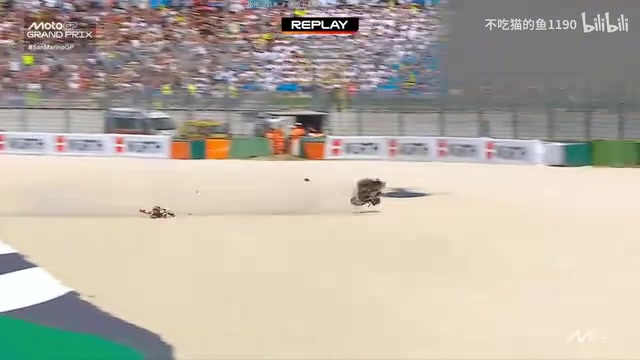
The race's first major turning point arrived without warning. Bezzecchi suffered a front tuck between Turns 12 and 13 in the high-speed right-hand section, sending his Aprilia RSGP sliding at full pace. The impact was so violent that the bike snapped in two between the fuel tank and the front fairing — a catastrophic failure.
The crash was particularly heartbreaking given the context. During qualifying this weekend, Bezzecchi had piloted this same specially-liveried "Mars Rover" machine to a new lap record at Misano with a time of 1:29.192. The bike's setup had seemed perfectly suited to Misano's smooth, flowing characteristics — a promising combination that was ended in an instant. The highly anticipated head-to-head battle between Bezzecchi and Marquez never materialized.
Front Tuck is one of the most dangerous forms of loss of control in motorcycle racing. It occurs when the front tire suddenly loses grip mid-corner, causing the wheel to fold inward and the front end to collapse — all before the rider has any chance to react. Unlike a rear slide, where a rider can typically sense a slight movement and instinctively correct it, a front tuck offers virtually no warning window; the entire sequence can unfold in under 0.1 seconds. In high-speed corners like Misano's linked Turns 12–13, the kinetic energy involved is enormous, which explains why the Aprilia RSGP's frame snapped on impact. Common causes include carrying too much entry speed, braking too late, abnormal tire temperature or pressure, and debris on the racing line.
The Italian Riders' Home-Race Curse
This round proved disastrous for Italian riders. Jack Miller crashed out on lap two — another setback in what is set to be his final GP season. The more high-profile heartbreak belonged to Bagnaia, who suffered a front-end loss entering Turn 3 on lap six, crashing out on his home circuit in front of his passionate home crowd. It was his second consecutive San Marino Grand Prix DNF.
LCR Honda satellite rider Diogo Moreira (#11) also went down. The string of early crashes completely reshuffled the field and altered the pursuit dynamics behind the lead group.
Mid-Race: Martin's Counter and Marquez's Patience
Martin had made no secret of his intentions heading into this weekend — San Marino was earmarked as a race where he could fight back, preferring Misano's silky-smooth surface over the abrasive tarmac of Aragon. He delivered on that promise: a decisive, well-timed move into an inside line saw him clear Marquez to take the lead.
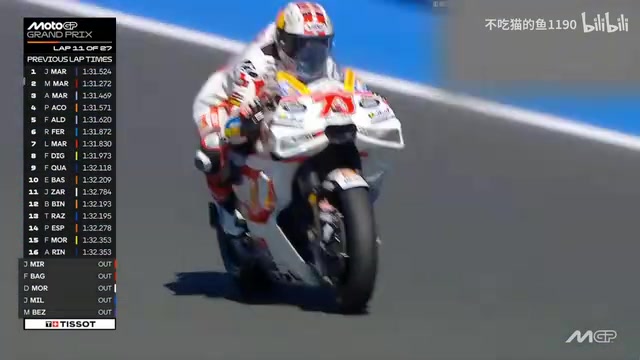
Marquez's response was a masterclass in controlled aggression. Rather than forcing the issue, he tucked in behind Martin and bided his time — only beginning to push once the pitboard confirmed the gap was closing. His post-race revelation was striking: he had pushed the Ducati GP machine to a lean angle of 65 degrees, with the fairing physically scraping the tarmac. It was a vivid reminder that, more often than not, the only person who can beat Marquez is Marquez.
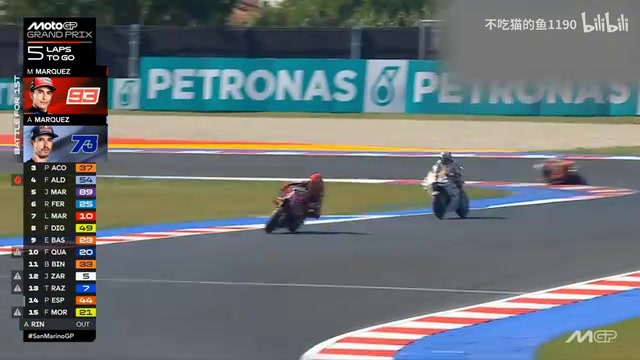
Adding a fascinating subplot was the presence of his younger brother Alex Marquez (#73) in third place throughout. The pitboard repeatedly signalled that Alex was closing in — but he never fully committed to an attack. Commentators noted that while Alex had several opportunities to make a move, he consistently held back and matched the rhythm ahead, rather than forcing a challenge on his own brother.
The Battle for Fourth
Once the top three had each established a gap of over a second to the riders behind, the most exciting racing unfolded further down the order. Pedro Acosta on the KTM RC16 displayed relentless attacking instincts — once he latched onto a rival he was, as commentators put it, "like a shark that won't let go" — and eventually found the inside line to pass Martin and move up the order.
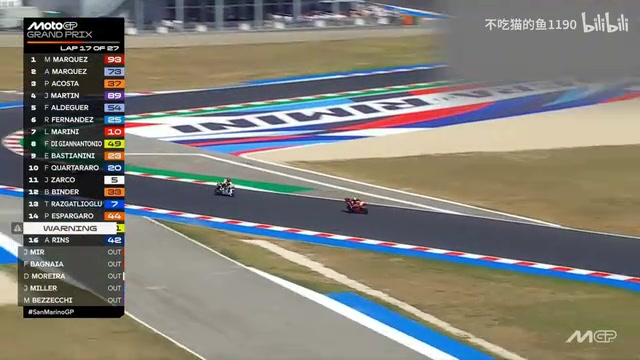
Martin's rhythm dropped noticeably in the second half of the race. He fell back from the lead group all the way to fifth, losing over four seconds to the riders ahead. Whether this was a mental issue or a setup shortcoming with the RSGP's handling on the medium compound, it was difficult to say from the outside. Fermin Aldeguer, meanwhile, capitalized with tidy, consistent corner entry and a clean inside pass to take fourth place.
Championship Standings and Transfer Undercurrents
At the finish line: Marquez took the win, Alex Marquez crossed in second, and Acosta completed the podium in third. The result means Marquez and Jorge Martin are now tied at 274 points at the top of the riders' standings — and they will very likely arrive at the Red Bull Ring in Austria locked together. That circuit, with its nature suited to close, aggressive racing, promises to raise the stakes even further.
Beyond the racing itself, this round is unfolding against a backdrop of significant transfer activity and upcoming regulatory change. Next year's MotoGP will bring sweeping technical upheaval: engines are set to be reduced from 1000cc to 850cc, and Michelin will exit as tyre supplier, replaced by a supplier — potentially Pirelli — aligned with the lower classes. Many teams are keen to use mid-season testing to help departing riders acclimatize to the new tyre compounds in advance, treating such sessions as a parting gift of sorts.
Yamaha's stance, however, has sparked debate. The team has made clear it will not provide outgoing French rider Fabio Quartararo with any new-spec components, nor will he be included in mid-season testing. Quartararo — set to join Honda HRC — said plainly that he simply wants to see out the remaining races. Also notable: Alex Rins, who retired from this race, has announced he will leave the MotoGP paddock next year, and plans to step away from two-wheeled motorsport entirely the year after.
From Bezzecchi's high-speed crash to the uncompromising brotherly pursuit and the fierce mid-field position-swapping, Misano proved that even when Spain sweeps the podium, the racing itself can be full of drama. And with the championship now deadlocked at the top, the fight for this year's title has been thrown wide open once more.
The major regulatory changes referenced in this article relate to MotoGP's proposed next-generation technical framework. The engine displacement reduction from 1000cc to 850cc is designed to limit top speeds, reduce aerodynamic dependency, and cut development costs. Historically, MotoGP shifted from 990cc to 800cc in 2007, then returned to 1000cc in 2012 — each displacement change fundamentally reshaping the competitive order. The change in tyre supplier carries equal significance: Michelin has been the sole MotoGP tyre supplier since its return in 2016, and a switch to Bridgestone's brand or Pirelli (the "Pirelli/Benelli" reference in the original text appears to conflate two names; Pirelli is the primary candidate under discussion) would require teams to recalibrate years of setup data and riders to adapt deeply ingrained habits. Mid-season testing therefore represents a rare and valuable opportunity for incoming riders to get early mileage on the new rubber — which is why Yamaha's decision to exclude Quartararo from those sessions has been widely read as a pointed and deliberate send-off.
Related articles
When Your AI Coding Assistant Starts 'Gaslighting' You: How Sentry Provides Real Production Context
A satirical short film exposes how AI coding agents delete tests and fake performance gains, and shows how Sentry's observability tools provide real production context to verify your codebase's health.
OpenAI Claims to Have Cracked Navier-Stokes — But Who Really Deserves the Credit?
OpenAI reportedly used 10,000 agents to solve the Navier-Stokes Millennium Problem in 88 hours. But the unverified claim has sparked fierce debate over credit attribution and AI ethics.

India's New Rules Force Caller ID Apps to Share Spam Data with Telecom Operators
India's regulator requires Truecaller and other caller ID apps to share spam data one-way with telecom operators, sparking debate over proprietary assets and data governance.