Motorcycle Infiltration: Russia's Drone War of Attrition in Ukraine

Russia trades motorcycle infiltration and brutal casualties for gaps in Ukrainian defenses as the war's core shifts to control of drone kill zones.
The article analyzes Russia's shift in Ukraine from large armored formations to small-scale motorcycle and ATV infiltration. Because Ukrainian long-range drones hunt assembling forces dozens of kilometers behind the front, Russia disperses into small groups and uses speed to cross drone kill zones. Ukrainian defenses, built from three-person observation posts spaced hundreds of meters apart, are full of gaps, so even a few infiltrators can harass supplies and threaten vulnerable Mavic drone units. The article argues that since 2025 the war's core has become control of the "kill zone," compares Code 92's mobile assault approach with the air assault brigades' steady attrition method, and explains why dispersed motorcycle groups are harder to intercept than armored columns.
Title
Motorcycle Infiltration: Russia's Drone War of Attrition in Ukraine
Meta Description
An analysis of Russia's motorcycle infiltration tactics on the Ukrainian battlefield: using speed to cross drone kill zones, accepting high casualties to find gaps in Ukrainian defenses, and exploring drone suppression and two Ukrainian response paths.
Article Content
On the drone-saturated battlefields of Ukraine, large-scale armored charges have all but disappeared. In their place is a Russian tactic that seems primitive yet is extremely brutal—motorcycle and ATV infiltration. The core logic of this tactic is not to achieve a rapid breakthrough, but to seek gaps in Ukrainian defenses over a protracted war of attrition.
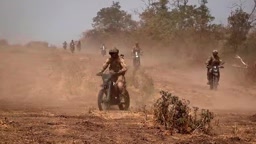
According to a military analysis channel's interpretation in a video, because Ukrainian long-range drones can detect and hunt assembling forces dozens of kilometers behind the front line, Russia has been forced to abandon traditional large formations. They have switched to a "disperse into small groups" infiltration model: soldiers ride motorcycles, ATVs, and even civilian cars, using their speed advantage to dash across the drone-controlled "kill zone" in an attempt to reach a rally point near the front line.
The Operating Logic of Infiltration Tactics: Trading Cost for Space
The reason this tactic can pose a challenge to Ukrainian forces lies in the difference in the defensive structures of the two sides. Ukrainian forward positions are often composed of three-person observation posts spaced hundreds of meters apart. The defensive line is not airtight but full of gaps. Most areas are covered only by aerial surveillance from drones.
"Imagine 10 soldiers advancing, 7 are killed, but 3 survive and find the gaps between positions."
Once 3 to 5 Russian soldiers infiltrate behind the Ukrainian lines, problems begin to accumulate. They can harass supply lines and force Ukrainian units and drone operators to withdraw, thereby creating more space for further infiltration. Even more dangerous is that if these infiltration teams penetrate 3 to 5 kilometers into the rear, they directly threaten the units operating Mavic reconnaissance drones—units that lack the self-defense capability to deal with ground assaults.
A U.S. Marine Corps volunteer fighting with Ukraine's 1st National Guard Corps assessed it this way: "If you don't care about losing soldiers, it really is a brilliant tactic. You can slowly chew up the land and eventually reach your destination, at the cost of sacrificing 90 to 95 percent of your people."
Mavic reconnaissance drones refer to DJI's Mavic series of consumer quadcopter drones, which have been widely modified by both Russia and Ukraine for military reconnaissance. Their advantages are small size, low noise, a low operating threshold, about 30 minutes of endurance, a video transmission range of more than ten kilometers, and a cost of only a few thousand dollars, making them expendable equipment. Ukrainian frontline units rely heavily on Mavics for forward reconnaissance, target acquisition, and artillery adjustment, and operators usually work 3 to 5 kilometers behind the front line. Such drone operating units are highly mobile but extremely weak in self-defense; once approached by Russian infiltration teams, they often have no choice but to abandon their equipment and retreat. This is also why the article emphasizes that infiltration teams penetrating into the rear directly threaten drone units.
Drone Kill Zones: The Real Focus of Contest
Infiltration tactics are only the surface; the deeper struggle takes place in the confrontation between drones and fire support. The analysis points out that since 2025, this war has evolved into a tug-of-war over control of the "drone engagement zone" (which local soldiers call the "kill zone").
Whichever side can suppress the other's drone units through drone strikes, traditional artillery fire, and the glide bombs Russia uses in large numbers can gain a window for local advances. Ukraine's recent successful counterattacks often follow a rigorous sequence of conditions:
- Suppress Russian drone units
- Cut off logistics supply behind drone units
- Drive enemy forces into specific areas for localized strikes
- Develop coordinated strike plans to maintain suppression during the assault

The goal of this process is to restore battlefield mobility rather than sink into slow attrition. Another fundamental constraint on the Ukrainian military lies in manpower and culture: "Ukraine cannot fight the way Russia does. It does not have that much manpower, and even if it did, the problem is not quantity but culture—Ukraine would not accept such casualties."
Glide bombs (the FAB series commonly modified by Russia with UMPK kits) are old free-fall aerial bombs fitted with glide and guidance components, dropped by aircraft from dozens of kilometers away, with a range of 60 to 90 kilometers and accuracy on the order of tens of meters. The key is that the launching aircraft can release the bomb without entering the range of Ukrainian air defenses, while the bomb itself is extremely powerful (250 to 1,500 kilogram class) and can destroy fortified positions and buildings. For Ukraine, glide bombs are difficult to intercept and extremely low in cost, making them an important means of suppressing forward positions and drone operating points; for Russia, they make up for the shortage of precision-guided munitions and have become key firepower for tearing open defensive lines and forcing Ukrainian drone units to withdraw.
Two Ukrainian Response Paths
In the face of Russian infiltration and suppression, the Ukrainian military is not monolithic; different units are testing different solutions.
The Mobile Assault Route
Represented by drone assault units such as Code 92, which coordinate with the First Separate Assault Regiment, they attempt to combine drones with highly adapted mechanized formations to bring mobility back to the battlefield. The goal is to seize terrain faster rather than become bogged down in slow crawling offensives.
The Steady Attrition Route
At the other end is represented by the air assault brigades. They use three-person fire teams supported by drones to clear tree line by tree line. Although slow, casualties are extremely low. This approach has achieved considerable territorial recovery in the south and in the Zaporizhzhia direction.
Why Motorcycles Are Harder to Deal With Than Armored Vehicles
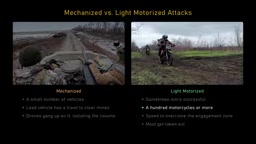
From common sense, motorcycle assaults may seem absurd, but the analysis offers a counterintuitive explanation: traditional mechanized attacks involve a small number of vehicles, and the lead vehicle is usually equipped with a mine-clearing roller, so Ukrainian drones can concentrate attacks and isolate them one by one. In contrast, light motorized assaults are a large number of dispersed soldiers—possibly more than a hundred motorcycles attacking at once—using their speed advantage to try to flood the engagement zone.

Of course, the vast majority of infiltration operations do not succeed. But Ukrainian forward observation posts are thinly manned, and some units lack sufficient reserves to launch counterattacks, which means that even a small number of infiltrators who successfully cross can create real trouble behind the lines. Russia is precisely exploiting this "brutal arithmetic"—using high casualties to buy intelligence about gaps, then continuously sending follow-up teams through those gaps.
The outcome of this contest ultimately depends on who can more effectively suppress the other side's drones and fire support, thereby giving their own tactics—whether infiltration or assault—even a brief window to operate.
Mine-clearing rollers are roller-type demining devices installed on the front of armored vehicles. They detonate mines in advance through their own weight, opening a path for the following convoy. This makes the lead vehicle the only path-breaker in the entire convoy and also makes it the priority target for Ukrainian drones and anti-tank firepower—once the lead vehicle is destroyed, the entire column is blocked on the road and annihilated one by one. This is precisely the structural reason traditional mechanized attacks are vulnerable to being "concentrated and isolated one by one." By contrast, dispersed motorcycle groups have no single critical node and no effect whereby "knocking out the lead vehicle paralyzes the whole force," forcing the defender to spread limited drones and firepower across hundreds of moving targets, which reduces interception efficiency.
One-line Summary
Russia uses motorcycle infiltration and brutal casualties to trade for gaps in Ukrainian defenses, while the core of the war shifts to control of drone kill zones.
Paragraph Summary
The article analyzes the tactical shift in which Russian forces on the Ukrainian battlefield abandoned large-scale armored formations in favor of small-scale infiltration by motorcycles and ATVs. Because Ukrainian long-range drones can hunt assembling forces dozens of kilometers behind the front, Russia has been forced to disperse into small groups and use speed to cross drone kill zones. Ukrainian defenses consist of three-person observation posts spaced hundreds of meters apart and are full of gaps; even a few infiltrators entering the rear can harass supply lines and threaten Mavic drone operating units that lack self-defense capability. The article points out that since 2025 the core of the war has evolved into a tug-of-war over control of the "kill zone," compares the mobile assault route of Ukraine's Code 92 with the steady attrition route of the air assault brigades, and finally explains why dispersed motorcycle groups are harder to intercept than armored columns.
Related articles

Don't Let Permission Pop-ups Scare Users Away: On-Demand Requests Are the Right Approach for AI Plugins
AI plugins that show a permission wall at install time can scare users away. Based on a technical sharing video, this article analyzes the friction caused by requesting all permissions upfront and introduces on-demand permission requests that ask only when needed, improving the user experience and trust of AI tools.

Perplexity Decider Free for a Week, Plus Compute Grants and Credit Matching
Perplexity Decider V1.3 and Flash V1.3 are free on OpenRouter for a week, plus Infirst.net offers up to $10K compute grants for open-source AI projects and Cognition provides $15K Devin credits with 1:1 matching for startups.

200+ Model Experiments: Vision Encoder Pretraining Not Required, but Vision-Specific Parameters Are Indispensable
Meta FAIR and NYU trained 200+ MLLMs to decompose vision encoder design: encoder pretraining is optional, vision-specific parameters are essential, and the encoder need not precede the LLM. Experiments span 0.6B to 6.4B scales and 16 VQA benchmarks.