Motorola Signature Phone: A $1,600 Push Into the Ultra-Premium Market

Motorola launches the $1,600 Signature slab flagship, its first push into the ultra-premium market.
Motorola is attempting what it has never done in the modern smartphone era: building a fully capable ultra-premium slab flagship. The Edge series fell short in imaging, materials, and software support, while the Razr foldable's success gave the brand confidence to move upmarket. Now the $1,600 Signature targets the ultra-premium segment dominated by Apple and Samsung. Information currently comes from a single source, and success will depend on whether Motorola can match its premium positioning in brand perception, channels, and service.
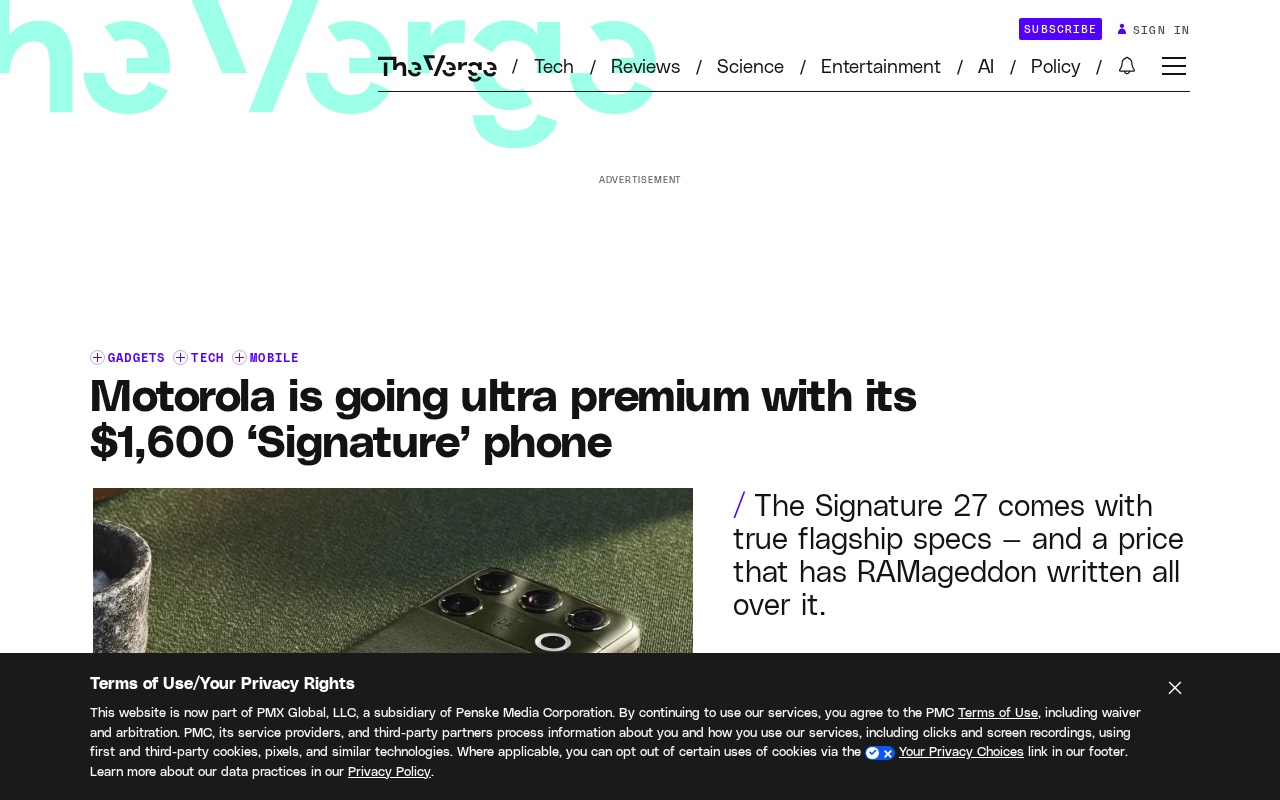
Motorola is attempting something it has never done in the modern smartphone era: building a fully capable flagship slab phone. Its previous high-end Edge devices never truly delivered, lacking the features needed to stand among top-tier flagships. Meanwhile, the company achieved major success with the Razr flip foldable and used that brand momentum to establish a foothold. Now, with the unveiling of the $1,600 "Signature" phone, Motorola is officially making a push into the ultra-premium market.
Motorola's Path to Premium
In the smartphone market, Motorola has long focused on mid-range and entry-level products, while Apple and Samsung have held tight control of the premium segment. The Edge series was once seen as Motorola's hope for moving upmarket, but neither market performance nor reputation met expectations. Analysts note that Edge devices fell short in imaging systems, materials and build quality, and software support, making them hard to compete with rivals at the same price point.
The success of the Razr foldable gave Motorola a new approach: attracting users through a differentiated form factor and brand nostalgia. However, the slab flagship market remains the true test of a brand's strength. The launch of the Signature means Motorola has decided to complete its premium puzzle in the slab phone segment as well.
The Edge series is Motorola's flagship product line introduced in 2020, sold on the strengths of curved displays, high refresh rates, and relatively aggressive pricing—typically in the $700–$1,000 range—aiming to enter the premium market dominated by Apple and Samsung with a "near-flagship" positioning. However, the series has long had several structural weaknesses: its imaging system lacks large sensors and mature computational photography tuning, build materials and water resistance often fall below rivals at the same price, and the software update cycle is relatively short. These factors have made it hard to classify the Edge as a "true flagship" in reviews and user perception; it is more often seen as a high-spec mid-range phone. Understanding this context helps clarify why the Signature is described as an attempt Motorola has "never made before"—it fills precisely the premium gap the Edge series has always lacked.
Signature: A Confident $1,600 Statement
The name "Signature" itself sends a strong signal: Motorola is trying to position this product as the culmination of its technical capabilities. The $1,600 price tag directly targets the industry's top flagships, even exceeding some foldable phones.
According to the original report, Motorola has poured into the Signature the premium features the Edge series lacked. Although full specifications have not yet been disclosed, it is clear that the phone will align with ultra-premium standards in design and materials.
The ultra-premium market typically refers to the slab phone segment above $1,000, currently dominated by Apple's Pro Max series and Samsung's Galaxy S Ultra series, with foldable products pushing the price ceiling even higher. The competitive logic in this segment differs from the mid-range market: users are buying not just hardware specs, but also brand premium, ecosystem integration, long-term software support, and exclusive after-sales service. For Motorola, a $1,600 price means it must simultaneously reach top-tier standards in imaging, materials, software support, and channel experience—otherwise consumers will easily dismiss it on the grounds of a "price-brand mismatch." This is also the core benchmark for judging the Signature's success.
Multiple Perspectives and Market Challenges
It is worth noting that current information about the Signature comes mainly from a single-source report and lacks cross-verification from other independent sources. Therefore, caution is still warranted regarding its specific configuration and actual experience.
From an industry perspective, Motorola faces several key challenges:
- Brand perception: In the premium market, Motorola needs to overturn users' entrenched impression of it as a "value-for-money brand."
- Competitive pressure: Apple and Samsung have deep roots in the premium market and continue to iterate and innovate.
- Channels and service: Ultra-premium users have higher expectations for after-sales service and ecosystem experience.
Can It Rewrite the Premium Landscape?
The success of the Motorola Signature depends not only on the product itself, but also on whether Motorola can match its ultra-premium positioning in marketing, channels, and service. If the Signature can prove its capabilities, Motorola may secure a place in the premium market; otherwise, it could repeat the fate of the Edge series.
For consumers, more competition means more choices. Whether the $1,600 price tag is worth it will ultimately be tested by the market.
One-line Summary
Motorola launches the $1,600 Signature slab flagship, its first push into the ultra-premium market.
Paragraph Summary
Motorola is attempting something it has never done in the modern smartphone era: building a fully capable ultra-premium slab flagship. The previous Edge series failed to rank among top flagships due to weaknesses in imaging, materials, and software support, while the success of the Razr foldable gave the brand confidence to move upmarket. Now the $1,600 Signature has arrived, directly targeting the ultra-premium market dominated by Apple and Samsung. The article notes that the phone is positioned as the culmination of the brand's technical capabilities, but current information comes from a single source and lacks cross-verification. Whether Motorola succeeds depends not only on product quality but also on whether it can match its ultra-premium positioning in brand perception, channels, and service.
Related articles

AI Detection False Positive Controversy: Writer Accused of Using AI, Who Should Bear the Burden of Proof?
A 2026 Commonwealth Short Story Prize regional winner was flagged by Pangram as 100% AI-generated but cleared after drafts were reviewed. The case exposes AI detection false positives and the burden-of-proof dilemma facing creators.

How Stanford Teaches AI-Native Engineering: Inside CS146S
Stanford's CS146S course confronts AI one-click assignment generation, exploring AI-native engineering education. Mihail Eric shares how to treat AI as an engineering partner and build system design and code review skills, offering a new model for engineering education.

Stanford's AI-Native Engineering Course: How to Teach Programming in the Age of Agents
Stanford CS146S course reform: Mihail Eric brings open-source maintainers into the classroom, having students propose changes in unfamiliar real codebases, exploring AI-native engineering teaching in the age of agents, shifting from writing code to cultivating engineering decision-making skills.