Multi-Agent AI Forex Trading System: A Complete Walkthrough from Training to Backtesting
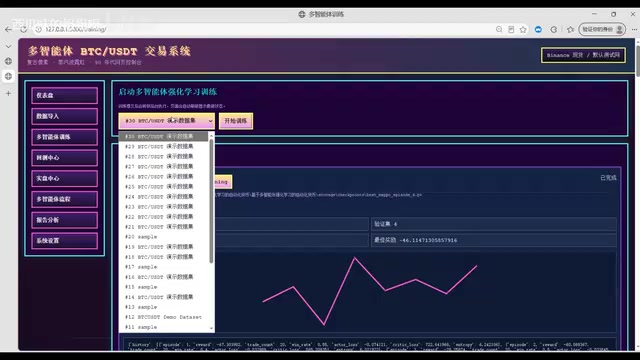
A visual multi-agent RL trading platform covering data, training, backtesting, and AI report generation in one closed loop.
This article breaks down an open-source multi-agent AI forex trading system designed for beginners, integrating the full quantitative development pipeline — data import, reinforcement learning training, strategy backtesting, and AI analysis — into a single visual platform. Built-in one-click data generation solves the cold-start problem; the multi-agent training module splits data at a 4:5:2 ratio with real-time logging; the backtesting center provides key metrics like annualized return, win rate, and max drawdown; and the AI analysis module uses LLMs like Qwen to convert raw numbers into readable strategy diagnostics. The author recommends paper trading only — ideal for developers learning reinforcement learning in financial contexts.
Project Overview: A Hands-On Multi-Agent Trading System
The combination of quantitative trading and reinforcement learning has long been a hot area in AI applications, yet truly beginner-friendly end-to-end projects are rare. This article breaks down an open-source multi-agent AI forex trading system shared by a Bilibili content creator. The core value of this system lies in what it is — not an isolated algorithm, but a complete closed-loop platform that includes a dashboard, data management, model training, backtesting, and AI-powered analysis.
For developers looking to get started with quantitative trading or reinforcement learning, this kind of project offers a valuable sandbox: from data preparation to model training, strategy backtesting, and result interpretation — every step is visualized and reproducible. Let's walk through each module in detail.
Data Management: One-Click Test Dataset Generation
One of the system's first standout features is its flexible data import mechanism. Users can either upload their own datasets or, when no data is available, use the "one-click import" function — which automatically generates 30 test data entries each time, with automatic numbering and management.
This design significantly lowers the barrier to entry. Many quantitative projects stall at the "no data" stage, but the built-in data generator lets developers immediately start experimenting — running through the entire pipeline first, then swapping in real data later. The dashboard also provides real-time visibility into data status, reward configuration, per-epoch training details, and overall training objectives, making the entire data flow easy to follow.
Multi-Agent Training: The Core of Reinforcement Learning

The training module is the heart of the entire system. After selecting a dataset (such as the 30 entries generated earlier) and clicking "Start Training," the system launches the multi-agent reinforcement learning process.
Using 30 data points as an example, the system splits them at roughly a 4:5:2 ratio (training set, test set, validation set). During training, the best reward value and training logs are displayed in real time. The model uses a unified base model for training, and the entire process is clearly logged so developers can monitor convergence.
From a technical standpoint, a multi-agent architecture makes a lot of sense in a trading context: different agents can handle different decision dimensions (e.g., trend analysis, risk control, position sizing), and through coordinated reward-guided learning, the overall trading strategy gradually improves. The system also provides a complete flowchart illustrating each step — snapshots, combiners, reward mechanisms, environment updates — which is extremely helpful for understanding how multi-agent collaboration works.
Backtesting Center: Strategy Review and Quantitative Performance Analysis

After training the model, backtesting is the critical step for validating strategy effectiveness. There is one important prerequisite: the dataset used for backtesting must match the model it was trained on — otherwise the results are meaningless.
Once backtesting is complete, the system automatically generates a review report containing several core quantitative metrics:
- Cumulative return: The strategy's overall profitability
- Annualized return: Return normalized to a yearly standard
- Win rate: Proportion of profitable trades to total trades
- Maximum drawdown: A measure of the strategy's risk tolerance
The system also plots a full equity curve to visually illustrate strategy performance. For experienced traders, these metrics enable rapid strategy evaluation; for beginners, they serve as an excellent introduction to quantitative assessment frameworks. All backtest results can be exported as JSON files for further analysis.
AI-Powered Analysis: Using LLMs to Interpret Trading Results

What truly sets this system apart from traditional quantitative tools is the integration of large language models for intelligent analysis. Users can click "Generate Report" on any training or backtest record, and the system will call an AI API (such as Qwen or ERNIE Bot) to interpret the historical data.

The value of AI analysis lies in translating cold numbers into understandable diagnostics. For example, a report might point out the current trade's reward value, win rate, and loss situation, along with where the standard deviation stands — if the standard deviation is high, the AI will flag that "this strategy has significant uncertainty"; if a large portion of the training data values are close to zero, the AI will conclude that "model training performance is poor and needs further improvement."
One important note: the AI API requires users to replace the API Key with their own. In the original author's demo, part of the analysis failed to generate because the key had expired — a reminder for developers to properly configure their own LLM credentials before deployment.
System Settings and Deployment Recommendations
In the system settings module, users can switch between internal network testing (paper trading) and mainnet testing (live trading), with features like mainnet order protection. However, using simulated internal network testing requires registering a Git account, making the configuration somewhat involved.
Key recommendation: Since the entire system is fundamentally a simulation and learning platform, the author strongly advises testing only in an internal network environment and not connecting real funds. Quantitative trading involves real financial risk, and no strategy should be deployed live without thorough validation.
Summary: A Well-Rounded Starter Project for Quantitative Trading
The value of this multi-agent AI forex trading system isn't that it will immediately make you money — it's that it presents the complete quantitative development pipeline (data → training → backtesting → AI analysis) in a visual, approachable format.
For developers wanting to learn how reinforcement learning applies to financial scenarios, or how multi-agent coordination works in practice, this is an accessible, well-structured entry-level project. The built-in data generator solves the cold-start problem, and the AI analysis module reduces the difficulty of interpreting results.
That said, as a starter project it does have limitations: the built-in dataset is small, the base model is relatively simple, and the AI API requires manual configuration. Developers who want to go deeper should replace the built-in data with real market data, scale up dataset size, and customize the reward mechanism after getting the basic pipeline running. Always remember the first principle of quantitative trading — validate thoroughly in a simulated environment before ever going live.
Related articles

Invalid Source Material Notice
The source material provided lacks substantive information and is unrelated to AI/tech topics, making it impossible to produce a complete professional article.

Invalid Source Material: Unable to Generate a Valid AI/Tech Article
This Twitter source material is an irrelevant marketing tweet with no AI or tech content, making it impossible to generate a valid professional article.
Insufficient Source Material: Unable to Generate a Valid Article
The source material was limited to a single broken tweet with no usable content, making it impossible to produce a complete, high-quality article.