Multi-Agent Coding: Why It's the Future of Software Development

Multi-agent coding reshapes software development through role division and cross-validation, but coordination cost and reliability remain key to adoption.
Based on a Hacker News discussion, this article outlines the shift in AI-assisted programming from single-model chat to multi-agent collaboration. It splits development into planning, execution, and review roles handled by different agents, with value in division of labor and checks and balances. It also examines high coordination costs, error amplification, and observability challenges, and argues developers will shift from writing code to designing collaboration rules.
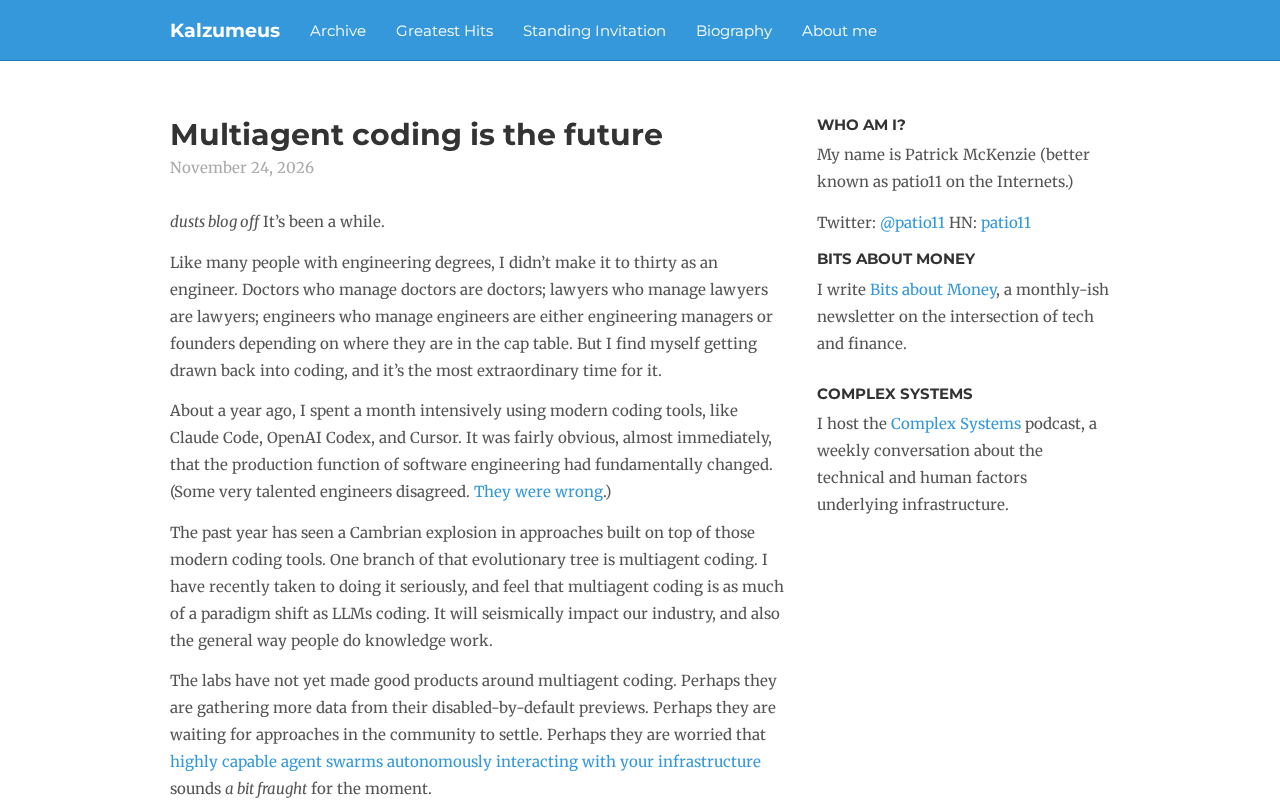
On Hacker News, a discussion titled "Multiagent coding is the future" drew attention from the tech community. Although the post's own engagement numbers weren't huge (18 points, 4 comments), it touches on an issue that more and more developers are taking seriously: when multiple AI agents work together, the way software is developed may fundamentally change.
From Single-Agent to Multi-Agent: A Paradigm Shift in Programming
For a while now, the dominant form of AI-assisted programming has been "one model, one chat box, one generation." Developers describe requirements to the model, the model returns code snippets, and then humans handle integration, debugging, and deployment. While this boosts local efficiency, it essentially still treats AI as a smarter code-completion tool.
What makes multi-agent coding different is that it breaks "writing code" into multiple roles and multiple stages, handled by different agents. One agent might understand requirements and break down tasks, another writes specific modules, a third reviews code quality, and a fourth runs tests and feeds back results. These agents can communicate with each other and exchange context, forming an automated collaboration chain.
The value of this model isn't in how strong any single agent is, but in division of labor and checks and balances. A single model easily loses context or hallucinates during long tasks, while a multi-agent structure can reduce these risks through cross-validation and separation of responsibilities.
Agent in this context refers to an AI system capable of goal decomposition, tool invocation, memory, and an environment-feedback loop—not just a model answering a single question. Typical implementations include patterns like ReAct (alternating reasoning and action) and Plan-and-Execute (plan first, then execute). A multi-agent system (MAS) is an architecture in which multiple agents collaborate through message passing, a shared blackboard, or an orchestrator. Common topologies include hierarchical (supervisor-worker), peer-to-peer (debate/voting), and pipeline (plan-execute-review). Understanding this distinction matters: the capability ceiling of a multi-agent system depends not only on the underlying model but also on the design of the orchestration protocol, context management, and verification mechanisms.
Why Multi-Agent Is Better Suited to Real Engineering Scenarios
Real software development is rarely a linear "generate once and done" process. Requirements change, dependencies conflict, tests fail, and code reviews raise revision requests. A single agent often struggles in these iterative scenarios because it needs to simultaneously play product manager, programmer, and test engineer in a single conversation.
Multi-agent architectures naturally fit this iterative nature. Take the common three-stage "plan—execute—review" pattern: the planning agent breaks vague requirements into an executable task list; the execution agent completes tasks one by one and produces code; and the review agent acts like a strict code reviewer, checking for logic flaws, boundary conditions, and style issues. When problems are found, the review results flow back to the execution agent for correction, forming a closed loop.
The discussion on Hacker News points to a similar view: the core advantage of multi-agent coding is letting each agent focus on what it does best, rather than expecting one general-purpose model to handle everything. This approach closely resembles the division of labor in human engineering teams.
Real-World Challenges: Coordination Cost and Reliability
Multi-agent coding isn't without its costs. The most immediate issue is coordination cost. Communication between agents requires designing protocols, managing context windows, and handling message ordering and conflicts. If the architecture is poorly designed, multiple agents may end up waiting on each other, duplicating work, or even arguing in circles—making overall efficiency lower than a single agent.
Reliability also deserves attention. Multi-agent systems introduce more uncertainty and more points of failure: one agent's erroneous output may be passed along by downstream agents as correct input, amplifying the error through the chain. How to design effective verification mechanisms and how to make agents proactively stop and request human intervention when uncertain are questions that must be answered for engineering deployment.
Moreover, multi-agent coding raises the bar for observability. Developers need to clearly know what each agent is doing and why it made a particular decision; otherwise debugging becomes extremely difficult.
Observability, in both distributed systems and agent systems, refers to the ability to reconstruct a system's internal state through logs, metrics, and traces. For multi-agent coding, the key is to record each agent's input context, tool calls, decision rationale, and output, and to be able to stitch the complete chain of a task into a replayable trace. Without these records, errors only manifest as problems in the final code, and developers find it hard to pinpoint whether the issue is a deviation in requirement decomposition, an execution error, or a review oversight. In practice, this usually requires structured logging, step-level snapshots, and breakpoint mechanisms that allow human intervention—this is also the dividing line between multi-agent frameworks moving from demos to engineering-grade systems.
What It Means for Developers
The rise of multi-agent coding doesn't mean developers will be replaced. On the contrary, it pushes the developer's role from "writing code line by line" toward "designing systems and defining collaboration rules." Developers need to think not just about how to write a particular function, but about how to decompose a complex task into granularity suitable for agent execution, how to design verification standards, and how to preserve human judgment at key checkpoints.
From the tooling ecosystem perspective, multi-agent coding is moving from experimental frameworks toward more practical forms. Practices around task orchestration, agent communication, and result verification are accumulating rapidly, which explains why this topic keeps getting discussed in the tech community.
The original Hacker News post title directly asserts that "multi-agent coding is the future." That judgment may be too absolute, but the direction it points to deserves serious attention: software development automation is moving from "assisted completion" toward "collaborative orchestration," and multi-agent is the core vehicle of this shift.
Orchestration refers to the layer that centrally schedules multiple agents' invocation order, dependencies, retry and fallback strategies—often called the orchestrator or controller. It determines who gets woken up under what conditions, how context is trimmed and passed, and whether failures are retried or escalated to humans. Mainstream frameworks like LangGraph, AutoGen, and CrewAI offer different abstractions at this layer: some explicitly define state machines with graph structures, while others drive role collaboration through conversation protocols. When choosing an orchestration approach, you need to weigh flexibility, debuggability, and the degree of coupling to the underlying model, because the orchestration layer often determines the overall reliability of the system more than any single agent.
FAQ
What's the difference between multi-agent coding and an ordinary AI coding assistant?
An ordinary AI coding assistant is typically a single model with single-turn or limited multi-turn interaction, mainly handling code generation and completion. Multi-agent coding has multiple agents with different responsibilities working together, covering the complete workflow of requirement decomposition, coding, review, and testing, with an emphasis on division of labor and verification.
What scenarios is multi-agent coding currently suited to?
It's better suited to engineering scenarios with relatively clear task boundaries that can be decomposed into multiple subtasks—for example, modular feature development, code review pipelines, and automated test generation. For scenarios with highly vague requirements or heavy reliance on human judgment, developers still need to be deeply involved.
What are the main risks of multi-agent coding?
High coordination costs, errors that may be amplified through the agent chain, insufficient system observability, and the lack of human review caused by over-reliance on automation are all risks to watch out for.
One-line Summary
Multi-agent coding reshapes the software development process through role division and cross-validation, but coordination cost and reliability remain key to real-world adoption.
Paragraph Summary
Based on a Hacker News discussion titled "Multi-agent coding is the future," the article outlines the paradigm shift in AI-assisted programming from single-model conversation to multi-agent collaboration. Multi-agent coding splits the development process into roles such as planning, execution, and review, handled by different agents that communicate with each other; its core value lies in division of labor and checks and balances rather than the capability of any single agent. This structure better fits the iterative nature of real engineering—changing requirements, failing tests, and repeated code reviews. But the article also points out practical challenges: high coordination costs, errors amplified through the chain, and insufficient observability. Finally, it emphasizes that the developer's role will shift from writing code line by line to designing systems and defining collaboration rules, while preserving human judgment at key checkpoints.
Related articles

Nothing CMF Buds 2A Drops to $17.89 on Black Friday: A New Low for ANC Earbuds
Nothing CMF Buds 2A wireless earbuds Black Friday deal: just $17.89 on Amazon, about $11 off retail and a record low. ANC earbuds at an entry-level price.

When AI Creation Gets Accused of "Spitting": Hacker News Heats Up Over the Glaude Controversy
A Hacker News post, "Spitting in the Face of Glaude," sparks debate on AI creation transparency and attribution ethics. This analysis examines the blurred creator identity behind the controversy and offers practical advice for AI content production.

Akai Embraces Custom Firmware: MPC Sample 1.4 Lets Users AI-Program Their Sampler
Akai embraces the modding community with MPC Sample 1.4 firmware, supporting vibe-coded custom firmware and effects. We analyze the impact of this open strategy on music hardware and AI-assisted programming.