Multi-Agent Systems in Practice: Five Coordination Patterns That Cut Costs by 85%

Building a multi-agent stack can cut costs by 85% while increasing output
The most effective developers are building multi-agent stacks, using cost routing to assign tasks to the most suitable models (cheap models for routine work, premium models for complex tasks), leveraging clean context isolation to improve code review quality, and adopting Agent Swarms for massive parallel processing — ultimately achieving 85% cost reduction while actually increasing output.
Introduction: From a Single Tool to a Multi-Agent Stack
The most effective developers today have stopped debating whether Claude, GPT, or Cursor is better — they're doing something far more radical: building multi-agent stacks where every task runs on the most suitable agent. The results are counterintuitive: costs are slashed by 85%, yet output doesn't drop — it actually increases.
This isn't theory. It's validated by multiple real-world engineering cases. This article breaks down the core logic of multi-agent systems across five dimensions: cost routing, context isolation, Agent Swarms, coordination patterns, and architecture design.
Cost Routing: It's Not About the Cheapest Model — It's About the Right One
Many people think "cost routing" simply means "replacing expensive models with cheap ones," but that barely scratches the surface.
Engineer Carola's case is a perfect example. She previously used Claude Code for everything — writing tests, refactoring modules, generating boilerplate — great quality, but her monthly bill hit $3,000. Then she ran a comparison test: Kimi K2.6 and Claude differ by less than 1% on SWE-Bench, but the price gap is 7x (Kimi at $0.8 per million tokens vs. Claude at $5). With even cheaper options like DeepSeek V4, the cost routing opportunity keeps expanding.
What is SWE-Bench? SWE-Bench is a standardized AI coding benchmark released by a Princeton University research team in 2023, specifically designed to measure how well large language models can solve real GitHub issues. The test set includes 2,294 real software engineering tasks from 12 mainstream Python open-source projects, requiring models to automatically generate code patches that pass unit tests given a codebase and issue description. SWE-Bench has become an industry-recognized hardcore metric because it doesn't test a model's ability to recite knowledge — it tests reasoning, localization, and repair capabilities in real engineering environments. This closely mirrors actual development scenarios, making it widely used for comparing different models' cost-effectiveness on programming tasks.
Carola's core approach was to categorize her work into three tiers:
- Routine repetitive tasks (85%): Writing tests, refactoring code, generating boilerplate → Use Kimi or DeepSeek V4 — cheap, fast, good enough
- Complex architecture design (15%): Requires deep reasoning and creativity → Keep using Claude — the extra cost is worth it
- Batch processing tasks: Processing 100 files, generating 100 reports → Use Agent Swarm for parallel processing
Final numbers: Weekly cost dropped from $700 to $100, while output actually increased. Because she stopped self-throttling due to cost — previously she'd think "this task is too expensive, I'll just do it myself," but now she just lets the agents handle it.
The Power of Clean Context: Why an Agent Reviewing Its Own Code Is Actually More Effective
Cognition, while developing their AI coding assistant Devin, ran an experiment: have Devin write code, then have another Devin instance review it. The results were striking — an average of two bugs found per PR, with 58% being critical issues (logic errors, edge cases, security vulnerabilities).
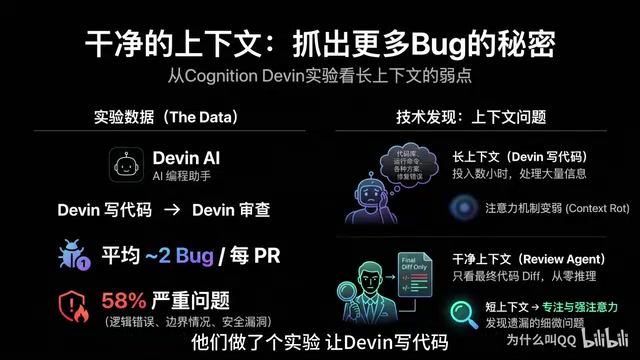
The crucial technical detail: the most effective approach was giving the Review Agent a completely clean context — no original requirements, no access to Devin's reasoning process, just the final code diff.
This exposes a fatal weakness of long-context models: Context Rot. From the underlying logic of the Transformer architecture, Self-Attention computational complexity grows quadratically with sequence length, and models in practice use positional encoding and attention weight distribution to "decide" which tokens to focus on. Stanford's 2023 research paper Lost in the Middle experimentally proved that when key information is placed in the middle of a long context, the model's retrieval accuracy drops significantly. When Devin writes code, it has already invested massive context in the task — reading the codebase, running commands, trying approaches, fixing errors — the attention mechanism weakens under long context and loses focus on certain details. The Review Agent starts clean: shorter context means stronger attention, catching subtle issues the original agent missed.
More importantly, the Review Agent is forced to reason backward from the implementation — not knowing the original requirements actually enables it to question things that were overlooked, like unsafe patterns or edge case handling.
This finding overturns the intuition that "more context is always better for agents." Sometimes, intentionally withholding certain information leads to better decisions.
Agent Swarm: The Right Way to Do Massive Parallel Processing
"100 agents working in parallel" sounds cool, but to hardcore engineers, this doesn't mean having them all modify the same file simultaneously — it's a classic MapReduce architecture: distribute, process, reduce.
MapReduce was originally proposed by Google in 2004 for processing large-scale distributed datasets — the Map phase shards input data for parallel processing, and the Reduce phase aggregates results from each shard. Agent Swarm transplants this classic pattern into the domain of semantic computation: each "worker node"
Related articles
 Tutorials
ChatGPT Plus Subscription Guide: Are GPT-5.5, image-2, and Codex Worth the Upgrade?
A detailed look at ChatGPT Plus features — GPT-5.5, image-2, and Codex — with a Plus vs Pro comparison and a complete step-by-step subscription guide for users outside the US.
 Tutorials
Harness AI Engineering in Practice: Using Claude Code to Master Enterprise-Level E-Commerce Development
Deep dive into Harness AI Engineering: master enterprise e-commerce development with Claude Code using the Rules, Skills, Wiki, and Changes framework.
 Tutorials
Cursor + Codex Dual-IDE Collaboration: A Practical Methodology for Open-Source Project Customization
A complete methodology for open-source project customization based on real-world experience, detailing the Cursor+Codex dual-IDE workflow, seven-stage process, MVP validation, and AI source code reading techniques.