Multi-Model + Human Verification: A New Framework for Validating AI-Generated Acceptance Criteria

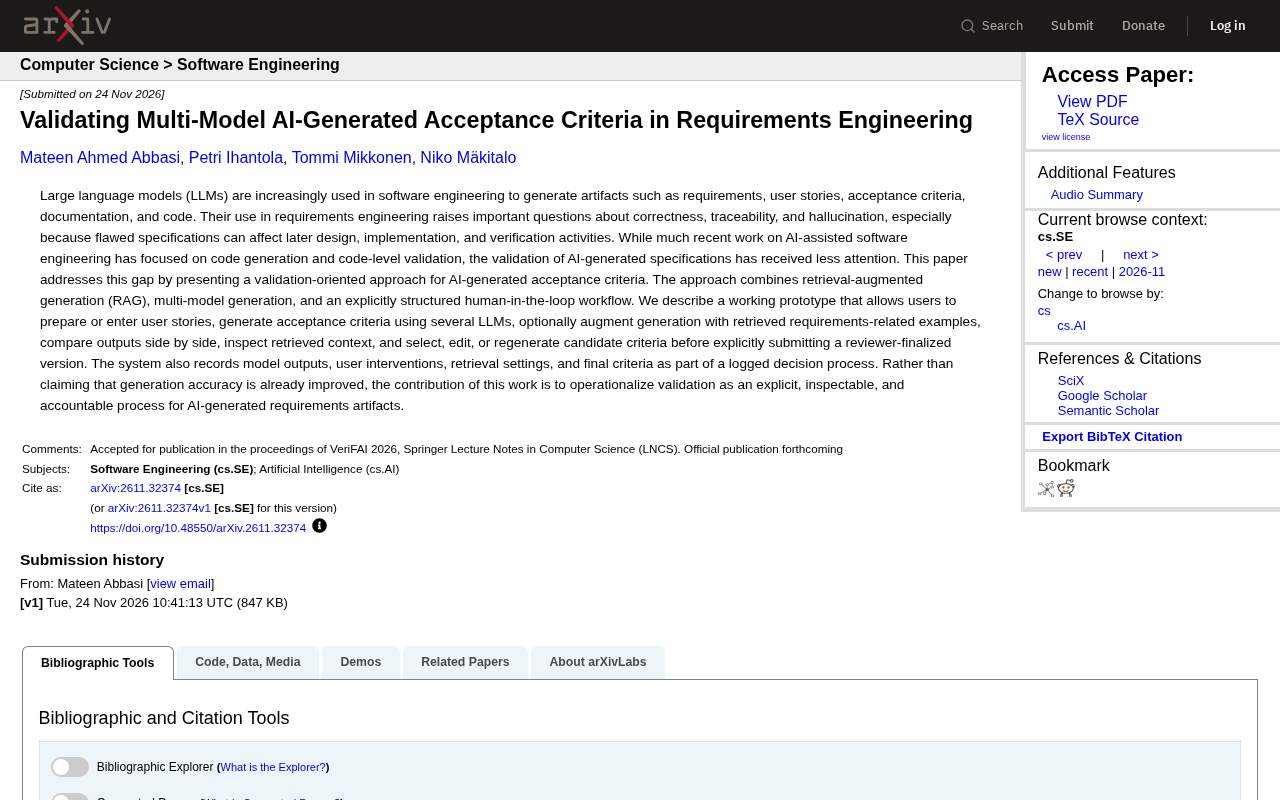
The paper uses RAG, multi-model comparison, and human-in-the-loop workflow to turn AI-generated acceptance criteria into an auditable verification process.
The article discusses a paper on verifying AI-generated acceptance criteria. It notes that AI-assisted software engineering research emphasizes code generation and verification, while how to verify AI-generated specifications is neglected; flawed specs burst out later at the coding/testing stage with multiplied costs. The method has three components: RAG with optional retrieved examples, parallel generation by multiple LLMs to expose model disagreements, and a workflow requiring explicit human submission of the final version. The system logs model outputs, user interventions, retrieval settings, and final criteria, forming a traceable decision log. The paper positions itself as operationalizing verification rather than improving generation accuracy, emphasizing engineering process redundancy to hedge against model uncertainty; its empirical effectiveness remains to be studied.
Large language models are penetrating every stage of software engineering, from code generation to documentation writing—and now even Acceptance Criteria in requirements engineering are being handled by AI. But a key question follows: when AI-generated specifications contain errors or hallucinations, downstream design, implementation, and verification are all affected in a chain reaction. A recent paper proposes a verification-oriented approach that seeks to turn "generation" into a "reviewable, traceable decision process" rather than simply chasing generation accuracy.
The neglected verification gap in requirements engineering
Over the past few years, research on AI-assisted software engineering has concentrated heavily on code generation and code-level verification—for example, whether generated code passes tests or complies with static analysis rules. By contrast, how to verify AI-generated specifications (such as user stories and acceptance criteria) has received noticeably less attention.
This imbalance carries real risks. Acceptance criteria are the bridge connecting requirements and tests. If AI-generated acceptance criteria are vague, miss boundary conditions, or fabricate constraints out of thin air, the problem won't surface immediately—it lies dormant until the coding and testing stages, by which point the cost of fixing it multiplies. The authors explicitly point out that flawed specifications affect subsequent design, implementation, and verification activities, so verification at the specification level cannot be left out.
The paper's contribution is not claiming "we made AI generate more accurately," but rather operationalizing verification itself: putting AI-generated acceptance criteria through an explicit, checkable, and accountable process. This stance is noteworthy—it acknowledges that current model outputs still cannot be fully trusted, and instead relies on process design as a safeguard.
A three-pillar architecture: RAG, multi-model, and human intervention
The proposed method consists of three core components that work together to form a verification loop.
Retrieval-Augmented Generation (RAG)
The system allows users to optionally incorporate retrieved requirements-related examples as context when generating acceptance criteria. The role of RAG is to anchor generation results in the project's existing requirements corpus, reducing room for the model to improvise. Users can also inspect the retrieved context to judge whether it is relevant and whether it has been used correctly.
RAG (Retrieval-Augmented Generation) is a technical paradigm that combines external knowledge retrieval with large language model generation. Its basic workflow: first encode user input as a query, retrieve semantically relevant passages from a vector database or document store, then concatenate these passages as context into the prompt so the model generates a response grounded in these materials. Compared with purely parametric generation, RAG anchors outputs in concrete, updatable corpora, reducing hallucinations and improving interpretability—because it is possible to trace which materials the model referenced. In requirements engineering scenarios, the retrievable corpus typically consists of historical user stories, existing acceptance criteria, domain glossaries, and project specification documents. RAG's effectiveness depends heavily on retrieval quality: if recalled content is irrelevant to the current user story, it can instead mislead generation, making it a necessary design choice to let users inspect whether the retrieved context has been used correctly.
Multi-model parallel generation
The same user story is used by multiple LLMs to separately generate candidate acceptance criteria, and the system supports side-by-side comparison of each model's output. The value of the multi-model strategy is not in selecting "the best one," but in exposing disagreements among models—when different models produce markedly different acceptance criteria, that inconsistency itself is a signal that warrants human review.
Multi-model parallel generation refers to calling multiple different large language models (possibly from different vendors, of different scales, or different versions) on the same input simultaneously, then comparing and aggregating the outputs. Common aggregation strategies include voting, consistency filtering, and human selection. In tasks requiring high reliability, the core value of this approach lies in using inter-model differences for cross-checking: if multiple models independently produce consistent results, confidence is relatively high; if disagreements are pronounced, it signals ambiguity or knowledge blind spots at that point, warranting focused review. It also has limitations—different models may share similar training data and biases, leading to "correlated errors," so consistency does not equal correctness. Therefore multi-model comparison is usually paired with human review, serving as a means to expose uncertainty and organize review workload, rather than an automatic adjudication mechanism.
An explicit human-in-the-loop workflow
Users can select, edit, or regenerate candidate criteria, then explicitly submit a version finally confirmed by the reviewer. The key lies in the word "explicit": the final version must be actively submitted by a human, and the system will not automatically adopt any model output.
Human-in-the-Loop (HITL) refers to setting up stages in an automated process that require human participation and confirmation, where humans bear the responsibility for judgment, correction, or final approval. In AI-assisted software engineering, common HITL forms include post-generation human review, selecting or editing among candidate options, and explicitly signing off on the final artifact. Its design point is "explicitness": the system does not automatically adopt model outputs, and the human approval action must leave a clear record, thereby attributing responsibility to a specific reviewer. HITL differs from passive "human-in-the-loop" oversight in that it emphasizes embedding human judgment at key decision points in the process, using process constraints to compensate for insufficient model reliability. The cost is additional human labor, so the granularity of review must be balanced against efficiency.
Turning the decision process into an auditable log
A pragmatic design of this prototype system is end-to-end logging: model outputs, user interventions, retrieval settings, and the final confirmed acceptance criteria are all incorporated into a logged decision process.
This means verification is not just "a human took a look and thought it was fine," but leaves a traceable evidence chain. If acceptance criteria later prove problematic, the team can trace back which model was used, which examples were retrieved, and what modifications were made by humans. For regulated industries or large-team collaboration scenarios, this auditability may be more valuable than generation quality itself.
From an engineering perspective, this design downgrades AI from a "black-box generator" to a "candidate provider," while human reviewers bear explicit decision responsibility. The paper summarizes this idea as making verification an explicit, checkable, and accountable process, rather than relying on blind trust in model accuracy.
Auditability refers to a system's ability to completely and credibly record key operations and decision bases, enabling third parties to later trace "who made what decision, when, and based on what information." In AI-involved development workflows, auditable logs typically need to cover model identifiers and versions, prompts and retrieval context, the model's raw output, human editing and selection actions, and timestamps of the final adopted result. Such records are especially important for regulated industries (such as medical, financial, and aviation software), because compliance reviews often require demonstrating that the decision process for requirements and specifications is traceable. From an engineering perspective, auditable logs are also the basis for defect attribution: when acceptance criteria later prove incorrect, the team can distinguish whether it was retrieval material error, model hallucination, or human review oversight, thereby improving the process in a targeted way rather than vaguely blaming "unreliable AI."
Implications for requirements engineering practice
This work reflects a forming consensus: for high-risk artifacts like specifications, AI's value lies more in accelerating the production and comparison of candidate solutions than in replacing human judgment. The combination of multi-model comparison, RAG, and human final review is essentially using redundancy in the engineering process to hedge against model uncertainty.
Of course, the paper also candidly acknowledges that its contribution is operationalizing the verification process, not proving that generation accuracy has improved. Whether this method can reduce defect rates in real projects and how much review cost it saves still require follow-up empirical research. But at least it puts the question "how should AI-generated acceptance criteria be verified" on the table and offers a workable prototype answer.
For teams attempting to introduce LLMs into the requirements phase, this framework offers a directly applicable idea: don't ask "is the AI generation correct?" but rather "do we have a process that can catch when it's wrong?"
One-line Summary
The paper proposes using RAG, multi-model comparison, and a human-in-the-loop workflow to turn AI-generated acceptance criteria into an auditable verification process.
Paragraph Summary
The article discusses a paper on verifying AI-generated acceptance criteria. The authors note that current AI-assisted software engineering research emphasizes code generation and verification, while how to verify AI-generated specifications (such as user stories and acceptance criteria) has long been neglected; flawed specifications lie dormant until coding and testing, by which point the cost of fixing them multiplies. The paper's method consists of three core components: RAG that optionally incorporates retrieved examples, parallel generation of candidate criteria by multiple LLMs to expose model disagreements, and a workflow requiring explicit human submission of the final version. The system logs model outputs, user interventions, retrieval settings, and final criteria throughout, forming a traceable decision log. The paper positions itself as operationalizing the verification process rather than improving generation accuracy, emphasizing engineering process redundancy to hedge against model uncertainty; its empirical effectiveness remains to be studied.
Related articles

Nothing CMF Buds 2A Drops to $17.89 on Black Friday: A New Low for ANC Earbuds
Nothing CMF Buds 2A wireless earbuds Black Friday deal: just $17.89 on Amazon, about $11 off retail and a record low. ANC earbuds at an entry-level price.

When AI Creation Gets Accused of "Spitting": Hacker News Heats Up Over the Glaude Controversy
A Hacker News post, "Spitting in the Face of Glaude," sparks debate on AI creation transparency and attribution ethics. This analysis examines the blurred creator identity behind the controversy and offers practical advice for AI content production.

Akai Embraces Custom Firmware: MPC Sample 1.4 Lets Users AI-Program Their Sampler
Akai embraces the modding community with MPC Sample 1.4 firmware, supporting vibe-coded custom firmware and effects. We analyze the impact of this open strategy on music hardware and AI-assisted programming.