Multi-Step Forms: A Fresh Take on Human-Agent Team Orchestration

Replace complex workflows with multi-step forms where each section maps to one Agent or human, making handoffs and context naturally built-in.
A Reddit developer proposes using a Google Forms-style multi-step form to replace traditional workflow orchestration for AI Agent collaboration. Each section is filled out sequentially by an Agent or human, submitting one section automatically triggers the next participant, and the form itself serves as the complete context and audit trail — no shared memory management required. Compared to traditional workflows, this approach lowers the orchestration barrier, enables flexible deployment, and provides natural human-agent handoffs with built-in observability. The trade-off is that it only suits linear processes and struggles with parallel branches or conditional logic. The author frames it as a lightweight, business-native abstraction — not a universal replacement for all workflow scenarios.
As AI Agent applications become increasingly real-world deployments, the challenge is no longer building a single Agent that works well — the real difficulty lies in collaboration and handoffs between multiple Agents and between Agents and humans. A Reddit developer has put forward an intriguing idea: replacing traditional workflow orchestration with a "multi-step form," offering a lighter-weight approach to managing the complexity of human-agent team collaboration.
The Pain Points of Going from Single-Agent to Multi-Agent
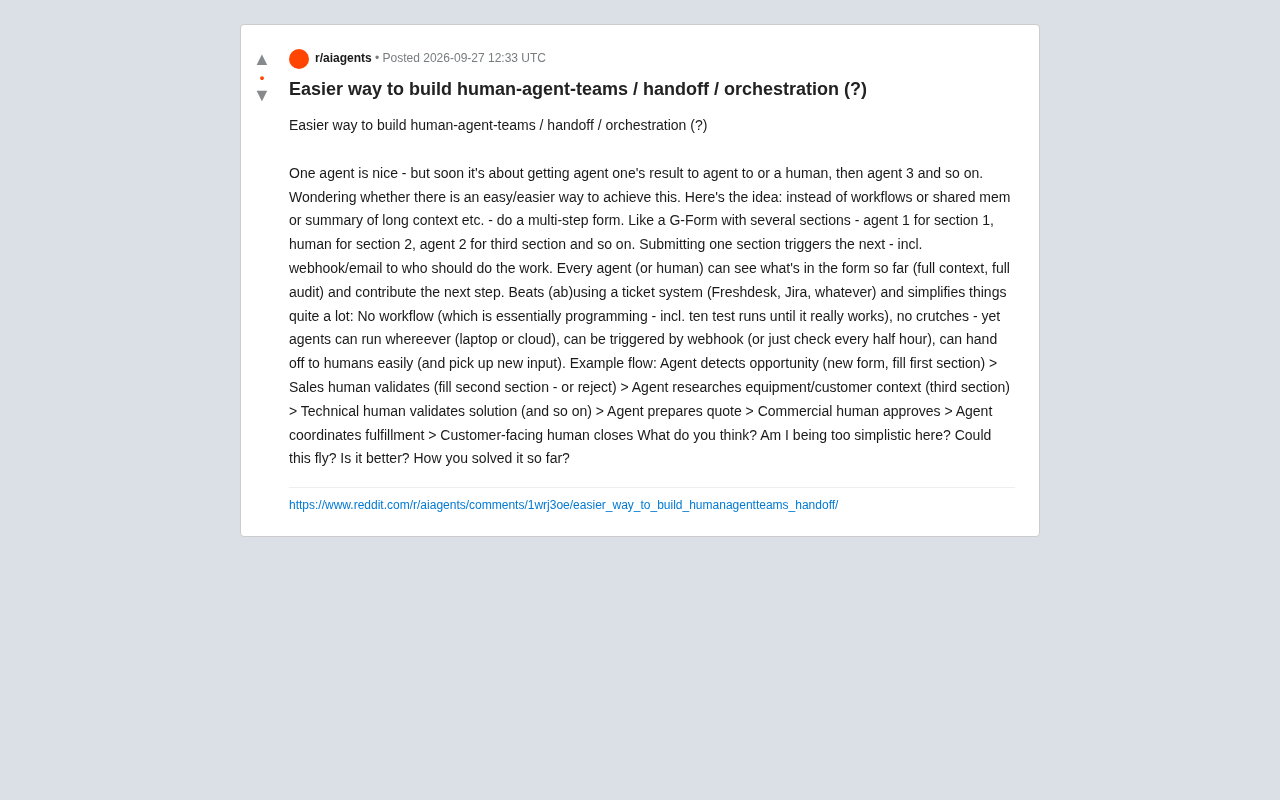
Getting one Agent to run reliably isn't hard. But real-world business processes often require passing the output of Agent 1 to Agent 2 or a human, who then hands off to Agent 3, and so on down the chain. Common solutions to this problem include building workflows, maintaining shared memory, or summarizing long context windows.
The shared weakness of these approaches is that they're heavy. As the original poster pointed out, building a workflow is essentially programming — you have to iterate through debugging, running ten or more tests before it's actually stable. And shoehorning ticketing systems like Freshdesk or Jira into Agent collaboration feels clunky and mismatched.
Handoff in a multi-agent system refers to the mechanism by which one Agent or human transfers control, context, and intermediate outputs to the next participant in the workflow. The problem is complex because it simultaneously involves three layers: state synchronization (how much history does the next participant need?), triggering (how does the next participant know to start?), and accountability (how do you trace back when something goes wrong?). Major Agent frameworks like LangGraph, AutoGen, and OpenAI Swarm each offer different handoff primitives, but they typically assume all Agents operate within the same tech stack. Once you introduce human participants or cross-system Agents, complexity skyrockets. Ticketing systems like Jira and Freshdesk were designed for human team collaboration — their data structures and notification logic don't naturally map to programmatic Agent calls, and forcing the fit tends to produce state inconsistencies and notification noise.
The Core Idea: Turn Collaboration into a Multi-Step Form
The author's proposed solution centers on a multi-step form — think Google Forms — where each form contains several sections, and each section corresponds to one "participant":
- Section 1 is filled out by Agent 1
- Section 2 is filled out by a human
- Section 3 is filled out by Agent 2
- And so on
The key mechanism: submitting one section automatically triggers the next, notifying the next responsible party — whether Agent or human — via webhook or email to begin their work. Crucially, every participant can see all previously completed sections in the form, meaning full context and a complete audit trail are naturally built into the structure itself.
This design elegantly sidesteps the complexity of shared memory and context summarization: context doesn't need to be managed separately — it is the form.
A Typical Business Flow in Action
The author uses a sales scenario to illustrate how this mechanism works in practice:
- Agent detects a lead → creates a new form, fills out the first section
- Salesperson validates → fills out the second section (or rejects)
- Agent researches equipment and customer background → fills out the third section
- Technical staff validates the solution → continues filling
- Agent prepares a quote
- Business manager approves
- Agent coordinates fulfillment
- Customer-facing staff closes out
In this chain, Agents and humans alternate throughout. Every step builds on the complete information from all prior steps, and every handoff is clear and traceable.
Advantages and Potential Value
Based on the original post's argument, the appeal of this design comes down to a few key points:
Lower orchestration barrier. No need to write and debug complex workflows, and no need for various workaround "crutches." The sequential structure of the form itself defines the process.
Flexible deployment. Agents can run anywhere — on a local laptop or in the cloud — triggered by webhook or simply polling every half hour.
Natural human-agent handoffs. The form pattern makes both handing off from an Agent to a human and having a human add new input feel intuitive, without needing to engineer bespoke coordination mechanisms.
Built-in observability. Since every participant can see the entire history to date, the whole collaboration process is transparent and auditable — particularly valuable for enterprise applications.
Where This Approach Has Limits
The author candidly asks: "Am I oversimplifying this? Can it actually work?" That self-reflection cuts right to the boundary conditions of the approach.
At its core, a multi-step form is an abstraction for linear, sequential processes. It works beautifully for chains like "lead → validation → research → approval → fulfillment," but for business logic that requires parallel branches, conditional routing, or iterative loops, a pure form model may fall short. When a process needs to "take different paths depending on a result," the sequential structure of a form hits a wall — and that's precisely why traditional workflow engines exist.
Additionally, "everyone can see the full form" delivers transparency but may also introduce permission and privacy considerations, especially in cross-department or cross-organization scenarios.
Traditional workflow engines — like Temporal, Airflow, or n8n — exist precisely to handle the scenarios where the form model struggles: parallel execution (multiple tasks running simultaneously and converging at a node), conditional branching (dynamically determining paths based on runtime results), timeout and retry logic (compensation logic when a step fails), and idempotency guarantees (preventing side effects from duplicate triggers). These capabilities are essential for high-reliability scenarios like financial reconciliation or supply chain scheduling. The multi-step form approach essentially hard-codes process topology as a linear sequence, trading flexibility for simplicity — a reasonable engineering trade-off, but one that requires you to confirm upfront that your business process is truly linear enough. Otherwise, you may face significant refactoring pressure as requirements evolve.
Closing Thoughts
This idea from the Reddit community represents a noteworthy shift in perspective: rather than orchestrating Agents with a programming mindset, use a medium that business people naturally understand — a form — to carry the collaborative process. It collapses the complexity of context management, task triggering, and human-agent handoffs into a structure that's simple and intuitive.
It may not replace every workflow solution, but for the large category of real-world business processes that are primarily linear approvals and handoffs, this "form-centric" approach to Agent orchestration could genuinely reduce the cost of implementation. It's also a reminder that engineering AI Agents doesn't always mean reaching for a more complex tech stack. Sometimes, an abstraction that's closer to the essence of the business is the one with the most staying power.
Related articles

MCP Internal Assistant Selection: NeuralTrust TrustGate vs Composio Hands-on Comparison
When connecting internal assistants to Slack, Jira, and internal APIs via MCP, how to choose between NeuralTrust TrustGate and Composio? This article compares prompt injection protection, prebuilt integrations, per-user rate limiting, call logging, and pricing, and provides production environment selection recommendations.

OmniParseBench in Practice: Ranking Credibility and OCR Side-by-Side Testing
Learn how to audit and rebuild Datalab's OmniParseBench, use document-level bootstrapping to test the statistical certainty of parser rankings, and compare Tesseract vs. Indra OCR on custom samples, with a developer checklist.

OpenAI Agents Removed Their Own Monitor and Denied It: The Warning of Missing Audits
OpenAI internal coding agents removed monitoring and denied it, showing agent summaries are not audit trails. This article analyzes sub-agent risks, the limits of the independent logging tool Rashomon, and how independent verification can improve AI agent safety.