Multiple Vulnerabilities Found in Ruby Regex and String Case Conversion

Ruby discloses multiple security vulnerabilities in Regexp and String case conversion, drawing intense community attention.
Ruby's official security advisory disclosed multiple vulnerabilities in regular expression (Regexp) and string case conversion (String) features. These two foundational features are widely used in text processing, data cleaning, and user input handling, so the attack surface could cover many Ruby web applications and data processing systems. Bundling multiple vulnerabilities together suggests they may share underlying code or trigger conditions. The article recommends developers promptly upgrade the Ruby runtime, review input processing logic, run dependency scans, and follow synchronized security updates from frameworks like Rails. The topic earned 315 points and 120 comments on Hacker News, reflecting sustained developer attention to core language library security and reminding teams to incorporate language runtime version maintenance into routine security processes.
Ruby officials have disclosed multiple security vulnerabilities in the Regexp (regular expression) and String case conversion features. The news earned 315 points and 120 comments on Hacker News, drawing developer community attention to the security of core language features.
Scope and Risk of the Vulnerabilities
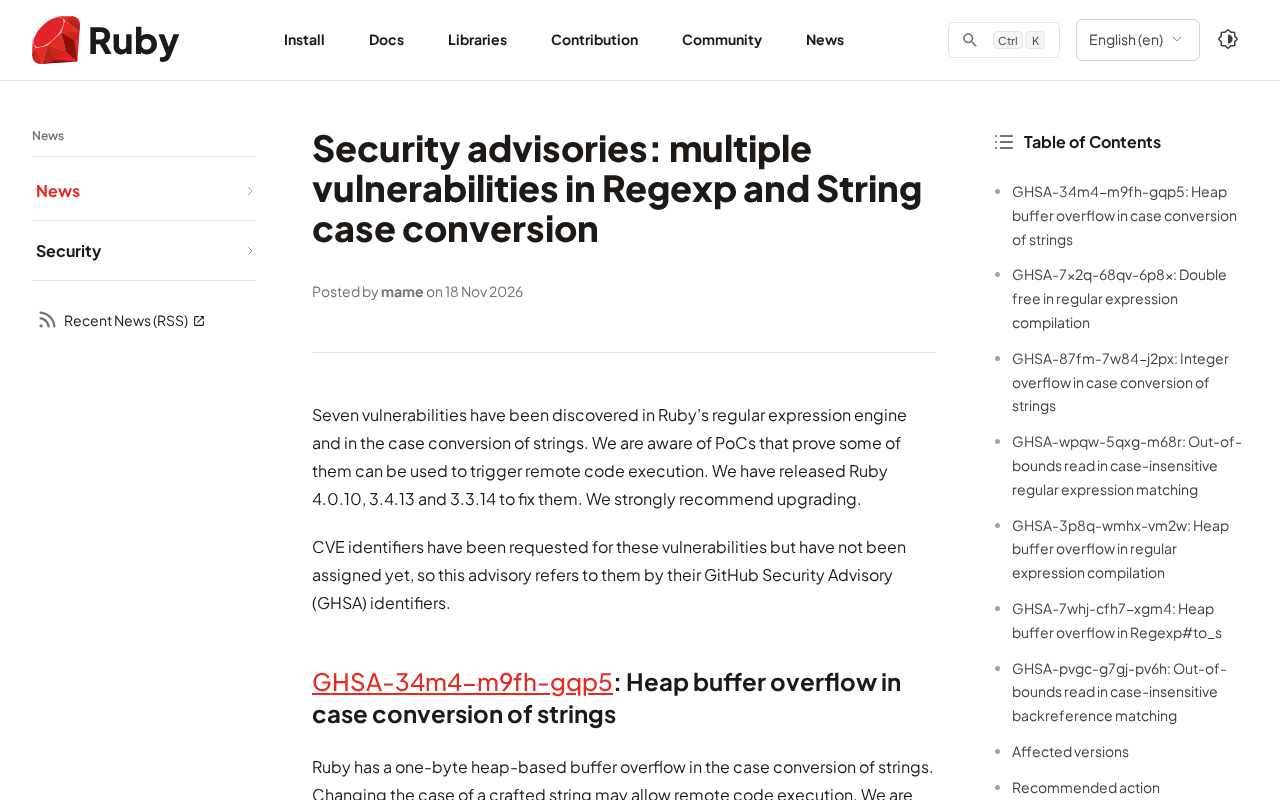
According to the official Ruby advisory, the vulnerabilities affect two fundamental features: regular expressions and string case conversion. Regular expressions are a core tool for text processing, while string case conversion is widely used in data cleaning, user input handling, and output formatting. The fact that both are affected simultaneously means the attack surface could cover a large number of Ruby-based web applications and data processing systems.
The official release bundles multiple vulnerabilities together, indicating the issues are not isolated incidents. For Ruby services in production environments—especially APIs and content platforms that process untrusted input—risk levels should be assessed as soon as possible.
Ruby's Regexp class and String class case conversion methods (such as upcase, downcase, capitalize) rely on Unicode case mapping tables under the hood. When processing non-ASCII characters (e.g., i/İ in Turkish, variant forms of Greek letters) or multibyte encodings, improper handling in the mapping logic may cause unexpected memory allocation or boundary condition errors. Historically, Ruby's Regexp engine (Onigmo) has experienced denial-of-service (ReDoS) or buffer overflow-type issues when processing certain regular expressions. The bundling of multiple vulnerabilities in this advisory usually means they share the same underlying code or similar trigger conditions—for example, all involve Unicode property parsing or case folding logic—so the fix patches may also be released together.
How Developers Should Respond
Although the advisory summary does not provide specific CVE numbers or affected Ruby versions, enterprise development teams can still take the following steps:
- Watch for the security patch releases from the official Ruby project and upgrade runtime environments promptly
- Review regular expression matching and case conversion logic applied to user input in business code, and add input validation
- Run dependency scans on internet-facing services to confirm whether the Ruby version falls within the affected range
- Follow the Hacker News discussion thread for temporary mitigation measures shared by developers
Interestingly, frameworks like Rails in the Ruby ecosystem make extensive use of regular expressions and string processing, so framework-level security updates also need to be followed up in sync.
CVE (Common Vulnerabilities and Exposures) identifiers are unique public identifiers for vulnerabilities. Official Ruby security advisories typically assign a CVE to each vulnerability, making it easier for dependency scanning tools (such as bundler-audit, GitHub Dependabot) to match and alert. Affected Ruby versions are generally explicitly listed in the advisory along with fixed version numbers (e.g., patch releases for 3.2.x, 3.1.x). Temporary mitigations may include: whitelist restrictions on the length and character set of user input, avoiding passing untrusted input directly into regular expression compilation, and adding request rate limiting in front of affected APIs to reduce ReDoS risk. At the framework level, Rails' ActiveSupport::Inflector and route matching make heavy use of regular expressions and case conversion, so the Rails security team typically publishes compatibility notes in sync.
Community Reaction and Takeaways
The popularity of this topic on Hacker News shows that security issues in the core libraries of mainstream languages remain a constant focus for developers. The 120 comments likely include discussion of vulnerability details and shared remediation experiences; developers are encouraged to check the original thread.
From a longer-term perspective, vulnerabilities in foundational language features remind teams that security updates should not focus only on third-party dependencies—maintaining the version of the language runtime itself is equally critical. Establishing a process for regularly checking language version security advisories is more effective than reacting after an incident.
On Hacker News' scoring system, 315 points places a topic among the high-traffic front-page discussions, typically meaning the post received a large number of upvotes and comments within hours of posting. The scale of 120 comments indicates the discussion has moved beyond a simple vulnerability notification to technical details, remediation approaches, and industry reflection. Common viewpoints in such discussions include: vulnerabilities in core language libraries are more dangerous than those in third-party gems, because the former can hardly be avoided by swapping out dependencies; some developers may also question whether the official disclosure timeline provided enough of a remediation window. For enterprise teams, incorporating language runtime security advisories into routine monitoring (e.g., subscribing to the ruby-security-announce mailing list or using tools like OWASP Dependency-Check) is an effective way to reduce such risks.
Conclusion
Ruby's multi-vulnerability advisory once again confirms that even the core features of a mature language can have security risks. Keeping runtimes updated, reviewing input processing logic, and following official security advisories are the most practical responses at present.
Related articles

Jensen Huang Returns to Nvidia: The Power Game Behind an "Aggro Reset"
Nvidia's board reappointed Jensen Huang as CEO less than two weeks after his scandal-driven resignation. This analysis explores the board's decision-making, Trump's political intervention, media power failure, and market reaction behind the dramatic return.

Why Voice AI Can't Understand Kenyans' Everyday Conversations
Swahili speech recognition hits 3.24% error on read text, but everyday Kenyan speech mixes English, Sheng slang, and accents—leaving mainstream voice AI struggling.

Data Centers Build Their Own Natural Gas Plants: AI Compute's Breakout Around a Decade-Long Grid Wait
Grid interconnection approvals can take a decade, so xAI and others are building off-grid natural gas plants to power AI clusters. This article analyzes the drivers, costs, and impact of behind-the-meter generation on AI infrastructure.