Muse Spark Open Weight Release: Why Developers Are So Excited
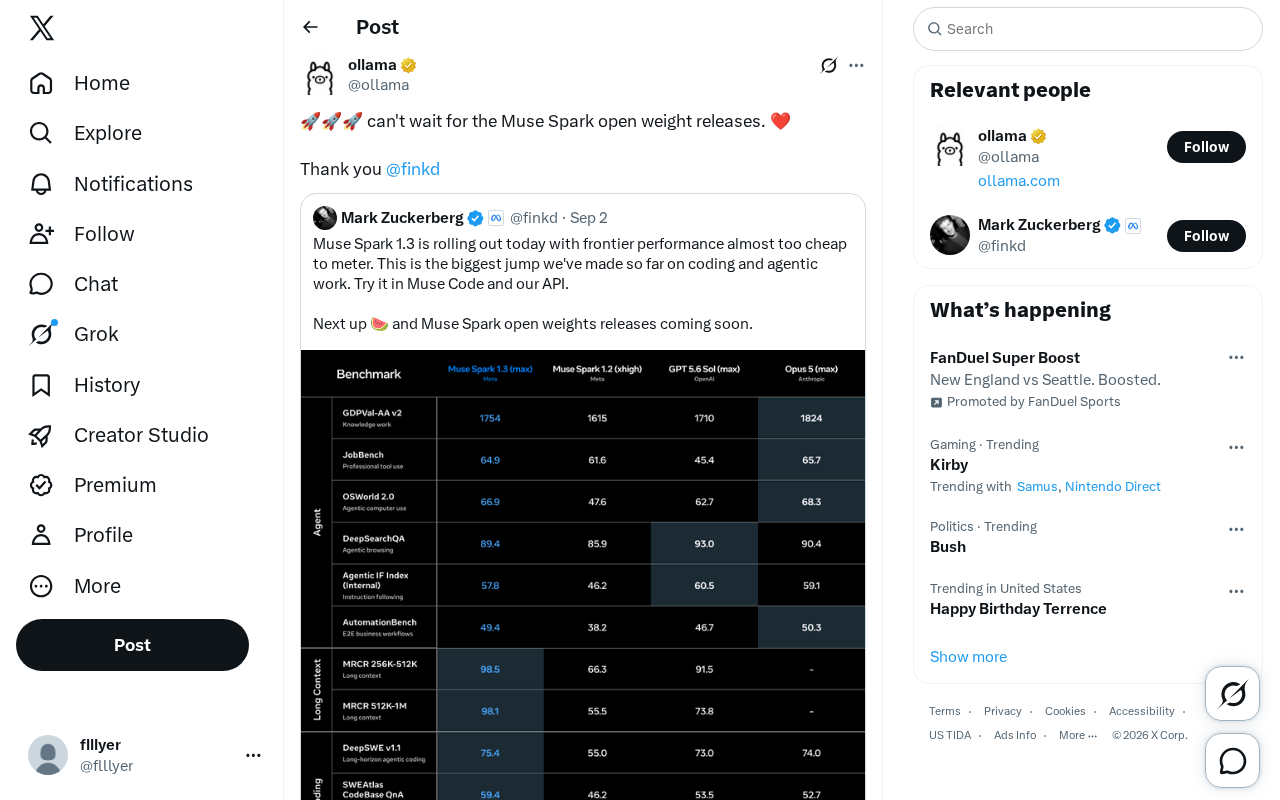
Why the Muse Spark open weight release matters for developers and the AI ecosystem.
A viral tweet expressing excitement for Muse Spark's open weight release highlights a major AI industry trend. This article explores what open weights mean, how Meta's open strategy with Llama has reshaped the ecosystem, and why lightweight open models offer developers deployment autonomy, cost savings, and customization. It also examines the ongoing open vs. closed source debate and its implications for AI's future.
The Industry Anticipation Behind a Single Tweet
Recently, a short tweet caught the AI community's attention: "🚀🚀🚀 can't wait for the Muse Spark open weight releases. ❤️ Thank you @finkd". The author expressed strong excitement for the upcoming Muse Spark open weight release, with a special thanks to Meta founder Mark Zuckerberg (@finkd is Zuckerberg's username on social media).
This tweet reflects a major trend in today's AI landscape — the value of open weight models is being highly recognized by the developer community. This article explores the significance of open weight models, the positioning of the Muse series, and why developers are so eager for releases like this.
What Are Open Weights?
The Fundamental Difference Between Open Weights and Open Source Code
Open weights refer to the publicly released parameter weights obtained after model training, available for developers to download, deploy, fine-tune, and build upon.
To understand what "weights" mean, we need to revisit the fundamentals of neural networks. A deep learning model consists of two components: the architecture (the structural design of the network, such as the number of layers, arrangement of attention mechanisms, etc.) and the weights (the numerical parameters on each neuron connection). The architecture determines "how the model thinks," while the weights carry "what the model has learned." Training a large language model is essentially the process of continuously adjusting billions or even trillions of weight parameters through massive amounts of data. This process requires thousands of high-end GPUs running for weeks or even months, costing anywhere from millions to hundreds of millions of dollars. Therefore, the trained weights represent the culmination of enormous computational investment and data engineering — they are the model's core knowledge carrier.
This differs from traditional open source software:
- Open source code: Publishing the source code logic so anyone can read, modify, and distribute it
- Open weights: Publishing the trained neural network parameters — the knowledge the model has learned
Notably, many open weight projects also release the model architecture code, but don't necessarily publish the training data or training code. This "partial openness" strategy is extremely common in the industry — it allows developers to use the model directly while giving the publisher some room for data compliance and competitive advantage.
For large models, the weights are the true core asset. An open weight model means developers can run powerful AI capabilities locally or in private environments without training from scratch, dramatically lowering the barrier to entry.
The Practical Value of Open Weights for Developers
Open weight models have far-reaching implications for the entire ecosystem. They enable researchers to inspect model behavior, allow enterprises to deploy AI while maintaining data privacy, and give individual developers the opportunity to innovate by standing on the shoulders of giants.
Meta's Llama series is the benchmark case for the open weight approach. From the original LLaMA released in February 2023 to the subsequent Llama 2, Llama 3, and Llama 4, Meta has progressively relaxed its licensing terms — from initially research-only use to allowing commercial use (free for businesses with fewer than 700 million monthly active users). This series of releases profoundly changed the industry landscape — before Llama, high-performance large models were almost entirely controlled by a handful of closed-source vendors; Llama's emergence spawned thousands of derivative models and fine-tuned versions.
Critical infrastructure also supports this thriving ecosystem. Hugging Face, the world's largest AI model hosting platform, provides standardized distribution channels for open weight models — developers can download and load models with just a few lines of code. Additionally, inference frameworks like vLLM, llama.cpp, and Ollama have made local deployment of open source models unprecedentedly simple. It's this complete toolchain that has taken open weights from "technically feasible" to "accessible to everyone."
This also explains why the tweet specifically thanked Zuckerberg — as the ultimate decision-maker behind Meta's open source strategy, he has driven a tech giant to give back training results worth hundreds of millions of dollars to the community for free.
Muse Spark's Product Positioning
The Advantages of Lightweight Models
Muse Spark's naming conveys a lightweight, flexible product positioning. "Muse" suggests creativity and inspiration, while "Spark" implies a lightweight, easy-to-use model version suited for rapid experimentation and edge deployment scenarios.
In the current large model competition, parameter count isn't the only metric that matters. More and more developers are focused on efficiency and accessibility — a model that runs smoothly on consumer-grade hardware with open weights may offer far more practical value than a closed ultra-large-scale model.
Behind this "small but powerful" trend is the maturation of a series of model compression and efficiency optimization techniques. Quantization is one of the most representative: it compresses model weights from 32-bit or 16-bit floating point numbers down to 8-bit, 4-bit, or even lower precision, dramatically reducing memory usage and computation while preserving model performance as much as possible. For example, a model that originally required 32GB of VRAM might need only 8GB after 4-bit quantization, enabling it to run on a single consumer-grade GPU. Knowledge Distillation is another key technique, where a small "student model" learns from the output behavior of a large "teacher model," reproducing comparable capabilities at a much smaller parameter scale. Additionally, techniques like model pruning and sparsification continue to lower deployment barriers.
"Edge Deployment" refers to running AI models directly on end-user devices — smartphones, laptops, embedded systems, or even IoT sensors — rather than relying on cloud servers. Edge deployment is critical for latency-sensitive applications (such as real-time translation, autonomous driving assistance, and local privacy computing), and these scenarios require precisely the kind of lightweight models with moderate parameter counts and fast inference speeds.
The Deeper Reasons Behind Community Excitement
The three rocket emojis and heart in the tweet fully capture the developer community's enthusiasm. Several layers of reasoning drive this anticipation:
- Complete deployment autonomy: Open weights mean developers have full control, no longer subject to any API provider's pricing changes, terms of service modifications, or sudden service discontinuations
- Business customization capabilities: Models can be fine-tuned on proprietary data to adapt general models for specific domain tasks — whether medical consultations, legal research, or code generation
- Significant cost advantages: Avoiding the high ongoing costs of calling commercial APIs. For high-volume production scenarios, self-deploying open source models can cost as little as one-tenth or even less than API calls over the long term
- Technical transparency: The ability to deeply study internal model mechanisms, conduct interpretability analysis, bias audits, and safety evaluations — particularly important for academic research and industries with strict compliance requirements
The Open Source vs. Closed Source Debate in AI
An Intense Battle Between Two Models
The AI industry is currently in the midst of an intense battle between open and closed approaches. Some companies, represented by OpenAI and Anthropic, lean toward closed-source commercialization, while others, led by Meta, continue to push open weight releases.
These two approaches are driven by fundamentally different business logics. The closed-source camp's core argument is that training frontier models is extraordinarily expensive, and keeping them closed protects intellectual property, ensures safety and control, and builds a sustainable revenue model through API subscriptions. OpenAI's GPT series and Anthropic's Claude series are textbook examples of this strategy — they provide services through API interfaces with pay-per-use pricing. The open source camp's logic is entirely different: Meta views open source as a strategic tool for building an ecosystem moat. By freely releasing high-quality model weights, Meta can cultivate a massive developer community around its technology stack, push industry standards toward its own technology, and undermine competitors' (especially Google's) closed-source advantages. For Meta, the AI model itself isn't a direct revenue product but rather infrastructure supporting its advertising business and metaverse strategy.
Interestingly, even OpenAI's name contains the word "Open," but the company has stopped publishing model weights and technical details since GPT-4. This shift has sparked widespread industry discussion and even caused philosophical rifts among co-founders — Elon Musk's public conflict with OpenAI stemmed precisely from this, leading him to found the competing company xAI.
Policy changes are also profoundly influencing this battle. The EU AI Act was officially passed in 2024, granting open source models certain exemptions: open weight general-purpose AI models can enjoy simplified transparency obligations. This policy signal has been viewed as a significant boon by the open source camp. In the United States, debate continues over whether to restrict open sourcing of highly capable models, with some legislators proposing draft legislation that could impose new restrictions on open weight releases.
The tweet's thanks to Zuckerberg precisely reflects the goodwill that the open source camp has built among developers. The open ecosystem Meta established through the Llama series has cultivated a large base of loyal community supporters.
The Controversies and Value of the Open Model
Open weights are not without controversy. Critics worry that once powerful model weights are made public, they could be misused to generate harmful content, create deepfakes, or bypass safety restrictions for dangerous purposes. Since open weights can be freely modified by anyone, users can remove built-in safety guardrails (so-called "jailbreaking"), making safety control more challenging.
In this debate, alignment is a core concept. It refers to the techniques and methodologies for ensuring AI systems' behavior remains consistent with human intent and values. Current mainstream alignment techniques include Reinforcement Learning from Human Feedback (RLHF), Constitutional AI, and Direct Preference Optimization (DPO), among others. The closed-source camp argues that alignment work needs to be conducted in controlled environments, and once weights are open-sourced, alignment effects can be easily undermined by third parties.
Supporters offer a compelling counter-argument: openness and transparency actually facilitate collective safety research. The open source community can independently conduct Red Teaming — a security assessment method that discovers model vulnerabilities through simulated adversarial attacks. History has repeatedly shown that security vulnerabilities in closed systems are often harder to discover and fix. In fact, many important AI safety research findings (such as systematic analyses of jailbreak attacks on large language models and watermarking techniques for generative AI) were accomplished by independent researchers working with open source models. Furthermore, open source enables tens of thousands of researchers worldwide to simultaneously audit model behavior — the efficiency of this "crowdsourced security audit" far exceeds what any single organization's internal team could achieve.
This debate over the degree of AI openness will continue for a long time. The ultimate answer will likely not be an either/or choice, but rather differentiated openness strategies for models at different capability levels.
The Future of the Open AI Ecosystem
A single short tweet encapsulates today's AI developer community's deep identification with the open source ethos. The upcoming release of Muse Spark's open weights, regardless of its ultimate performance, represents another positive step for the open AI ecosystem.
From a broader perspective, we are witnessing a critical inflection point in the AI industry: open weight models' capabilities are rapidly approaching and, in some tasks, even surpassing closed-source commercial models. Llama 3.1 405B has already matched GPT-4 on multiple benchmarks, and more open source models fine-tuned for specific tasks perform even better in vertical domains. This trend means that the democratization of AI capabilities is no longer just a slogan — it's becoming reality.
For developers, every open weight release means more possibilities are unlocked. We have every reason to share the tweet author's excitement about the coming future of open AI.
Note: Due to limited information in the original source, this article's analysis of Muse Spark's specific technical parameters is based on industry conventions and naming inferences. Please refer to official announcements for actual release details.
Related articles
Autonomy Pivots to Gas-Powered Cars: A Survival Play for the Car Subscription Model
Autonomy pivots from EV to gas-car subscriptions. This article analyzes the heavy-asset challenges, EV residual value risks, and lessons for mobility innovation.
Abolish Copyright? Core Arguments and Reflections in the Intellectual Property Debate
Should copyright be abolished? This article analyzes core arguments for and against, covering excessive protection terms, AI training data disputes, open-source movements, and possible IP reform.
Cymphony Raises $25M Series A Led by Sequoia: AI Agent Enterprise Security Challenges and Opportunities
Sequoia leads Cymphony's $25M Series A for AI agent security, valued over $100M. Exploring enterprise AI agent security challenges, permission management, and emerging market opportunities.