Musk Claims Tesla Will Sell 5 Million Cars a Year by 2030—The Math Says Impossible
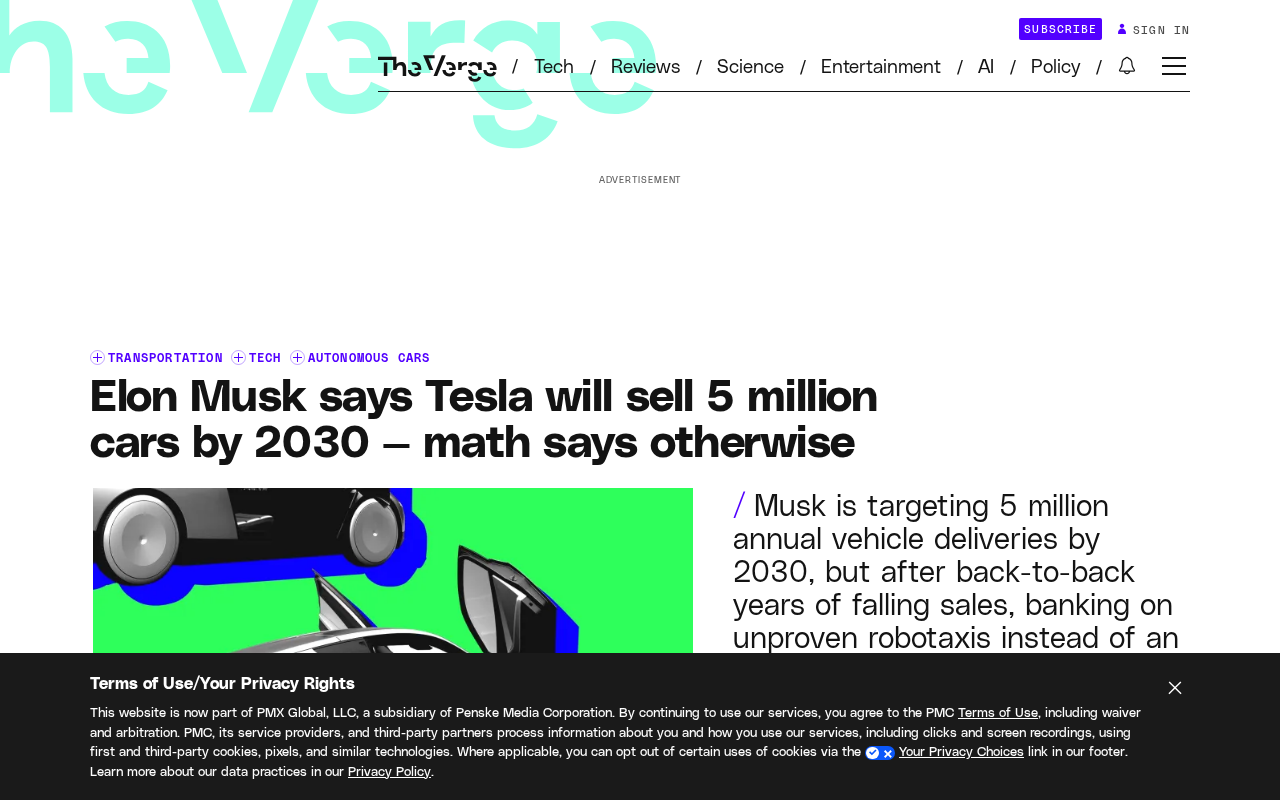
Musk says Tesla will sell 5 million vehicles a year by 2030, but slowing growth and a narrow product line make the goal hard to achieve.
The article questions Musk's prediction that Tesla will sell 5 million vehicles annually by 2030. Using Toyota and Volkswagen as references, it notes Tesla would need to grow from about 1.31 million to 5 million in 8 years, requiring a CAGR above 18%. It argues the goal is unrealistic due to slowing growth, first-quarter 2024's first YoY decline since 2020, overreliance on Model 3/Y, delays in an affordable model, and intensifying global competition.
At Tesla's recent earnings call, Elon Musk once again made a signature bold prediction: by 2030, Tesla's annual deliveries will reach 5 million vehicles. He confidently stated: "Our goal is to reach 5 million cars a year around 2030, and I think we have a good chance of achieving that."
However, between a beautiful vision and harsh reality, there is often cold, hard math. This article will analyze from multiple angles why this goal looks so far out of reach.
1. What Does 5 Million Vehicles Mean?
Annual sales of 5 million vehicles is an extremely large number. For comparison, in 2022, global auto sales leader Toyota Group sold about 10.5 million vehicles, and Volkswagen Group about 8.3 million. That means Tesla would need to reach half the scale of traditional auto giants in less than a decade.
A more intuitive comparison: Tesla's global deliveries in 2022 were about 1.31 million vehicles. To achieve the 5 million target, the compound annual growth rate over the 8 years from 2022 to 2030 would need to remain above about 18%. Although Tesla once experienced rapid growth in its early years, maintaining such a growth rate becomes extremely difficult as the base expands.
Compound Annual Growth Rate (CAGR) is the geometric mean used to measure average annual growth over a period. The formula is ((Ending Value/Beginning Value)^{1/Number of Years}-1). The article's statement that "growing from 1.31 million to 5 million over 8 years requires a CAGR of about 18%" means ((500/131)^{1/8}-1 \approx 18.2%). The significance of CAGR is that it smooths out annual fluctuations and reflects long-term trends; but it is sensitive to the base—the same absolute increase can push up the growth rate when the base is small, while the growth rate is diluted as the base becomes larger. Therefore, for an automaker moving from the million level to the five-million level, maintaining a high CAGR is far more difficult than in the startup phase.
2. The Growth Curve Is Slowing
Tesla's growth story is not linear. In recent years, its delivery growth rate has clearly slowed. In 2023, although Tesla still grew, the pace fell short of Wall Street expectations. Entering 2024, the situation worsened further—first-quarter deliveries even saw their first year-over-year decline since 2020.
According to multiple foreign media reports, Tesla faces weak demand and intensifying competition in major global markets. In China, the strong rise of local brands such as BYD continues to erode Tesla's share; in Europe, consumers' distaste for Musk's political stance and aging models have affected sales; in the United States, high loan rates and inflationary pressure have dampened willingness to spend.
Math doesn't lie: if Tesla's annual sales continue to hover between 1.8 million and 2 million vehicles, then reaching 5 million by 2030 would require adding nearly 40% in sales each year, which is almost fantasy.
Year-over-year (YoY) and quarter-over-quarter (QoQ) are two basic ways to interpret delivery data. YoY compares with the same quarter last year and can remove seasonality in auto sales (such as year-end pushes and early-year slow seasons); QoQ compares with the previous quarter and is more sensitive to short-term changes. The article's statement that "first-quarter 2024 deliveries saw their first YoY decline since 2020" emphasizes a trend inflection point rather than a single-quarter fluctuation. To assess whether Tesla is on track for 5 million vehicles, one should look at whether YoY growth remains stable within the required range for multiple consecutive quarters, rather than the absolute value of a single quarter.
3. Product Line Bottleneck
Currently, Tesla's sales mainly depend on two models: Model 3 and Model Y. These two vehicles contribute more than 95% of deliveries. Although the Cybertruck has been delivered, it belongs to the niche pickup market and is expensive, making it difficult to become a volume model.
Musk has repeatedly promised to launch a $25,000 affordable model, but the project has progressed slowly and was even rumored at one point to have been shelved. Without an affordable model, it will be difficult for Tesla to open up the mass market, and the 5 million target precisely requires support from the mass market.
Volume model refers to a mainstay product aimed at the mass market that spreads costs through scale and has a relatively affordable unit price; it is usually the automaker's sales base. The auto industry is highly dependent on economies of scale: fixed costs such as R&D, tooling, and production lines are enormous, and only annual sales of hundreds of thousands of vehicles or more can effectively dilute per-vehicle costs. Tesla has long relied on two volume models, Model 3/Y, while the full-size pickup segment where the Cybertruck sits is a niche market with high unit prices and low sales. Without a truly affordable volume model, the sales ceiling will be locked in by the product structure itself, and this is also the biggest structural obstacle to the 5 million target.
4. The Competitive Environment Is Not What It Used to Be
Unlike a few years ago when Tesla stood alone, today's global EV market is flourishing with many players. Traditional automakers such as Volkswagen, GM, and Ford have rolled out competitive electric models; Chinese brands such as BYD, NIO, and XPeng are advancing in both domestic and overseas markets; even tech giants like Apple once ventured into carmaking (though they ultimately gave up).
Tesla's brand halo is fading, and its product iteration speed lags behind competitors. Against such a backdrop, maintaining or even increasing market share will be difficult, to say the least.
5. Musk's Track Record of Predictions
Looking back at history, this is not the first time Musk has made bold predictions. He has repeatedly promised timelines for achieving full self-driving, but none were fulfilled; he also predicted that Tesla would achieve 500,000 deliveries in 2020, and it was only barely achieved in the end.
According to analyses by Bilibili uploaders and YouTube channels, Musk's predictions often carry a strong marketing flavor, aimed at boosting the stock price and fan enthusiasm rather than being based on rigorous business planning. Therefore, regarding the 5 million target, outsiders are generally skeptical.
Conclusion
Musk's vision may deserve respect, but the laws of mathematics cannot be defied. Under the multiple pressures of slowing demand, intensifying competition, and a narrow product line, the probability of Tesla achieving annual sales of 5 million by 2030 is extremely slim. Unless there is a revolutionary technological breakthrough or business model innovation, this can only be a beautiful fantasy.
For investors and consumers, it is more important to focus on Tesla's actual execution and market performance rather than believing distant grand claims.
One-line Summary
Musk says Tesla will sell 5 million vehicles a year by 2030, but slowing growth and a narrow product line make the goal hard to achieve.
Paragraph Summary
The article questions Musk's prediction that Tesla will sell 5 million vehicles annually by 2030. The author first uses Toyota's and Volkswagen's global sales as references, pointing out that Tesla would need to grow from about 1.31 million vehicles to 5 million within 8 years, requiring a CAGR of more than 18%. It then argues from three angles that the goal is unrealistic: the growth curve has clearly slowed, with first-quarter 2024 deliveries posting their first YoY decline since 2020; the product line relies excessively on Model 3/Y, and an affordable model has yet to materialize, making it hard to support the mass market; global competition is intensifying, with traditional automakers and Chinese brands continuing to erode share. Coupled with Musk's repeated past prediction misses, the article concludes that unless a revolutionary breakthrough occurs, the goal is little more than fantasy.
Related articles

OpenAI Partners with Shield: How the Astra Agent Revolutionizes IT Troubleshooting
OpenAI and Shield launch the Astra agent, which autonomously logs into computers and legacy systems to fix IT issues in real time, 35-40% faster than traditional models, with humans involved only when judgment is needed.

iPhone Duo Battery Life Tested: One Charge a Day Is Unavoidable, and the Large Screen Is the Culprit
iPhone Duo battery test: heavy use needs at least one charge a day, and about 30% remains after 6.5 hours of screen-on time. How often the large screen is unfolded is key; a MagSafe battery pack helps, and long-term degradation is also worth watching.

Kimi K3.1 Pro Open-Sourced: 2.8 Trillion Parameters Close In on Opus
Moonshot releases the open-source MoE model Kimi K3.1 Pro, with 2.8T total parameters and 104B activated, trailing Opus 5.5 by under 1 point on Terminal Bench 4.0.