Musk Promises to Give SpaceX Shares to Every Child in the U.S.

Musk plans to give one SpaceX share to each of 72 million U.S. children, worth about $10.5 billion, but feasibility is in doubt.
Musk announced a plan to give one SpaceX share to each of about 72 million U.S. children starting next year, estimated at roughly $1,450 per share for a total value of about $10.5 billion. Because SpaceX shares are not publicly traded, cashing out requires an IPO or the secondary market, so short-term cash flow pressure is limited—but the children would become indirect shareholders and create governance variables at a future IPO. The plan faces practical obstacles including identity verification, transfer restrictions, gift tax, and reporting of children's assets, and it is unclear whether it has board approval. Whether or not it happens, the statement reflects Musk's confidence in SpaceX's long-term value and is a highly personal-style PR move.
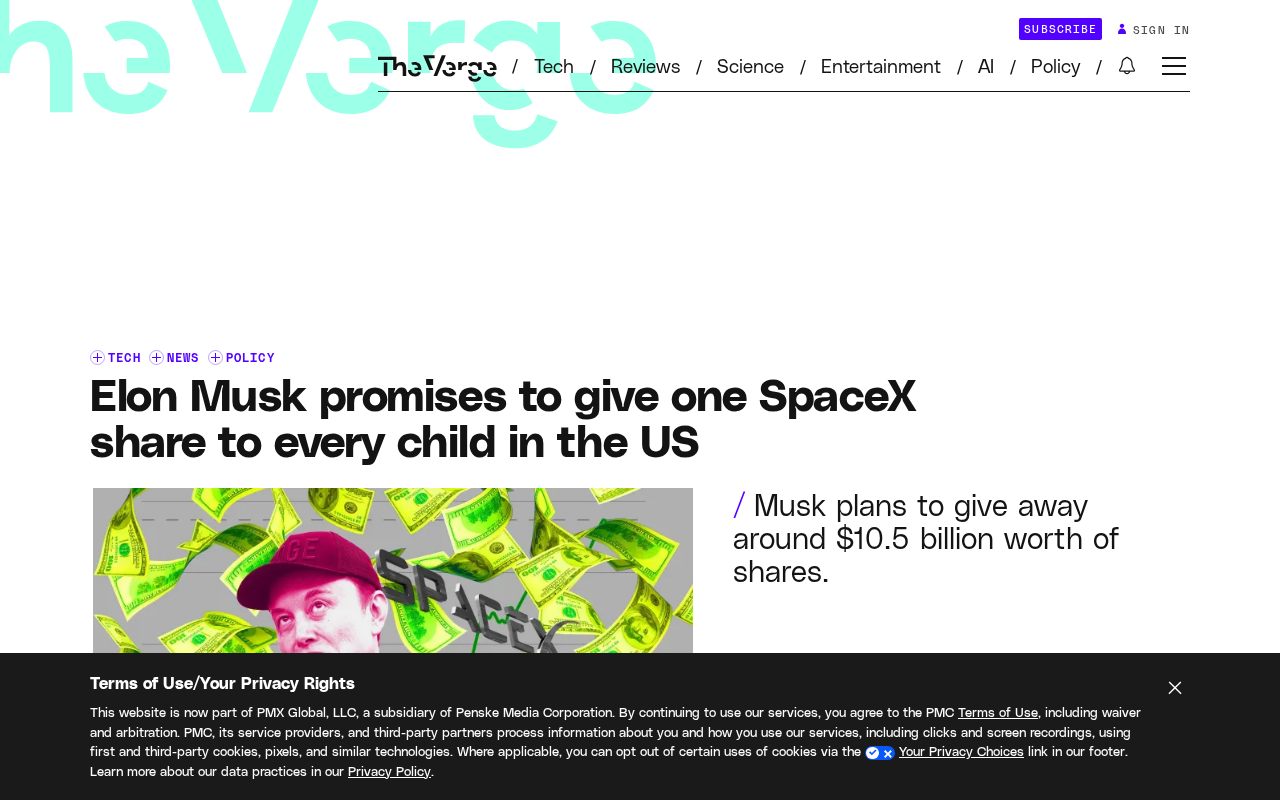
Elon Musk has thrown out another eye-catching plan: starting next year, give one share of SpaceX stock to every child in the United States. According to CNBC, as of July 2025 there are roughly 72 million children in the U.S., which means Musk would be handing out stock worth about $10.5 billion.
Plan details and scale
Musk, who also runs SpaceX and Tesla, did not disclose how the plan would actually be carried out—for example, how eligible children would be defined, how the shares would be held in custody, or whether there would be a lock-up period. But on quantity alone, 72 million shares (assuming one share per child) is no small matter for SpaceX's equity structure.
SpaceX is currently one of the highest-valued private companies in the world, and its internal share price has climbed steadily in recent years. Working backward from the $10.5 billion total, each share would be worth about $1,450. That figure roughly matches SpaceX's valuation level in the private market.
Why stock instead of cash
Handing out cash directly would require enormous liquidity, whereas giving away stock is different. SpaceX shares do not currently trade on public markets; employees and early investors typically cash out through secondary markets or company buybacks. Giving shares to children effectively turns those kids into indirect shareholders of SpaceX.
This arrangement has several potential implications. First, cashing out requires waiting until the company goes public or is acquired, so in the short term it would not pressure SpaceX's cash flow. Second, if SpaceX IPOs in the future, this group of child shareholders would automatically become public-market investors, introducing new variables at the corporate governance level. Third, tax treatment would be extremely complicated—gift tax, reporting obligations for assets held in children's names, and so on would all need supporting arrangements.
Gift tax is a federal tax in the U.S. levied on gratuitous transfers of property, with the tax obligation falling on the donor (not the recipient). In 2025 the individual annual exclusion is about $19,000 per recipient; amounts above that must be reported and draw down the lifetime exemption (about $13.99 million in 2025). If Musk really gave one share to each of 72 million children, even at $1,450 per share, that would far exceed the annual exclusion, requiring him to tap his personal lifetime exemption or even pay gift tax.
Reporting obligations for assets in children's names are equally hard to ignore. U.S. rules require that investment income in a minor's name above a certain threshold (about $1,350 in 2025) be reported separately, which may trigger the "Kiddie Tax," taxed at the parents' marginal rate. In addition, shares registered in a child's name usually require setting up a UTMA/UGMA custodial account or a trust, managed by a guardian until the child comes of age, further adding administrative complexity.
Feasibility in doubt
The biggest uncertainty lies in execution. There are 72 million children in the U.S., spread across all states, involving a huge amount of administrative work such as guardianship, trusts, and identity verification. Even if processed in bulk through brokerages or fintech platforms, the costs would not be low.
Another issue is that SpaceX shares are not freely tradable securities; transfers are typically restricted by the company's charter and shareholder agreements. Whether Musk's personal holdings can be given away on such a large scale to non-employees and non-investors needs legal confirmation.
CNBC's report also did not say whether the plan has been approved by SpaceX's board. Musk has announced grand plans on social media many times in the past; some ultimately came to fruition, while others remained talk. Whether this one can be delivered depends on whether a concrete execution framework is announced later.
Restrictions on transfers of private company equity are the core legal obstacle at the execution level. As a Delaware-incorporated private company, SpaceX's charter and shareholder agreements typically include right of first refusal (ROFR) and transfer-consent provisions: before a shareholder transfers shares to an outside party, the company or other shareholders have the right to buy on the same terms, and transfers often require board approval. If Musk's personal holdings were given away on a large scale to children who are neither employees nor investors, these restrictive provisions could be triggered.
In addition, the registration and custody of private company shares lack the mature brokerage infrastructure that supports publicly traded securities. Registering 72 million dispersed child shareholders one by one would involve a huge amount of KYC (Know Your Customer) and identity verification work, with extremely high costs and compliance risks. This is also why similar arrangements usually hold shares in bulk through trusts or special purpose vehicles (SPVs) rather than registering them directly in individuals' names.
More symbolic than financial
Regardless of how execution ultimately goes, the statement sends two signals. First, Musk has extremely strong confidence in SpaceX's long-term value—being willing to give away stock rather than cash means he believes these shares will be worth more in the future. Second, this is a highly personal-style PR move that draws public attention to SpaceX while also crafting a narrative of "shareholders for all."
For ordinary families, the real value of one SpaceX share depends on whether it can be cashed out in the future. With no timetable for an IPO, this "gift" is more like a long-term option.
One-line Summary
Musk plans to give one SpaceX share to each of the 72 million children in the U.S., worth about $10.5 billion in total, but feasibility is in doubt.
Paragraph Summary
Musk announced a plan to give one SpaceX share to each of the roughly 72 million children in the U.S. starting next year, estimated at about $1,450 per share for a total value of roughly $10.5 billion. Because SpaceX shares are not publicly traded, cashing out requires waiting for an IPO or the secondary market, so in the short term it would not pressure the company's cash flow—but it would make these children indirect shareholders and create governance variables at a future IPO. The plan faces practical obstacles such as identity verification, share transfer restrictions, gift tax, and reporting of children's assets, and it is unclear whether it has board approval. Whether or not it happens, the statement conveys Musk's confidence in SpaceX's long-term value and is also a highly personal-style PR move.
Related articles

OpenAI Partners with Shield: How the Astra Agent Revolutionizes IT Troubleshooting
OpenAI and Shield launch the Astra agent, which autonomously logs into computers and legacy systems to fix IT issues in real time, 35-40% faster than traditional models, with humans involved only when judgment is needed.

iPhone Duo Battery Life Tested: One Charge a Day Is Unavoidable, and the Large Screen Is the Culprit
iPhone Duo battery test: heavy use needs at least one charge a day, and about 30% remains after 6.5 hours of screen-on time. How often the large screen is unfolded is key; a MagSafe battery pack helps, and long-term degradation is also worth watching.

Kimi K3.1 Pro Open-Sourced: 2.8 Trillion Parameters Close In on Opus
Moonshot releases the open-source MoE model Kimi K3.1 Pro, with 2.8T total parameters and 104B activated, trailing Opus 5.5 by under 1 point on Terminal Bench 4.0.