Musk's Space Dominance: How Starlink Throttling Undermines Ukraine's Defense

Starshield throttling disabled Ukrainian drone interceptors, exposing the war risks of private control over space communications.
SpaceX's Starshield service throttled the Ukrainian military last week, blocking high-speed mobile terminals from the network and directly reducing Ukraine's ability to intercept Russian drones, making energy infrastructure more vulnerable. The incident exposes the fragility of commercial satellite services in conflict: Musk as a private individual holds ultimate control over LEO communications, and his decisions can shape battlefield dynamics. With over 5,000 Starlink satellites in orbit, the de facto monopoly leaves Ukraine with few short-term alternatives. The article notes the lack of international regulation for militarized commercial satellites and the blurred power boundaries of tech giants as non-state actors.
SpaceX's Starlink has once again sparked controversy over its role on the battlefield in Ukraine. Last week, the Starshield service used by the Ukrainian military was throttled, preventing high-speed mobile terminals from accessing the network and directly affecting the Ukrainian military's ability to intercept Russian drones. This incident not only exposes the vulnerability of commercial satellite services in military conflicts but also thrusts Elon Musk's private control over low Earth orbit communications into the spotlight.
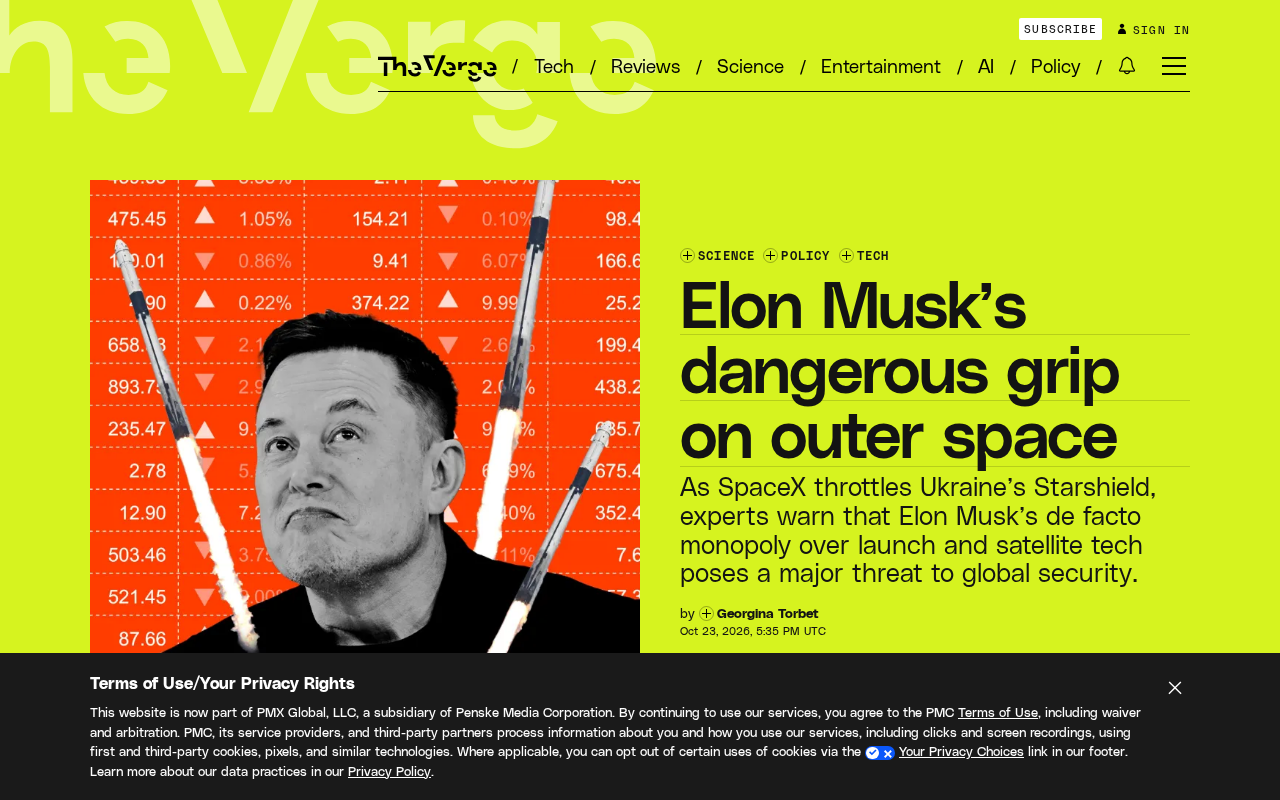
Incident Review: How Throttling Affected the Battlefield
According to the original report, Starshield is the military version of SpaceX's Starlink, designed specifically to provide communications support to the Ukrainian military. Last week, the service was throttled, specifically by blocking terminals moving above a certain speed threshold from accessing the network. This change directly caused Ukrainian interceptor drones—used to shoot down Russian drones carrying bombs—to suddenly fail when moving at high speed. With interceptors out of action, Russia can more easily attack Ukraine's energy infrastructure, worsening the local humanitarian crisis.
The technical details of the throttling have not been fully disclosed, but it can be inferred that SpaceX may have limited terminal usage through geofencing or speed thresholds. Such restrictions may originally have been intended to prevent abuse of the service or use beyond the scope of commercial licensing, but in wartime they produced unintended military consequences.
Starshield is a separate business line officially announced by SpaceX in late 2022, distinct from the consumer-facing Starlink and positioned to provide end-to-end services to government and military customers. It relies on Starlink's satellite platform and laser inter-satellite links but can carry customer-customized payloads, such as Earth observation sensors, anti-jamming communications modules, or encryption devices, and allows government customers exclusive access to specific frequency bands and ground gateways. Starshield contract models typically involve agencies such as the U.S. Department of Defense and the National Reconnaissance Office, with service terms, coverage areas, and usage restrictions agreed upon by both parties rather than the generic "civilian" declarations in Starlink consumer terms. For this reason, the Ukrainian military uses Starshield rather than ordinary Starlink terminals, and its throttling mechanism may come from contract-level speed thresholds or geofencing configurations rather than a mere technical failure. This distinction is crucial to understanding where responsibility lies: Starshield's operational decision space is more constrained by contracts than civilian Starlink, but SpaceX still retains actual control over network parameters.
The Militarization Dilemma of Commercial Space
Starlink's involvement in the Ukraine conflict is hardly news. From initially providing emergency communications support to later being used for command and control, SpaceX's services have become part of the Ukrainian military's operational system. However, this model of relying on a commercial company to provide critical military infrastructure inherently carries enormous risks.
As SpaceX's CEO, Musk holds ultimate control over Starlink services. He has stated on social media that Starlink is "for civilian use only," but the Ukrainian military clearly uses it for military purposes. This blurred boundary allows Musk to influence battlefield dynamics through technical means at critical moments—whether out of commercial considerations, political stance, or personal judgment.
This throttling incident is not an isolated case. Previously, Musk refused to activate Starlink service near Crimea to prevent Ukrainian attacks on Russia's Black Sea Fleet. These decisions have sparked ethical and legal discussions about how a private individual can influence the course of international conflicts.
Low Earth orbit (LEO) communications satellites typically operate at altitudes between 300 and 2,000 kilometers, offering significant advantages over geostationary orbit (about 35,786 kilometers): signal round-trip latency drops from about 600 milliseconds to 20–50 milliseconds, making them suitable for time-sensitive missions such as real-time command and control and drone video transmission; a single satellite covers a small area, but a large-scale constellation can achieve continuous global coverage. Both Starlink and Starshield are deployed in this altitude band, and Starlink currently has more than 5,000 satellites in orbit, accounting for the majority of active communications satellites worldwide. Frequency and orbital slot resources in LEO are coordinated and allocated by the International Telecommunication Union (ITU), but ITU rules mainly target national administrations and lack direct constraints on the militarized repurposing of commercial constellations. This means operators like SpaceX can rapidly change service coverage and performance parameters through software configuration under existing frequency licenses without going through traditional diplomatic or arms control procedures. This ability to "software-define coverage" is precisely the technical basis that enables private companies to influence battlefield dynamics without changing hardware.
The Monopoly Risk of Space Infrastructure
Starlink currently has more than 5,000 satellites in orbit, occupying the vast majority of low Earth orbit communications satellites. This de facto monopoly makes it difficult for any country or organization to bypass SpaceX when using satellite internet. For Ukraine, finding an alternative in the short term is almost impossible—other satellite communications systems either have insufficient coverage or limited bandwidth.
More broadly, Musk's control over space communications raises concerns about space resource governance. The international community has not yet established effective mechanisms to regulate the military use of commercial satellite constellations, while companies like SpaceX can make decisions affecting war and peace without transparency.
Geopolitics and the Power Boundaries of Tech Giants
This incident once again highlights the role of tech giants in geopolitics. Musk is not only an entrepreneur but also a non-state actor capable of influencing national security. His decisions may be based on commercial interests, personal ideology, or even improvised judgments about the international situation, yet the consequences of these decisions are borne by soldiers and civilians on the battlefield.
Ukraine's dependence on Starlink also reflects a new feature of modern warfare: the deep coupling of communications infrastructure and weapons systems. When communications are cut or throttled, the effectiveness of weapons systems drops sharply. This provides a warning for future conflicts: diversification of critical infrastructure is essential.
Non-state actors in international relations theory originally referred to entities such as multinational corporations, non-governmental organizations, and armed groups that are not national governments. Traditionally, communications infrastructure has been regarded as within the domain of national sovereignty, operated by state-owned telecom operators or strictly regulated private enterprises, with clear legal procedures for wartime requisition and control. The rise of commercial satellite constellations has changed this landscape: a private company can simultaneously provide communications services to the militaries of multiple countries, and its CEO's personal decisions—such as whether to activate service in a specific area—may directly change the course of a conflict. Current international humanitarian law's distinction between "civilian objects" and "military objectives" was mainly designed for state actors, and the characterization of commercial companies' voluntary or forced involvement in military communications remains unclear. The Starlink case shows that when ownership and control of critical infrastructure are concentrated in private individuals, the traditional chain of sovereign accountability breaks down, and the international community lacks mechanisms for mandatory disclosure, prior consultation, or wartime neutrality review.
Conclusion: Who Will Constrain Private Power in Space?
The Starlink throttling incident is a microcosm that reveals an urgent problem in the era of commercial space: when private companies control infrastructure capable of influencing the course of war, who ensures the transparency and accountability of their decisions? At present, the answer is not clear. The international community needs to accelerate the establishment of a regulatory framework for commercial satellite services while promoting the diversification of critical communications technologies to avoid tying national security to one person.
For Ukraine, the immediate lesson is painful. For the rest of the world, it may be an early warning bell.
One-line Summary
Starshield throttling disabled Ukrainian drone interceptors, exposing the war risks of private control over space communications.
Paragraph Summary
SpaceX's Starshield service last week throttled the Ukrainian military, preventing high-speed mobile terminals from accessing the network and directly reducing the Ukrainian military's ability to intercept Russian drones, making it easier for Russia to attack energy infrastructure. The incident exposes the vulnerability of commercial satellite services in military conflicts: Musk, as a private individual, holds ultimate control over low Earth orbit communications, and his decisions can influence battlefield dynamics based on commercial, political, or personal judgment. With more than 5,000 Starlink satellites in orbit, the de facto monopoly makes it difficult for Ukraine to find alternatives in the short term. The article points out that the militarized use of commercial satellites lacks an international regulatory framework, the power boundaries of tech giants as non-state actors are blurred, and diversification of critical communications infrastructure is essential.
Related articles

OpenAI Partners with Shield: How the Astra Agent Revolutionizes IT Troubleshooting
OpenAI and Shield launch the Astra agent, which autonomously logs into computers and legacy systems to fix IT issues in real time, 35-40% faster than traditional models, with humans involved only when judgment is needed.

iPhone Duo Battery Life Tested: One Charge a Day Is Unavoidable, and the Large Screen Is the Culprit
iPhone Duo battery test: heavy use needs at least one charge a day, and about 30% remains after 6.5 hours of screen-on time. How often the large screen is unfolded is key; a MagSafe battery pack helps, and long-term degradation is also worth watching.

Kimi K3.1 Pro Open-Sourced: 2.8 Trillion Parameters Close In on Opus
Moonshot releases the open-source MoE model Kimi K3.1 Pro, with 2.8T total parameters and 104B activated, trailing Opus 5.5 by under 1 point on Terminal Bench 4.0.