Musk vs. Ambani: The Commercial Battle Behind Starlink's Blocked Entry Into India

Musk vs. Ambani: the real fight behind Starlink's India delays is over spectrum rules and market access.
SpaceX's Starlink has been unable to enter the Indian market, and Musk has publicly pointed the finger at billionaire Mukesh Ambani and his Reliance Jio. The dispute centers on satellite spectrum allocation: Starlink wants administrative assignment to lower entry barriers, while domestic operators push for auctions to protect their incumbency. With over a billion people and vast rural connectivity gaps, India is one of the most valuable potential markets for LEO satellite internet. The Indian government must balance opening competition to bridge the digital divide against protecting domestic industry — a tension that mirrors similar struggles playing out across emerging markets worldwide.
Overview
Elon Musk, founder of Tesla and SpaceX, has publicly accused Indian billionaire Mukesh Ambani of obstructing market competition, pointing to Starlink's prolonged inability to launch its satellite internet service in India. The accusation has further escalated tensions between the two business titans.
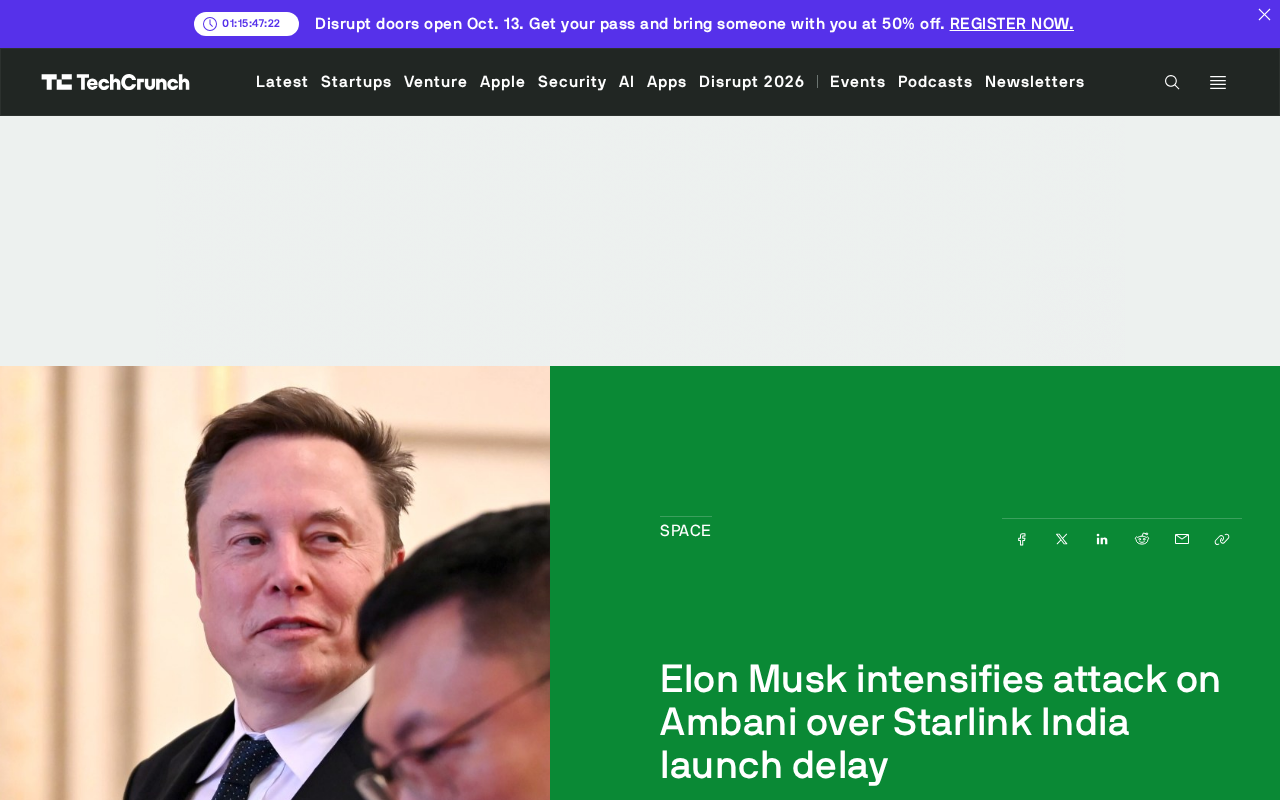
Based on publicly available information, Musk's core grievance centers on access to India's telecommunications and satellite communications market. He argues that entrenched domestic interests are using various means to block outside competitors — and Ambani's Reliance Jio is one of the dominant forces in India's telecom sector.
The Commercial Roots of the Conflict
At its core, this dispute is a battle for market power between global satellite internet players and India's homegrown telecom giants. India's enormous population of over one billion, combined with significant connectivity gaps in rural and remote areas, represents precisely the use case where low-Earth orbit (LEO) satellite internet holds the greatest advantage.
For Starlink, India is an indispensable piece of its global expansion puzzle. For Ambani's Reliance Jio, the entry of satellite internet could directly erode its existing share of India's broadband and mobile communications market. The divergence of interests is stark.
One of the central flashpoints is how satellite spectrum should be allocated. International operators like Starlink advocate for administrative assignment of spectrum, while domestic incumbents prefer an auction-based mechanism — a difference that directly determines who can enter this emerging market faster and at lower cost.
Starlink is SpaceX's LEO satellite internet constellation, currently operating over 6,000 satellites at an orbital altitude of roughly 550 kilometers — far below the 36,000-kilometer orbit of traditional geostationary communications satellites. This enables latency as low as 20–40 milliseconds, theoretically delivering a broadband experience comparable to terrestrial connections. The key advantage of LEO satellite internet is its ability to cover terrain that ground-based cell towers struggle to reach, including mountainous areas, islands, and remote rural communities — a perfect fit for India's 600+ million rural residents. Reliance Jio, founded by Ambani in 2016, quickly became India's largest telecom operator through aggressive subsidy strategies and now serves over 450 million users. Their head-on collision is, in essence, a market competition between two infrastructure paradigms: ground-based mobile networks versus space-based internet.
The Regulatory and Market Access Battle
Gaining market access in India has always been complex, involving regulatory approvals, localization requirements, and data sovereignty considerations. Musk's public statements are, to a significant degree, an attempt to use media pressure to push for regulatory policy concessions.
For an international tech company seeking entry into an emerging market, the stance of dominant local players carries considerable influence. Musk's attribution of the delays to Ambani's "obstruction" reflects both the real resistance Starlink faces and a strategic move to shape the regulatory narrative.
It's worth noting that these accusations currently come primarily from Musk's own public statements. A complete response from Ambani's camp and India's regulatory authorities has yet to materialize. The ultimate outcome on market access will depend on how the Indian government balances supporting domestic industry against allowing external competition.
The debate over satellite spectrum allocation has global relevance. Administrative Assignment means a government regulator directly grants spectrum usage rights based on application criteria — generally more favorable to international operators and carrying a lower barrier to entry. Spectrum Auction requires operators to publicly bid for usage rights, raising the financial bar but typically advantaging incumbents with deep capital and local relationships. India's Telecom Regulatory Authority of India (TRAI) conducted a public consultation on satellite broadband spectrum allocation, with domestic players like Reliance Jio explicitly backing the auction approach, while Starlink and Amazon's Kuiper advocated for administrative assignment. The Indian government ultimately leaned toward administrative assignment, though policy implementation remains uncertain. This choice will directly determine whether international satellite operators can enter the market at an acceptable cost.
Implications for India's Digital Economy
Regardless of how the dispute unfolds, the pace at which India opens its satellite internet market will have far-reaching implications for the country's digital economy. If Starlink succeeds in entering India, network coverage in remote areas could improve significantly — a meaningful step toward bridging the digital divide.
At the same time, domestic enterprises have legitimate reasons for seeking market protection, touching on deeper issues of national communications infrastructure security, employment, and industrial sovereignty. India has consistently maintained a cautious stance on market access for foreign tech companies in similar situations.
This public clash between Musk and Ambani is, in essence, a microcosm of the tension between globally scaled tech services and domestic industry protectionism. Its ultimate resolution may serve as a reference point for how other emerging markets handle satellite internet access.
Conclusion
Starlink's delayed entry into India is, on the surface, a war of words between two billionaires. At a deeper level, it is a multifaceted contest over spectrum policy, market access, and industrial interests. As LEO satellite internet technology matures, clashes like this — between global players and local giants — will only become more frequent. India, as one of the world's largest emerging markets, is a policy landscape well worth watching closely.
Related articles

Should U.S. College Fraternities Be Banned? A Researcher's Incisive Observations
Why not just ban U.S. college fraternities? A researcher finds the key resistance comes from decision-makers' own fraternity identities and schools' "willful ignorance."

Microsoft Discovery: Accelerating Scientific Discovery with AI Agents
Microsoft's Discovery platform runs specialized AI agents to help researchers screen and prioritize the most promising compounds and experimental paths, reducing experiments and accelerating scientific discovery.

Cambridge Heavy Industries Secretly Develops Desktop-Scale Nuclear Fusion Device
Cambridge Heavy Industries is secretly developing a desktop-scale laser-driven nuclear fusion device, targeting the equipment supply market for fusion power plants. This article analyzes its miniaturization technology path, commercialization logic, and unique positioning in the fusion startup wave.