N8N Automation Course in Practice: Building AI Workflows with Zero Code

An N8N course shows a zero-code AI automation path: low-code balance, 30 practical workflows, and job prospects.
This article documents an online course on the N8N automation platform. Instructor Venky uses everyday examples like washing machines and ATMs to explain that automation is about letting machines handle repetitive work, and compares coded vs no-code automation: both produce the same output, but no-code has a lower learning cost. N8N uniquely supports both low-code and no-code, open-source cloud and local installation, and 30 days of practical projects such as HR resume screening, scheduled Slack notifications, and WhatsApp/Telegram chatbots, along with job market data and learning advice.
N8N Automation Course in Practice: Building AI Workflows with Zero Code
AI automation is changing how companies handle repetitive tasks. In a recent online course about the N8N automation platform, instructor Venky presented a complete learning path for mastering N8N from scratch in 30 days. Venky has over five years of IT experience and has worked with Python, Django, and AWS. He currently works as an automation and AI engineer. Using a large number of examples, he explained what automation really means and where N8N fits uniquely into that picture.
What Is Automation? Insights from Washing Machines to ATMs
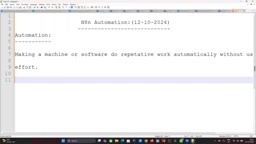
Instead of starting with technical concepts, Venky opened with everyday scenarios. He noted that the previous generation spent half a day doing laundry, while a washing machine reduces that to 15 minutes with no manual intervention. Likewise, ATMs turned withdrawing money from a two-hour bank queue into a matter of minutes. The core logic is simple: letting machines or software automatically complete repetitive, boring, everyday work is automation.
This logic holds in enterprise settings as well. Venky gave the example of customer support ticket escalation: in the past, after a customer submitted an issue, support staff had to manually determine whether the ticket should go to development, networking, or QA, and then forward it by hand. Now, AI can directly perform analysis, classification, and routing, eliminating the need for manual triage.
N8N's Positioning: Balancing Low-Code and No-Code
When a student asked about the differences between N8N and tools like UiPath, Zapier, and Make, Venky pointed out that these all belong to the no-code automation platform category, but N8N is special because it supports both low-code and no-code modes.
This means several usage patterns are possible: people with no programming background can build workflows by dragging and dropping nodes; people with a programming background can embed Python or JavaScript code inside N8N to handle complex logic, such as when an app has no ready-made API, they can write code to extract data and pass it to the next node. N8N officially supports two programming languages—Python and JavaScript.
Venky particularly emphasized that N8N is open source. Developers can modify the source code according to their needs and republish it. This explains why N8N supports both cloud installation and local Docker or NPM installation, each with its own pros and cons. The course would cover installation options specifically on the second day.
Low-code and no-code are two concepts that are often used interchangeably, and the main difference lies in “whether code is required.” No-code platforms (such as Zapier and Make) provide fully visual configuration interfaces, where users complete workflow setup through drop-down menus, conditional logic, and connectors. These are suitable for business users who need to launch simple tasks quickly. Low-code platforms, on top of visualization, retain a code entry point. When encountering logic that built-in nodes cannot cover (such as custom data cleaning or calling non-standard APIs), users can insert scripts or functions. N8N is a typical low-code platform: its nodes themselves are visual, but each node allows Python or JavaScript inside. This design lets the same tool serve both complete beginners and developers with an engineering background, avoiding the dilemma of “simple needs are overkill, complex needs are impossible.”
Coded Automation vs. No-Code Automation: Same Output, Different Paths
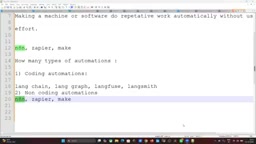
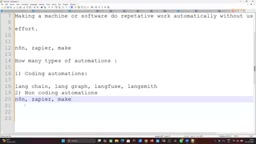
Venky divided automation into two major categories. Coded automation requires writing Python or Java, or using frameworks such as LangChain, LangGraph, and LangFuse. No-code automation is done through visual interfaces on platforms such as N8N, Zapier, and Make.
The key insight is: the final output of both is the same. The same requirement—automatically sending a confirmation email after a customer places an order—can be implemented with a Python script, or by dragging a few nodes in N8N. The difference lies in the learning cost: the coding route may take 6 months to a year before someone can get started, while the no-code route allows people without a programming foundation to produce results in a shorter time. Venky's position was clear: if you are interested in coding, you can learn the LangChain stack; if your time is limited or you do not want to touch code, tools like N8N are entirely sufficient.
The LangChain, LangGraph, and LangFuse mentioned in the article are three common types of frameworks for building AI applications today. Understanding them helps clarify the division of labor between the coding route and the N8N route. LangChain mainly addresses “how to connect large models with external data and tools,” providing abstractions such as prompt templates, chained calls, and tool calling. LangGraph is a framework in the LangChain ecosystem for building stateful, multi-step agent workflows, suitable for complex scenarios requiring loops, branching, and human intervention. LangFuse focuses more on observability, used to record and evaluate the inputs and outputs, latency, and cost of large model calls. These frameworks are powerful but require programming ability, whereas N8N partially encapsulates these capabilities into visual components through built-in nodes and API integrations, lowering the barrier to use. The tradeoff is that highly customized scenarios may still require returning to code.
Practical Project Preview: From HR Resume Screening to Multi-Platform Chatbots
The course showcased several projects to be completed within 30 days. The most eye-catching was automated HR resume screening: suppose a company receives 10,000 resumes, and HR cannot possibly read all of them in one day. With N8N, resumes can be uploaded to Google Drive, and N8N automatically detects new files every few minutes, extracts keywords, and matches them against the job description. The entire process can be built in 20 to 30 minutes.
Another core scenario is chatbot development. Traditional methods require mastering frameworks such as LangChain, but in N8N it can be built through built-in nodes and API integrations. Venky also mentioned Slack automation—managers need to remind the team to update progress at a fixed time every day, and through N8N's Slack node, messages can be automatically posted on schedule without manual intervention. Automation for WhatsApp and Telegram is also covered in the course.
The key technologies behind the automated resume screening workflow are keyword extraction and text matching. N8N itself does not directly “understand” resumes. It usually calls a large model node or a natural language processing API to convert the resume PDF/Word into text, then extracts structured fields such as skills, years of experience, and education, and finally performs similarity or rule-based matching against the requirements in the job description (JD). There are two common approaches: one is to use a large model to directly output “whether it matches, the reason for the match, and a score”; the other is to use embedding vectors to calculate the semantic similarity between the resume and the JD. The former is more interpretable and faster to build, while the latter is better suited for large-volume, low-cost initial screening. It should be noted that automated screening may still be affected by resume formatting, language, and model bias, so in actual implementation, a manual review step is usually retained.
Job Market and Learning Advice
During the course, Venky checked recruitment data for N8N-related positions in real time: about 5,000 jobs globally on LinkedIn, about 300 on Indeed, and about 356 in India on Glassdoor. Roles include automation engineer, N8N developer, AI engineer, and similar directions. He also mentioned that freelance and remote work opportunities exist as well.
As for the course itself, it covers one complete workflow each day for 30 days, and students can add these projects to their resumes. Venky frankly stated that he does not promise job guarantees, but he would create a WhatsApp group to share recruitment information. The course provides recorded videos, notes, and learning materials, with each lesson lasting about one hour. For students with long career gaps, his advice is to improve competitiveness by combining skills such as Python.
N8N's installation method directly affects the user experience and cost. Cloud hosting is ready to use out of the box, requires no server maintenance, and is suitable for rapid validation and small teams, but data passes through a third-party environment and pricing is based on execution counts or plans. Local Docker installation runs N8N on your own server or computer, giving you full control over data. It is suitable for privacy-sensitive businesses or those needing long-term operation, but you must handle upgrades, backups, and network exposure yourself. NPM installation is closer to a development environment and convenient for secondary development and source-code debugging, making it suitable for developers with Node.js experience. When choosing, you can prioritize three questions: can the data go to the cloud, how large is the monthly execution volume, and do you need to modify the source code? For individual learners, local Docker is usually the most cost-effective starting point.
One-line Summary
An N8N course presents a zero-code AI automation path: low-code balance, 30 practical workflows, and job prospects.
Paragraph Summary
This article documents an online course about the N8N automation platform. Instructor Venky began with everyday examples such as washing machines and ATMs to explain that the essence of automation is letting machines complete repetitive work, and compared coded automation with no-code automation: both produce the same output, but the latter has a lower learning cost. N8N's unique positioning is that it supports both low-code and no-code, allowing both node dragging and embedding Python/JavaScript, and it is open source with cloud and local installation options. The course will use 30 days to complete practical projects such as HR resume screening, scheduled Slack notifications, and WhatsApp/Telegram chatbots, and presents recruitment data for N8N-related roles on platforms such as LinkedIn and Indeed, along with advice on improving competitiveness by combining skills such as Python.
Related articles

curl 8.23.0 Fixes 24 CVEs, AI-Assisted Research Contributed 20
curl 8.23.0 fixes 24 CVEs, 20 found by AI-assisted research, including a High-severity HTTP/2 use-after-free that could become RCE. Here's the source, fix details, and upgrade checklist.

Multi-Agent Voice Command Center in Practice: Deconstructing the VAPI + Supabase Architecture
Deconstructing the Load Bearing Empire multi-agent voice command center: VAPI voice pipeline, Supabase Edge Functions for Webhooks, 8 Postgres tables tracking agent state, and Vercel-managed frontend design.

Gemini CLI Shutdown: Real-World Benchmark vs Claude Code — Which Is Faster and Cheaper?
After Gemini CLI shut down for personal accounts in June 2026, SideHub benchmarked Claude Code vs Antigravity CLI on four real coding tasks: correctness tied, but Claude Code was 3.2x cheaper and nearly 12x faster per task.