n8n One-Click Deployment of 30+ AI Tools: A Free Self-Hosted Alternative to Zapier

Deploy a private AI automation platform with 30+ tools including n8n and Ollama in one command
The GitHub open-source project n8n-install bundles the n8n workflow engine, Ollama local LLMs, Flowise+RAG knowledge base Q&A, Supabase backend, and 30+ other tools, enabling one-click deployment via Shell scripts and Docker Compose. It provides developers and enterprises with a free self-hosted alternative to Zapier/Make, offering complete data sovereignty, unlimited executions, and deep customization.
Project Overview: Build a Private AI Automation Platform with a Single Command
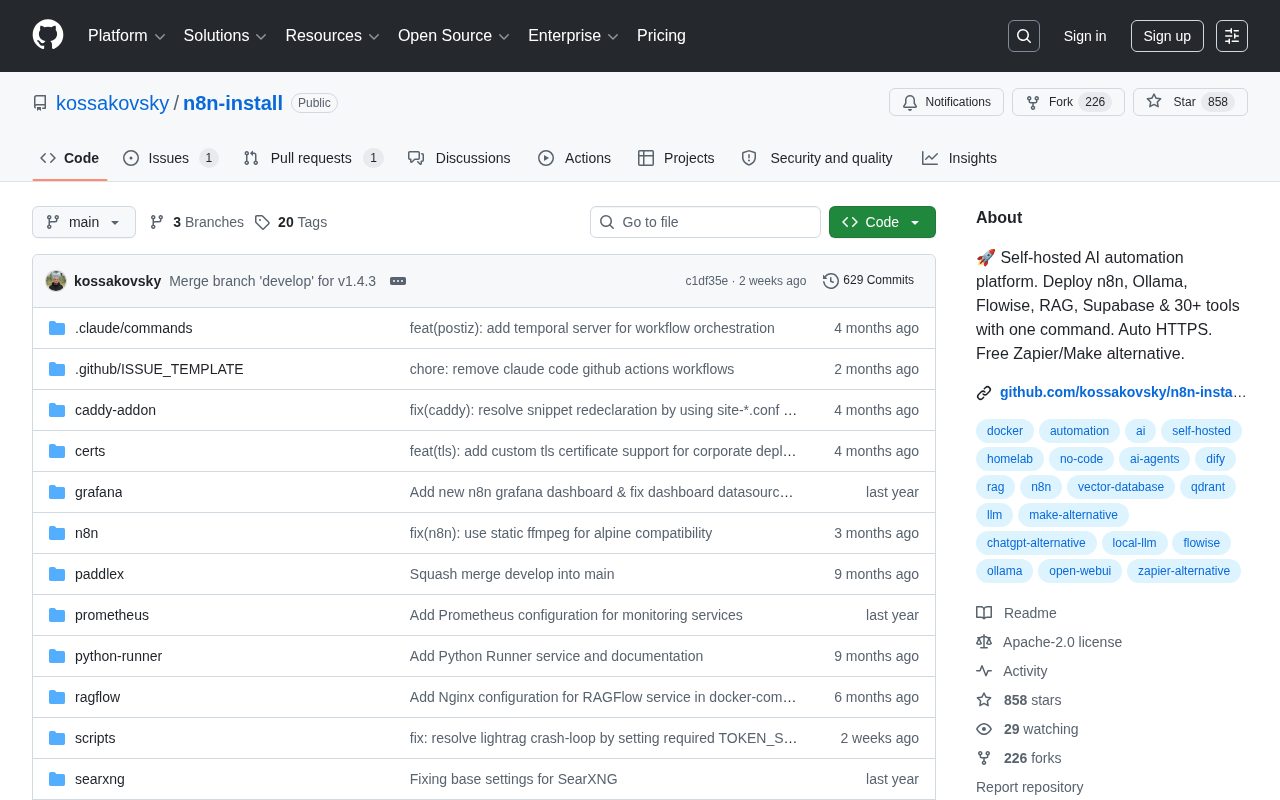
As AI automation tools become increasingly prevalent, quickly setting up your own AI workflow platform has become a pressing need for many developers and businesses. The open-source GitHub project kossakovsky/n8n-install was created precisely for this purpose — it bundles n8n, Ollama, Flowise, RAG, Supabase, and 30+ other tools into a package that can be deployed with a single command, making it a free self-hosted alternative to Zapier and Make.
The project has currently earned 858 Stars and 226 Forks, primarily written in Shell scripts, embodying the engineering philosophy of "simplicity is king."
Core Components and Tech Stack Explained
n8n: Open-Source Workflow Automation Engine
n8n is the core engine of the entire platform. As an open-source workflow automation tool, it supports connecting various APIs and services through a visual interface. n8n (pronounced "nodemation") was born in 2019, created by Jan Oberhauser, and adopts a fair-code licensing model. The core concept of workflow automation is abstracting repetitive business processes into directed acyclic graphs (DAGs) composed of triggers and actions. n8n currently has over 400 built-in integration nodes, covering a wide range of scenarios from CRM, databases, and message notifications to AI model invocations. Its technical architecture is built on Node.js, written in TypeScript, with a Vue.js frontend for the visual orchestration interface.
Compared to SaaS solutions like Zapier, n8n's self-hosted mode delivers three key advantages:
- Complete data sovereignty — data never passes through third-party servers. With data protection regulations like GDPR becoming increasingly strict, having all workflow execution data, credentials, and business logic stored on your own infrastructure offers significant compliance advantages.
- No execution limits — free from commercial pricing constraints
- Deep customization — supports custom nodes and code logic
Ollama: Running Open-Source LLMs Locally
The project integrates Ollama, allowing you to run open-source large models like LLaMA, Mistral, and Gemma on your own server, completely independent of external APIs like OpenAI. Ollama is an open-source framework designed specifically for running large language models locally, wrapping model downloading, quantization, execution, and API serving into a unified command-line tool. Its underlying inference engine is based on llama.cpp, supporting GGUF-format quantized models that can run efficiently on consumer-grade hardware.
Quantization here refers to the technique of compressing model weights from 32-bit floating-point numbers to 4-bit or 8-bit integers, which can reduce memory usage by 4-8x while retaining most inference quality. Ollama provides an OpenAI-compatible REST API interface, meaning existing applications built on the OpenAI API only need to change the endpoint address to seamlessly switch to local models, dramatically reducing migration costs. The Ollama model library currently hosts hundreds of open-source models, including Meta's LLaMA 3, Mistral AI's Mistral/Mixtral, Google's Gemma, and Alibaba's Qwen series.
For data-sensitive scenarios — such as internal document processing or customer data analysis — this local deployment approach is practically a necessity.
Flowise + RAG: Building Private Knowledge Base Q&A Systems
Flowise provides low-code LLM application building capabilities. Combined with the RAG (Retrieval-Augmented Generation) module, users can quickly set up intelligent Q&A systems based on private knowledge bases.
RAG's Technical Mechanism: RAG (Retrieval-Augmented Generation) is an architectural paradigm proposed by Meta AI's research team in 2020, designed to address the knowledge cutoff date limitation and hallucination problems of large language models. Its workflow consists of three phases: First, the indexing phase, where documents are split into semantic chunks, converted into high-dimensional vectors through embedding models, and stored in vector databases (such as Qdrant, Pinecone, Weaviate, etc.). Second, the retrieval phase, where when a user asks a question, the question is similarly vectorized, and approximate nearest neighbor (ANN) algorithms find the most semantically relevant document fragments in vector space. Finally, the generation phase, where the retrieved context and user question are combined into a prompt and sent to a large language model to generate the final answer. This architecture enables AI systems to provide accurate answers based on the latest, domain-specific private data without requiring expensive fine-tuning.
Flowise's Role: Flowise is an open-source low-code platform built on LangChain and LlamaIndex that visualizes the complex LLM application development process into a drag-and-drop node orchestration interface. LangChain is currently the most popular LLM application development framework, abstracting prompt templates, model calls, memory management, and tool usage into composable modular components. Flowise builds on this foundation with a graphical interface, enabling users without programming backgrounds to build AI applications with advanced features like conversation memory, document Q&A, and Agent autonomous decision-making. In this project, Flowise complements n8n — n8n handles business process automation orchestration while Flowise focuses on AI conversation and reasoning chain construction. The two call each other via APIs, together forming a complete intelligent automation system.
From document import and vectorized storage to retrieval-augmented generation, the entire pipeline can be completed end-to-end within this platform.
Supabase: Open-Source Backend Infrastructure
Supabase serves as an open-source alternative to Firebase, providing database, authentication, storage, and other infrastructure support for the entire platform. Founded in 2020, Supabase's core tech stack is built around PostgreSQL. Unlike Firebase's use of NoSQL databases, Supabase chose the relational database PostgreSQL as its foundation, meaning users can use standard SQL for data operations while enjoying PostgreSQL's rich extension ecosystem.
The pgvector extension is particularly critical — it adds vector storage and similarity search capabilities to PostgreSQL, allowing Supabase to simultaneously serve as both a traditional database and a vector database, which is extremely valuable in AI application scenarios. Supabase also integrates GoTrue (identity authentication), PostgREST (auto-generated RESTful APIs), Realtime (WebSocket-based real-time data synchronization), and Storage (object storage) components, providing AI applications with complete backend capabilities including user management, data persistence, file storage, and real-time communication. With it, building complete AI applications no longer requires setting up additional backend services.
Deployment Features: Why It Truly Delivers an Out-of-the-Box Experience
One-Click Deployment, Extremely Low Barrier
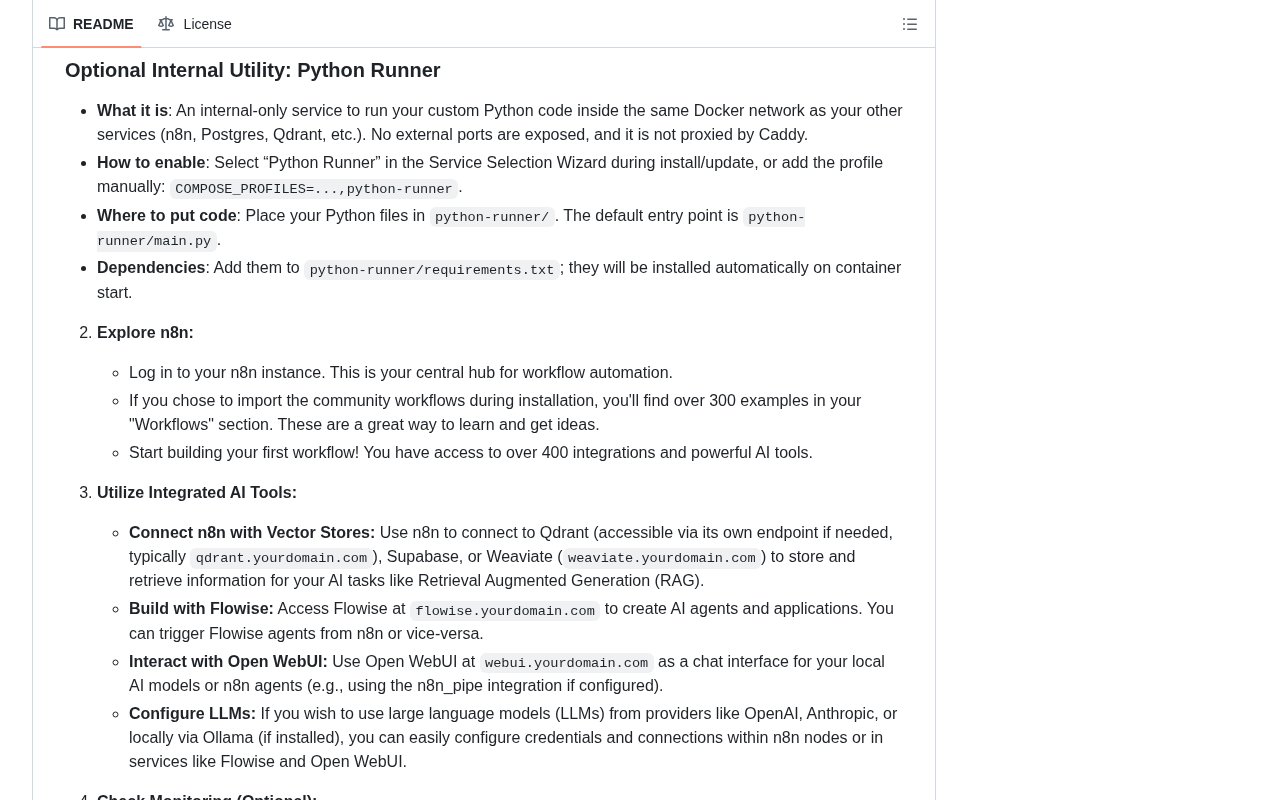
The project's biggest highlight is its extremely low deployment barrier. Through carefully orchestrated Shell scripts and Docker Compose configurations, users only need to execute a single command to spin up the complete tech stack on a VPS or local server.
Docker Compose is Docker's official multi-container orchestration tool that defines service dependencies, network topology, volume mappings, and environment variables through YAML configuration files. This project containerizes 30+ tool components separately, with each service running in an independent Docker container, communicating through an internal network, achieving process-level isolation. The advantage of this microservices architecture is that a single component failure won't crash the entire system, and each component can be independently upgraded or replaced. Shell scripts serve as the "glue" here, responsible for detecting the host environment (operating system, CPU architecture, GPU availability), automatically installing the Docker runtime, generating environment configuration files, and finally calling docker-compose up to start all services, greatly reducing DevOps technical requirements.
Automatic HTTPS Certificate Configuration
The project includes built-in automatic HTTPS certificate request and configuration (based on Let's Encrypt + Nginx/Caddy reverse proxy). Once deployed, you immediately get production-grade secure access, eliminating the hassle of manually configuring SSL certificates. Let's Encrypt is a free certificate authority operated by the Internet Security Research Group (ISRG), implementing automatic certificate issuance and renewal through the ACME protocol, currently providing HTTPS certificates for over 300 million websites. Caddy, as a next-generation web server, natively supports automatic HTTPS, further simplifying the certificate management process.
30+ Tools Forming a Complete Ecosystem
Beyond the core components mentioned above, the project integrates 30+ commonly used tools and services, forming a relatively complete AI automation ecosystem. This "all-in-one" bundling approach saves users significant time that would otherwise be spent on individual configuration and compatibility troubleshooting.
Use Cases: Who Should Use This Solution
This solution is particularly suitable for the following types of users:
Independent Developers and Small Teams: Get equivalent or even stronger automation capabilities without paying the steep subscription fees for tools like Zapier. For reference, Zapier's Professional plan starts at $49/month (annual billing) with 2,000 task executions; the Team plan starts at $69/month, and Enterprise requires custom pricing. Make (formerly Integromat) Core plan is $10.59/month but only supports 10,000 operations. In contrast, a VPS with 16GB RAM (such as Hetzner's CPX31) costs about €15/month and can execute workflows unlimited times. For teams with monthly workflow executions exceeding 5,000, self-hosted solutions typically recoup the initial investment within 3-6 months, with significant long-term economic advantages.
Data-Sensitive Enterprises: All data flows remain within your own servers. Combined with Ollama running LLMs locally, you can achieve complete data isolation to meet compliance requirements.
AI Application Prototyping: From workflow orchestration to LLM invocation, from vector databases to backend services, the all-in-one environment dramatically accelerates prototype validation.
Important Considerations Before Use
Despite the project's excellent design philosophy, there are several points to consider before actual use:
- High server resource requirements: Running LLM components like Ollama has explicit GPU and memory requirements. At least 16GB RAM is recommended, with a dedicated GPU needed for local inference. For example, running a 7B parameter quantized model requires approximately 4-6GB VRAM or memory after 4-bit quantization; a 13B model needs 8-10GB. If using CPU-only inference, response speed drops significantly — a 7B model's generation speed may fall to just a few tokens per second, making real-time interaction impractical.
- Operational costs cannot be ignored: Self-hosting means you must handle system updates, data backups, and troubleshooting yourself, which requires a certain level of operational capability. However, for small teams lacking ops capabilities, the "zero-maintenance" characteristic of SaaS solutions still holds undeniable value — you need to carefully balance cost savings against operational investment.
- Complexity from component coupling: While integrating 30+ tools is convenient, it also increases system complexity. A version upgrade of one component may affect overall stability. A progressive upgrade strategy is recommended for production environments — validate compatibility in a test environment before pushing to production.
Conclusion: The Future Direction of Self-Hosted AI Automation Platforms
The n8n-install project represents a trend worth watching: consolidating scattered AI toolchains into unified self-hosted platforms. It genuinely lowers the barrier to entry for AI automation, enabling more developers and teams to build their own intelligent workflows at minimal cost. As the open-source AI ecosystem continues to flourish — from the model layer (LLaMA, Mistral, etc. iterating continuously) to the infrastructure layer (vector databases and inference engines constantly improving) to the application layer (Agent frameworks maturing steadily) — the value of such one-click deployment solutions will only grow.
If you're looking for an alternative to Zapier or Make, or want to build a private AI automation platform, n8n-install is an option worth serious evaluation.
Related articles
 Tutorials
ChatGPT Plus Subscription Guide: Are GPT-5.5, image-2, and Codex Worth the Upgrade?
A detailed look at ChatGPT Plus features — GPT-5.5, image-2, and Codex — with a Plus vs Pro comparison and a complete step-by-step subscription guide for users outside the US.
 Tutorials
Harness AI Engineering in Practice: Using Claude Code to Master Enterprise-Level E-Commerce Development
Deep dive into Harness AI Engineering: master enterprise e-commerce development with Claude Code using the Rules, Skills, Wiki, and Changes framework.
 Tutorials
Cursor + Codex Dual-IDE Collaboration: A Practical Methodology for Open-Source Project Customization
A complete methodology for open-source project customization based on real-world experience, detailing the Cursor+Codex dual-IDE workflow, seven-stage process, MVP validation, and AI source code reading techniques.