n8n Open-Sources Personal AI Agent nod: It Has Its Own Computer, Can Chase Invoices and Cancel Trials
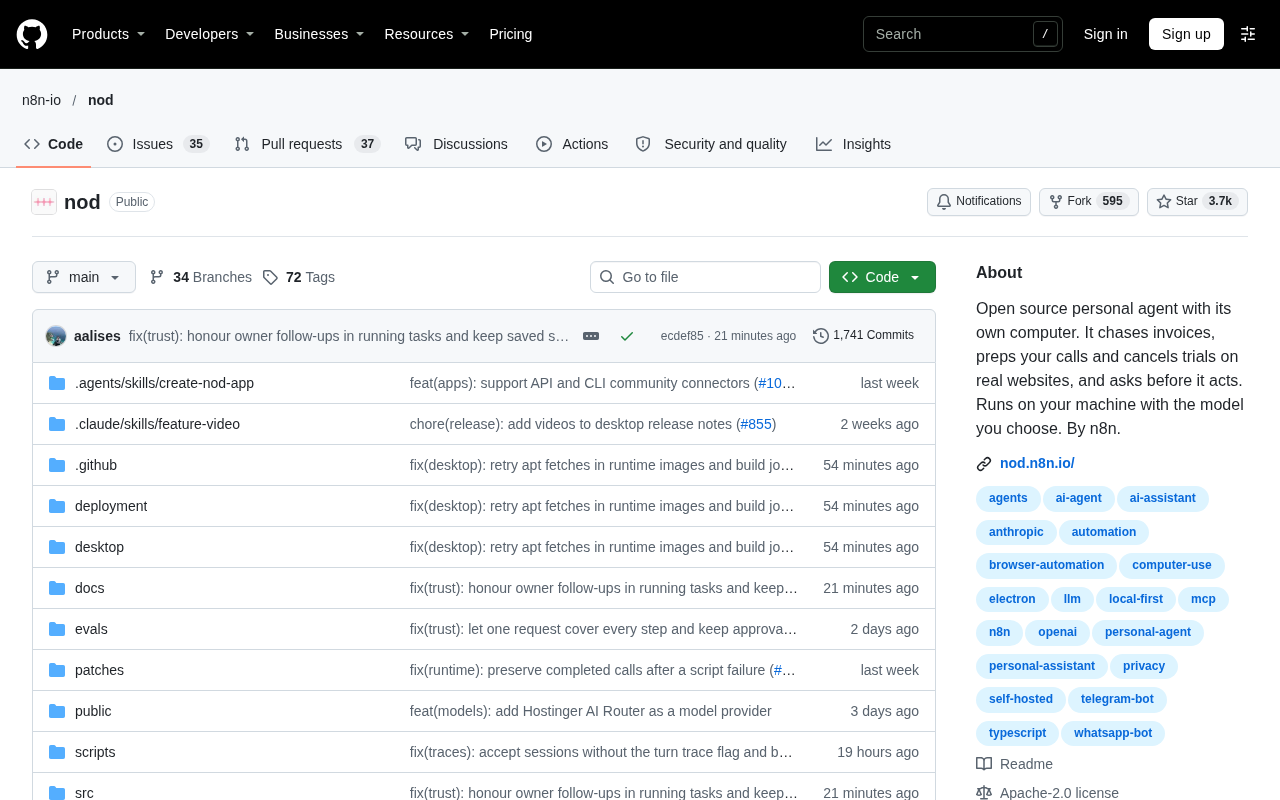
n8n's open-source personal AI agent nod has a virtual computer that can execute operations on real websites, runs locally, and asks before acting.
The n8n team has open-sourced a personal AI agent project called nod, which surpassed a thousand GitHub stars within a week of launch. Unlike chat-based assistants, nod has a virtual computer and can execute operations on real websites such as chasing invoices, preparing call materials, and canceling trial subscriptions, and it asks for user consent before acting. It runs on the user's local machine, supports model selection, and emphasizes data sovereignty. GitHub data shows 3,724 stars, 593 forks, and 1,008 stars added in one week; the project is still early-stage. The article analyzes its "takes action" positioning, local-first architecture, and "asks before it acts" safety design, and identifies three groups who should pay attention: individuals with repetitive web operation needs, privacy-sensitive users, and developers and automation enthusiasts.
The n8n team has open-sourced a personal AI agent project called nod, which gained over a thousand stars on GitHub within a week of launch. Its fundamental difference from most "chat-based assistants" on the market is that nod has its own virtual computer and can execute actions on real websites—chasing down invoices, preparing call materials, canceling subscription trials—and it asks for your consent before taking action.

An agent that "takes action," not just an assistant that "talks"
Most AI assistants stop at the chat window: you ask, it answers, and you still have to complete the remaining steps yourself. nod's design approach is different—it hands browser and operating system capabilities directly to the agent, letting it click, fill in forms, and submit on real web pages.
The three typical scenarios described in the project description illustrate this well: chasing invoices, preparing materials for calls, and canceling trial subscriptions on real websites. What these three things have in common is that they all require logging in, navigating, and operating forms—the "dirty work" that traditional chatbots cannot complete independently. nod delegates these processes to the agent, turning the user from an operator into a reviewer.
This positioning brings it closer to a "digital employee" than an "intelligent Q&A." According to the GitHub project page, nod is developed by the n8n team and written in TypeScript.
Virtual computer and browser automation
The original text mentions that nod has "its own virtual computer," which typically means the agent runs in an isolated virtualized environment (such as a virtual machine or container) pre-installed with a browser, operating system tools, and automation frameworks. The agent controls the browser through programmatic interfaces (such as Playwright, Puppeteer, etc.), simulating real user actions like clicking, typing, and navigation. Unlike traditional API integrations, this approach can handle websites without open APIs and can cope with complex scenarios like login states and CAPTCHAs. The virtual computer also provides a security boundary: the agent's operations are confined to the sandbox and do not directly affect the user's main system.
Local execution + model of your choice: keeping control in the user's hands
nod emphasizes two forms of "autonomy" in its architecture: autonomy over where it runs and autonomy over model selection.
The agent runs on your own machine, not in some cloud service. The model is also specified by you, not tied to a specific vendor. This is especially critical for handling sensitive matters like invoices, accounts, and subscriptions—data doesn't have to leave the local environment, and the model invocation strategy remains in the user's hands.
This choice is consistent with n8n's consistent product philosophy: putting automation capabilities in users' hands rather than locking them in a black box. For teams concerned about data sovereignty and compliance, a local-first agent architecture is a prerequisite for adoption.
Local-first architecture and data sovereignty
"Local execution" means the agent's core processes, task data, and browser sessions all remain on the user's own machine, with only necessary model inference requests sent to the user's chosen model provider (which could also be a locally deployed open-source model). This architecture contrasts with cloud agents: cloud agents require uploading account credentials and web content to third-party servers, creating data leakage and compliance risks. Local-first also brings auditability—users can inspect the operation logs of every step the agent takes. For enterprise users, this helps meet data protection regulations like GDPR and avoids the risk of tools becoming unavailable due to a service provider shutting down.
"Asks before it acts": the key design for agent safety
Letting AI operate on real websites on behalf of humans—everyone can see the risks: misclicks, accidental deletions, and unauthorized authorizations can all cause real losses. nod's response to this is "asks before it acts"—it asks before executing.
This means the agent is not a fully automated pipeline but a semi-automated system with human confirmation steps. It can plan and advance tasks, but on key actions it returns decision-making authority to the user. From a product design perspective, this is a pragmatic trade-off for agent tools at the current stage: it leverages the efficiency of automation while retaining human veto power over irreversible operations.
By contrast, when a fully unattended agent runs on real websites, the cost of a single wrong click may far exceed the time saved. nod's confirmation mechanism is a direct response to this risk.
Human confirmation steps and irreversible operations
"Asks before it acts" is a human-in-the-loop mechanism. After planning an action sequence, the agent pauses before executing key steps (such as submitting forms, confirming payments, or deleting data) to show the user the upcoming operation and request approval. This is different from a simple permission popup: the agent needs to understand which operations are irreversible or high-risk and proactively identify them. Current technical implementations typically combine rule engines (such as flagging sensitive operations on specific domains or buttons) with model judgment. This design reduces the tail risk of fully autonomous agents but also poses challenges for interaction design—too frequent confirmation requests undermine the value of automation, so how to balance efficiency and safety is a key indicator of product maturity.
Community traction and project status
Judging from GitHub data, nod's initial attention is considerable: 3,724 stars, 593 forks, with 1,008 stars added in one week. Such growth rates typically appear in projects that solve real pain points and are backed by teams with an established reputation—n8n's user base in the workflow automation space has clearly brought initial traffic to nod.
It's worth noting that the project is still at an early stage. The open-source agent space itself is still rapidly evolving, and capability boundaries, stability, and security models will continue to change. For developers who want to try it out, the value of participating now lies in influencing the project's direction; for ordinary users, it may still be worth waiting to see how mature it becomes.
The n8n ecosystem and the open-source agent space
n8n is an open-source workflow automation platform that allows users to connect various applications and services through visual nodes. nod being developed by the n8n team means it can potentially reuse n8n's integration ecosystem and user base. The open-source agent space currently includes projects like AutoGPT, BabyAGI, and OpenHands, but most focus on code generation or general task planning, while nod explicitly focuses on the niche scenario of "executing operations on real websites." The TypeScript tech stack lowers the barrier for web developers to participate and facilitates integration with existing Node.js toolchains. Early-stage star growth often reflects community recognition of a project's direction, but actual usability still needs time to verify.
Who should pay attention to nod
Three groups of people are worth noting this project.
The first is individual users who already have a large number of repetitive web operations, such as those who frequently handle invoices and subscription management—nod's "proxy operation" model can directly reduce their burden. The second is users who are sensitive about data privacy and don't want to hand account operations to cloud agents—local execution + model of your choice hits the mark. The third is developers and automation enthusiasts—the TypeScript tech stack and n8n ecosystem mean a lower barrier for secondary development.
nod represents a product direction that is taking shape: agents no longer just answer questions but have their own computer, run errands for you in the real world, and leave the final decision to you.
One-line Summary
n8n's open-source personal AI agent nod has a virtual computer that can execute operations on real websites, runs locally, and asks before acting.
Paragraph Summary
The n8n team has open-sourced a personal AI agent project called nod, which surpassed a thousand GitHub stars within a week of launch. Unlike chat-based assistants, nod has a virtual computer and can execute operations on real websites such as chasing invoices, preparing call materials, and canceling trial subscriptions, and it asks for user consent before acting. It runs on the user's local machine, supports model selection, and emphasizes data sovereignty. GitHub data shows 3,724 stars, 593 forks, and 1,008 stars added in one week; the project is still early-stage. The article analyzes its "takes action" positioning, local-first architecture, and "asks before it acts" safety design, and identifies three groups who should pay attention: individuals with repetitive web operation needs, privacy-sensitive users, and developers and automation enthusiasts.
Related articles

Nothing CMF Buds 2A Drops to $17.89 on Black Friday: A New Low for ANC Earbuds
Nothing CMF Buds 2A wireless earbuds Black Friday deal: just $17.89 on Amazon, about $11 off retail and a record low. ANC earbuds at an entry-level price.

When AI Creation Gets Accused of "Spitting": Hacker News Heats Up Over the Glaude Controversy
A Hacker News post, "Spitting in the Face of Glaude," sparks debate on AI creation transparency and attribution ethics. This analysis examines the blurred creator identity behind the controversy and offers practical advice for AI content production.

Akai Embraces Custom Firmware: MPC Sample 1.4 Lets Users AI-Program Their Sampler
Akai embraces the modding community with MPC Sample 1.4 firmware, supporting vibe-coded custom firmware and effects. We analyze the impact of this open strategy on music hardware and AI-assisted programming.