NarrowSpec: Speculative Decoding Speeds Up Without Matching the Target Model's Hidden Width

NarrowSpec shows draft model residual streams can be cut to half or a quarter of the target width with acceptance rate largely preserved and end-to-end speedups delivered.
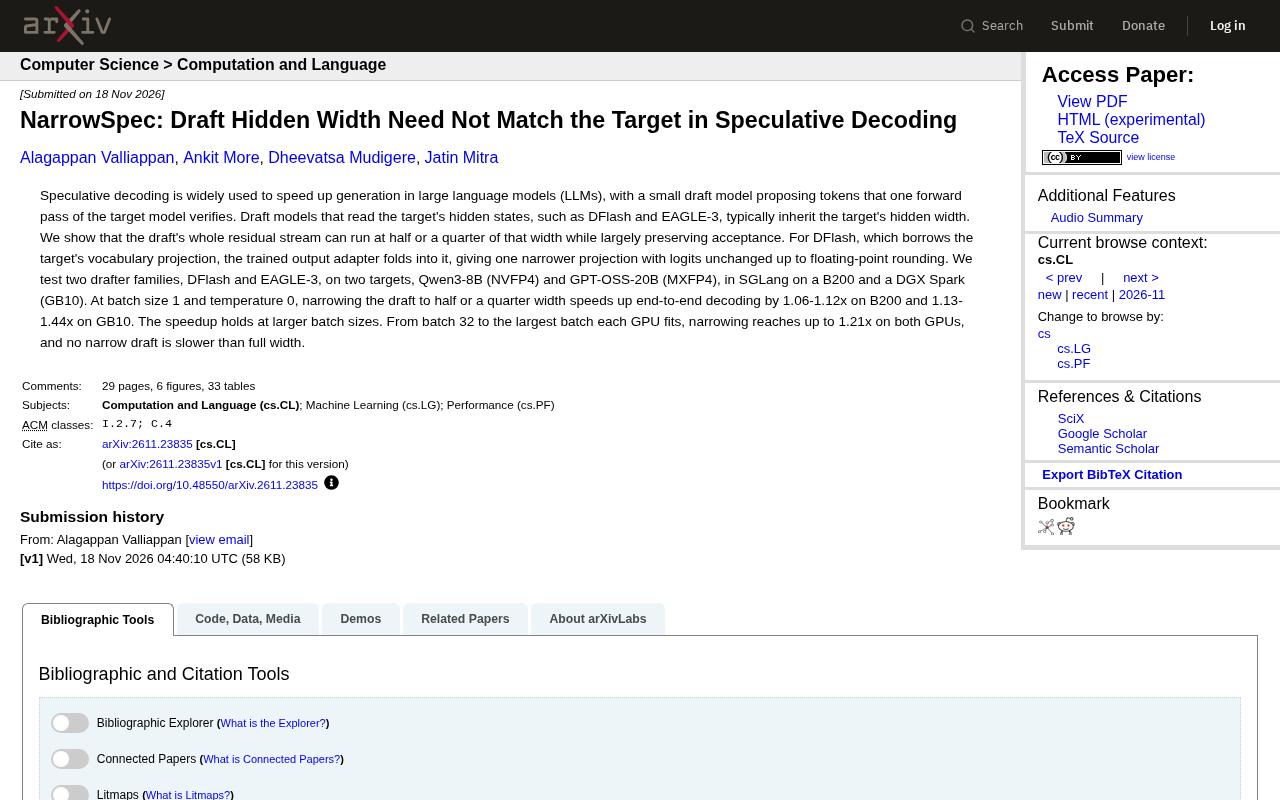
NarrowSpec challenges the default constraint in speculative decoding that draft models reading target hidden states (DFlash, EAGLE-3) must inherit the target's hidden width. Research shows the draft's entire residual stream can run at half or a quarter of the target width with acceptance rate essentially unchanged. Validated on DFlash and EAGLE-3 with Qwen3-8B (NVFP4) and GPT-OSS-20B (MXFP4) in SGLang on B200 and GB10, it delivers 1.06–1.12× speedup on B200 and 1.13–1.44× on GB10 at batch size 1, up to 1.21× at larger batches, with no regression.
Speculative Decoding has become a mainstream approach for accelerating large language model (LLM) generation: a small draft model first proposes several tokens, which are then verified by the target model in a single forward pass. But a long-assumed design constraint is that draft models reading the target model's hidden states (such as DFlash and EAGLE-3) typically must inherit the target's hidden width. NarrowSpec challenges this assumption: the draft model's entire residual stream can run at half or even a quarter of the target's hidden width, with essentially no impact on acceptance rate.
Why draft width has always followed the target
Draft models like DFlash and EAGLE-3 are not fully independent small models; they read the target model's hidden states as conditioning input to improve proposal hit rates. The hidden states come from the target model's residual stream, whose width is determined by the target architecture. To align with these states, the most straightforward approach is to set the draft model's own residual stream width equal to the target's.
This inheritance relationship is simple and reliable in engineering, but it carries a hidden cost: although the draft model has few parameters, its per-token forward computation is not determined solely by parameter count — the residual stream width directly affects the scale of matrix multiplications. The larger the width, the higher the overhead of the draft stage itself, partially offsetting the theoretical gains of speculative decoding.
NarrowSpec's observation is that this width matching is not necessary. What the draft model really needs is a sufficiently good conditioning signal, not a dimension-by-dimension aligned hidden representation. Compressing the draft's residual stream as a whole still preserves most of the useful information.
Residual stream is the main information channel running through every layer in the Transformer architecture: each layer's output is added back to this uniformly wide vector, and hidden states are read from this channel. Its width is the model's hidden size, fixed by the target model architecture — for example, Qwen3-8B and GPT-OSS-20B each have their own hidden dimension. If a draft model uses the target's hidden states as conditioning input, the most direct alignment method is to set its own residual stream width to the same value, because then the conditioning vector and the draft's internal representation can be added or concatenated dimension by dimension without additional down/up-projection mappings. This also explains why DFlash and EAGLE-3 have long followed width inheritance: it is the most convenient implementation path and the least likely to introduce information loss.
NVFP4 and MXFP4 are two low-precision floating-point quantization formats for inference, both storing weights or activations in 4 bits, with the main difference being the granularity and sharing method of scaling factors: NVFP4 uses smaller blocks with fine-grained scaling, while MXFP4 follows the block scaling specification in the open standard. Both aim to significantly reduce memory footprint and memory bandwidth requirements, enabling large models to run on a single card or edge devices. Note that quantization changes the numerical distribution and precision of the target model's hidden states, so whether the draft model can still maintain acceptance rate on quantized targets is one of the key checkpoints for whether NarrowSpec's conclusions can be deployed in practice — this work validates the effectiveness of narrow drafts on exactly these two quantized targets.
Half or quarter width, acceptance rate essentially unchanged
The research team tested two draft model families: DFlash and EAGLE-3, each validated on two target models — Qwen3-8B (NVFP4 quantized) and GPT-OSS-20B (MXFP4 quantized) — running in SGLang, with hardware including B200 and DGX Spark (GB10).
The key result: reducing the draft width to half or a quarter of the target largely preserves the acceptance rate. This means the quality of draft proposals does not suffer a cliff-like drop, and the additional overhead of the verification stage remains controllable.
For DFlash there is an additional structural benefit. DFlash borrows the target model's vocabulary projection, and NarrowSpec folds the trained output adapter into this projection, ultimately producing a narrower projection with logits unchanged within floating-point rounding error. In other words, output-side computation is also compressed, not just the intermediate residual stream.
Acceptance rate refers to the proportion of tokens proposed by the draft model that are verified by the target model and can be directly accepted. It is the core lever of speculative decoding gains: the higher the acceptance rate, the more tokens each target model forward pass can confirm, and the greater the equivalent speedup; if the acceptance rate drops significantly, failed verification requires rollback and recomputation, and the draft stage's overhead becomes a net burden. Therefore, evaluating whether a narrow draft is viable cannot rely solely on whether the draft itself is faster — it must also confirm that the acceptance rate does not suffer a cliff-like drop. NarrowSpec's key evidence is precisely this: after halving or even quartering the width, the acceptance rate is largely preserved, indicating that the conditioning signal required by the draft does not depend on a fully dimension-aligned hidden representation.
Vocabulary projection (LM head) is the matrix that maps the model's last-layer hidden states to the vocabulary dimension to produce logits. DFlash borrows the target model's projection to generate candidate tokens, saving it from maintaining its own output layer. NarrowSpec's approach is to mathematically fold the trained output adapter into this projection matrix, obtaining an overall narrower equivalent projection: since folding is a composition of linear transformations, the output logits match the original implementation within floating-point rounding error, while the matrix multiplications involved in the forward pass are smaller. This extends compression from the draft's intermediate residual stream to the output side, an additional structural benefit on the DFlash path.
End-to-end speedup: holds for both small and large batches
At batch size 1 and temperature 0, compressing the draft to half or quarter width yields end-to-end decoding speedups of 1.06–1.12× on B200 and 1.13–1.44× on GB10. The gains are more pronounced on GB10, indicating that on relatively constrained hardware, computational savings in the draft stage more easily translate into overall throughput improvements.
The speedup also holds at larger batch sizes. From batch 32 all the way to the maximum batch each GPU can accommodate, narrow drafts achieve up to 1.21× speedup, and on neither GPU does the narrow draft turn out slower than the full-width draft. This matters for practical deployment: speculative decoding is often used in online serving, where batches tend to be large — if the speedup only held at batch size 1, its engineering value would be greatly diminished.
You might not have noticed that narrow drafts show no performance regression across two GPUs, two target models, and two draft families — this consistency is more convincing than peak numbers in a single configuration.
Implications for speculative decoding engineering practice
The signal from NarrowSpec is that the design space of draft models is larger than previously assumed. Aligning draft width with the target has been more a matter of convention than a verified necessity. When width can be chosen independently, draft models can further compress computation along the dimension of residual stream width, beyond parameter count.
For inference frameworks, this means draft model configuration can be adjusted to hardware characteristics: use narrower drafts on computationally constrained devices to gain higher end-to-end throughput; on devices with ample compute, narrow drafts won't slow things down either. The approach of folding the output adapter into the vocabulary projection avoids the overhead of an extra projection layer.
Currently, this work's validation is concentrated on two families (DFlash and EAGLE-3), two target models, and two GPUs. Whether it applies equally to broader model architectures and quantization schemes still requires more experimental confirmation. But the conclusion that "draft hidden width need not match the target" itself already provides a new degree of freedom for draft design in speculative decoding.
One-line Summary
NarrowSpec demonstrates that draft model residual streams can be compressed to half or a quarter of the target width, with acceptance rate essentially unchanged and end-to-end speedups delivered.
Paragraph Summary
NarrowSpec challenges a long-default design constraint in speculative decoding: draft models reading the target model's hidden states (such as DFlash and EAGLE-3) must inherit the target's hidden width. The research shows that the draft model's entire residual stream can run at half or even a quarter of the target width, with essentially no impact on acceptance rate. Validation covers two draft families, DFlash and EAGLE-3, and two quantized targets, Qwen3-8B (NVFP4) and GPT-OSS-20B (MXFP4), running in SGLang on B200 and DGX Spark (GB10). DFlash can also fold its output adapter into the vocabulary projection, yielding a narrower projection with unchanged logits. End-to-end, at batch size 1, speedups are 1.06–1.12× on B200 and 1.13–1.44× on GB10; from batch 32 to maximum batch, up to 1.21×, with no case where the narrow draft is slower than the full-width one.
Related articles

Nothing CMF Buds 2A Drops to $17.89 on Black Friday: A New Low for ANC Earbuds
Nothing CMF Buds 2A wireless earbuds Black Friday deal: just $17.89 on Amazon, about $11 off retail and a record low. ANC earbuds at an entry-level price.

When AI Creation Gets Accused of "Spitting": Hacker News Heats Up Over the Glaude Controversy
A Hacker News post, "Spitting in the Face of Glaude," sparks debate on AI creation transparency and attribution ethics. This analysis examines the blurred creator identity behind the controversy and offers practical advice for AI content production.

Akai Embraces Custom Firmware: MPC Sample 1.4 Lets Users AI-Program Their Sampler
Akai embraces the modding community with MPC Sample 1.4 firmware, supporting vibe-coded custom firmware and effects. We analyze the impact of this open strategy on music hardware and AI-assisted programming.