Nationwide Emergency Alert System Test Briefly Interrupts TV and Radio Broadcasts
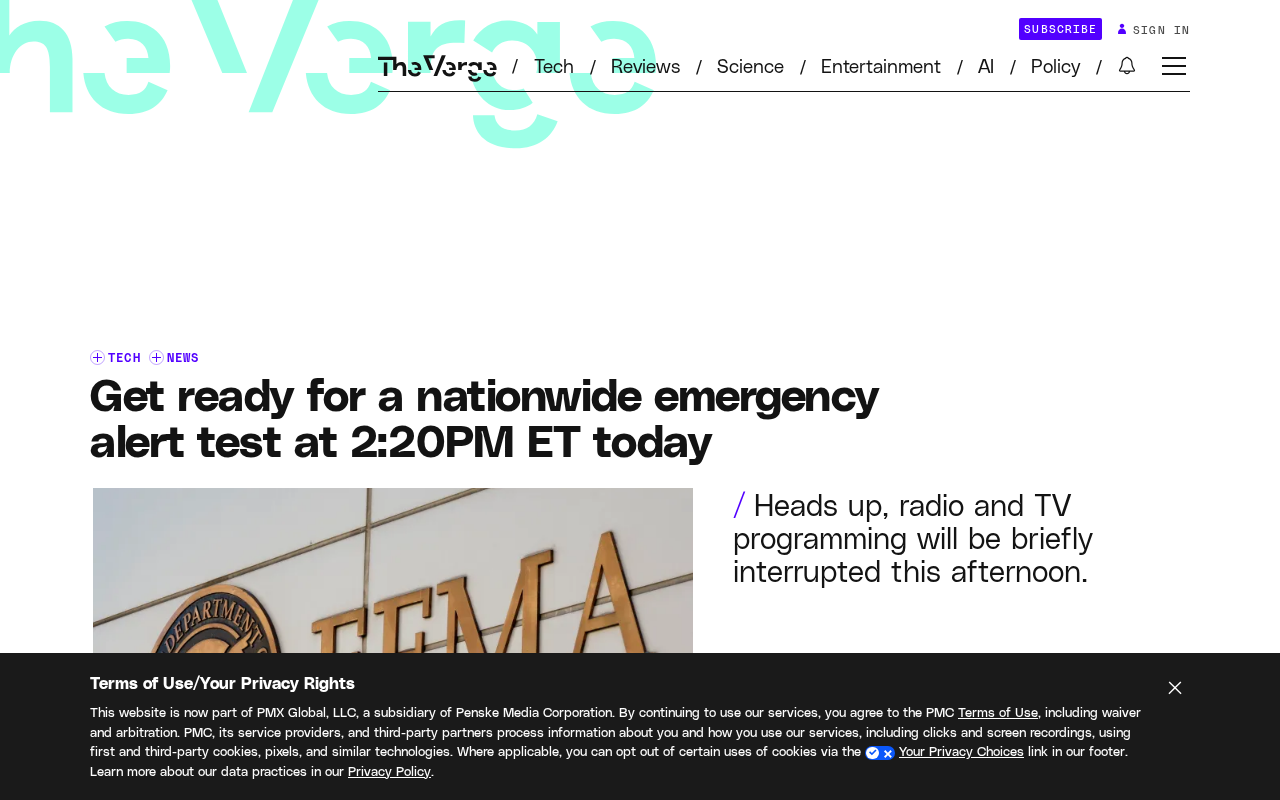
FEMA and the FCC conduct a nationwide EAS test every three years as required by law, interrupting radio and television for about one minute.
The Federal Emergency Management Agency (FEMA) and the Federal Communications Commission (FCC) conducted a routine test of the nationwide Emergency Alert System (EAS) on Tuesday at 2:20 PM ET, interrupting radio and television broadcasts for about one minute. This is a legally mandated test that FEMA must perform every three years—a planned interruption, not a communication failure. The test covered radio stations, TV stations, and cable television systems to verify the reliability of the nationwide distribution chain. The article notes that amid frequent communication outages, official advance notice helps the public distinguish planned tests from real malfunctions, and that this fixed-interval, full-chain end-to-end testing approach offers a useful reference for building high-availability AI-driven alerting systems.
The Federal Emergency Management Agency (FEMA) and the Federal Communications Commission (FCC) conducted a test of the nationwide Emergency Alert System (EAS) on Tuesday at 2:20 PM ET, during which radio and television broadcasts were interrupted for about one minute. Unlike recent communication outages, this was a planned test—FEMA is required to conduct one every three years.

Test Coverage: Radio, Television, and Cable Networks
According to FEMA, this test covered radio and television broadcasters, cable television systems, and other channels. This means most American households would receive the test signal simultaneously on their TVs and radios, with the standard emergency alert notification appearing on screen or in audio.
The EAS is a core component of the U.S. public warning system. It delivers information to the public through multiple transmission paths—broadcast, television, cable, and satellite—when the President declares a national emergency. This test was a routine verification of that multi-layered distribution network.
EAS (Emergency Alert System) is the nationwide public warning mechanism in the United States that replaced the older EBS (Emergency Broadcast System) in 1997, jointly managed by FEMA, the FCC, and the National Oceanic and Atmospheric Administration (NOAA). Its technical architecture uses a hierarchical distribution protocol, with Primary Entry Point (PEP) stations serving as the first-tier nodes to receive presidential-level alerts, which are then relayed level by level to local radio stations, TV stations, cable headends, and satellite systems. EAS messages use digital encoding (SAME headers) to identify event type, affected area, and effective time, allowing receiving devices to automatically filter and play alerts for the relevant region. In addition to presidential-level national alerts, the EAS also carries local tornado, flash flood, and AMBER alerts, and often interfaces with NOAA Weather Radio. Understanding this hierarchical structure helps explain why a nationwide test needs to cover so many transmission paths.
Why Test Every Three Years?
FEMA conducts a nationwide EAS test every three years—this is a regulatory requirement, not an ad hoc arrangement. The purpose of regular testing is to confirm that the alert chain can work reliably in a real emergency—from the alert originator to every television and every radio receiver, the entire chain must remain operational.
For the general public, understanding the nature of this test helps avoid unnecessary panic. Against the backdrop of frequent communication outages, a sudden interruption of TV and radio signals can easily cause confusion, and official advance notice serves precisely to distinguish a "planned test" from a "real malfunction."
The regulatory basis for nationwide EAS tests can be traced to the FCC's 2011 rule revision, which required periodic end-to-end exercises of the national-level EAS. The first nationwide test was conducted on November 9, 2011, and since then has generally maintained a roughly three-year cadence (2016, 2018, 2021, 2023, etc.). The test is organized jointly with FEMA as the initiating party and the FCC as the regulator, with cooperation from the broadcasting industry and the Emergency Communications Committee (ECC), among others. After the test, the FCC publicly collects response data and failure reports from each link, which are used to revise technical standards. Therefore, this test is not merely an equipment check but a systematic exercise with data feedback and compliance assessment.
Implications for AI and Automated Alerting Systems
From a broader perspective, this test also reflects a common challenge for public warning systems: reliability must be maintained through repeated verification. Modern AI-driven alerting and notification systems face similar issues—no matter how advanced the model, if the notification distribution chain has not undergone end-to-end exercises, it may still fail in an emergency.
The EAS's approach of testing at fixed intervals across the entire chain offers a useful reference for building high-availability AI alerting systems: testing should not only verify individual components but should cover the complete path from trigger to end-user reception.
What Does the Public Need to Do?
For ordinary users, this test requires no action. The test signal lasts about one minute, after which radio and television return to normal programming. Through such routine tests, FEMA and the FCC ensure that the national emergency alert system is always in a state of readiness.
This also reminds us that when a real emergency occurs, radio and television remain among the public information channels with the widest coverage and most direct reach. Regular testing is a necessary cost of maintaining the credibility of this channel.
One-line Summary
FEMA and the FCC conduct a nationwide EAS test every three years as required by law, interrupting radio and television for about one minute.
Paragraph Summary
The Federal Emergency Management Agency (FEMA) and the Federal Communications Commission (FCC) conducted a routine test of the nationwide Emergency Alert System (EAS) on Tuesday at 2:20 PM ET, interrupting radio and television broadcasts for about one minute. This is a legally mandated test that FEMA must perform every three years—a planned interruption, not a communication failure. The test covered radio stations, TV stations, and cable television systems, aiming to verify the reliability of the nationwide distribution chain from the alert originator to user receivers. The article notes that amid frequent communication outages, official advance notice helps the public distinguish planned tests from real malfunctions. At the same time, this fixed-interval, full-chain end-to-end testing approach offers a useful reference for building high-availability AI-driven alerting and notification systems: reliability must be maintained through repeated exercises across the complete path, not just by verifying individual components. The public needs to take no action; signals resume automatically after the test ends.
Related articles

Gemini 4 Neon vs Claude Opus 5.5: Who Wins Across Five Real-World Tasks?
Bilibili creator tests Gemini 4 Neon vs Claude Opus 5.5 across 3D video, games, design, writing, and advice. Neon matches Opus daily, but 3D and design still lag.

Former Huawei Genius Youth Open-Sources AI Agent Guide: 90+ Hands-On Case Studies
Former Huawei Genius Youth Li Bojie open-sources AI Agent Book, the most systematic Chinese Agent learning repo on GitHub, with 90+ runnable examples covering context compression, memory frameworks, MCP tool calling, prompt injection attack and defense, and other enterprise-level hands-on content.

The Most Detailed FDE Tutorial on Bilibili: Case-Based Teaching from Business Practice to Interviews
B站UP主推出FDE从入门到面试实战教程,讲师深入业务一线,用马氏学习平台真实案例讲解FDE岗位要求。本文分析案例教学法、笔记策略与私密信息处理,为AI岗位求职者提供参考。