Navier-Stokes Expert: AI Proof Counterexamples and the Trillion-Dollar Engineering Challenge

AI constructs a Navier-Stokes counterexample—mathematically major, but of limited engineering impact.
The article discusses AI's breakthrough in a Navier-Stokes proof: constructing a counterexample showing finite-time blowup under specific non-physical conditions via a specialized vortex structure with unbounded local vorticity but finite total energy. Though mathematically impressive, experts say it has almost no direct impact on everyday fluid engineering, as the counterexample lies in an extreme parameter regime. Engineers still rely on costly computation for simulation and design, facing a trillion-dollar engineering problem. The real value is deepening understanding of the equations' solution properties.
AI Breakthrough on a Millennium Prize Math Problem
On the Lex Fridman podcast, a Navier-Stokes equations expert discussed a recent unexpected advance by AI in mathematical proof. AI successfully constructed a counterexample showing that, under specific conditions, three-dimensional fluid equations can exhibit blowup in finite time. The counterexample is remarkably ingenious: it creates a highly specialized vortex structure that continuously stretches and thins in the third dimension, with a shrinking radius—much like a figure skater pulling in their arms to spin faster. Through a special contraction rate, the fluid's total energy remains finite, yet in localized filamentary regions the flow blows up, producing infinite vorticity.

This result surprised many mathematicians. Only in the past roughly 15 years has the mathematics community seriously begun searching for counterexamples; before that, based on physical intuition—that diffusion smooths out singularities—most believed counterexamples could not exist. The AI proof is mathematically impressive, but it also raises a deeper question: what does this proof mean for practical engineering?
The Navier-Stokes equations are the fundamental equations describing fluid motion (such as air and water), derived from the laws of conservation of mass and momentum. Whether a general solution to the three-dimensional form exists and is smooth is one of the seven "Millennium Prize Problems" announced by the Clay Mathematics Institute in 2000, with a $1 million prize for a solution. The core question is: for any smooth initial conditions, does the equation always admit a smooth solution, or can a singularity develop in finite time (i.e., "blowup"), causing the solution to lose meaning. This mathematical problem is closely tied to physical phenomena such as turbulence, but a rigorous mathematical answer remains unknown.
In the Navier-Stokes equations, "finite-time blowup" refers to the fluid's velocity field (or vorticity) tending to infinity within finite time, mathematically manifesting as a loss of regularity of the solution. If this occurs, it means the equations can no longer describe the fluid's evolution. Physically, because fluid viscosity (diffusion) typically dissipates energy and smooths velocity gradients, blowup is intuitively unlikely. Mathematicians have long sought either to prove that solutions remain smooth forever or to construct counterexamples exhibiting blowup. The AI-constructed counterexample targets the latter possibility, demonstrating that under specific non-physical conditions, local vorticity can grow without bound.
Mathematical Breakthrough vs. Engineering Reality
For those working in fluid engineering day to day, this mathematical theorem has almost no direct impact. The expert candidly admits: "Fluid simulation and prediction today is just as hard as it was a month or two ago." Whether designing aircraft wings, artificial hearts, or other devices, engineers still must rely on expensive supercomputers and wind tunnel resources to simulate, predict, and control flow. The AI-proven counterexample lies in a "non-physical" parameter regime whose extreme conditions do not arise in real-world engineering, and thus it has not changed the daily practice of applied mathematics and engineering analysis.
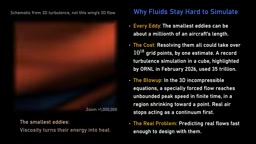
The expert captured this contrast in a pithy phrase: "We solved the million-dollar math problem, but there's still a trillion-dollar engineering problem." The "trillion" here is not hyperbole but a literal economic scale. If fast, efficient fluid prediction methods could be developed and inverse design achieved, the potential benefits would span core industries—transportation, defense, health, and energy—with lower drag, fewer emissions, and better performance, whose cumulative economic value reaches the trillion-dollar level.
In fluid mechanics, the "non-physical" parameter regime refers to extreme conditions that are nearly impossible in nature or engineering practice—for example, abnormally high Reynolds numbers, carefully engineered initial vortex structures, or idealized settings that ignore certain physical effects (such as surface tension or compressibility). Although these conditions satisfy the equations themselves, the corresponding flow states cannot stably exist or be observed in the real world. Therefore, mathematical conclusions based on such counterexamples generally cannot be directly extended to engineering problems, and engineers must still rely on empirical models and numerical simulation to handle real flows.
The Deeper Questions Behind the Counterexample
Despite its limited engineering impact, the importance of this mathematical result lies in touching on the fundamental nature of the equations. We still do not fully understand whether solutions to the Navier-Stokes equations exist, and under what conditions solutions lose regularity. The AI-constructed counterexample is a small step toward understanding "what possibilities are actually contained in the equations." The expert emphasized that this is part of a larger human goal: understanding what the equations mean from a practical standpoint, not merely proving a theorem.

From an engineering perspective, fluid problems are hard because they involve nonlinearity, multiscale interactions, and inverse design. AI's success in mathematical proof demonstrates the potential of machine learning in formal reasoning, but it does not directly translate into efficiency gains in engineering simulation. The real challenge is how to turn these mathematical insights into fast, reliable computational methods so that design optimization can be completed in reasonable time.
Vorticity is the physical quantity describing the local strength of rotation in a fluid, defined as the curl of the velocity field. In the Navier-Stokes equations, vorticity dynamics reveals how the stretching and twisting of vortex tubes enhances rotation: when a vortex tube is stretched, its cross-sectional area decreases, and by conservation of angular momentum its rotation speed increases, so vorticity grows. This "vortex stretching" mechanism is key to the turbulent energy cascade. The AI-constructed counterexample exploits a special vortex structure that continuously stretches and thins in the third dimension, causing local vorticity to tend to infinity in finite time and thus achieve blowup. This mechanism is analogous to a figure skater pulling in their arms to spin faster.
The Outlook for the Trillion-Dollar Engineering Problem
The expert notes that the "trillion-dollar" value of fluid engineering problems stems from their broad application scenarios. Transportation needs more fuel-efficient aircraft and cars; defense involves aerial and underwater vehicles; health concerns artificial hearts and drug delivery; and energy relates to turbomachinery and pipe flow. Each scenario requires accurate prediction and inverse design of fluid behavior, and current computational costs are extremely high.

Solving these engineering problems requires interdisciplinary efforts: combining numerical methods, physical modeling, and machine learning to develop surrogate models capable of rapidly predicting complex flows. AI's success on the mathematical counterexample may inspire new ideas, but there is still a long way to go before practical engineering application. As the expert said, the mathematical result matters, but it is only a baby step toward "understanding what is in the equations," while the engineering community faces a trillion-dollar real-world challenge.
One-line Summary
AI constructs a Navier-Stokes counterexample—a mathematical breakthrough with limited engineering impact.
Paragraph Summary
The article discusses AI's breakthrough in a Navier-Stokes mathematical proof: successfully constructing a counterexample showing that under specific non-physical conditions, three-dimensional fluids can exhibit finite-time blowup. The counterexample is achieved through a highly specialized vortex structure, with local vorticity growing without bound while total energy remains finite. Though mathematically impressive, experts note it has almost no direct impact on everyday fluid engineering, since the counterexample lies in an extreme parameter regime. The engineering community still relies on expensive computational resources for simulation and design, facing a "trillion-dollar engineering problem." The real value lies in deepening understanding of the solution properties of the N-S equations—a small step toward practical application.
Related articles

Claude Code v2.1.316 Update Analysis: Enterprise Gateway and Multiple Stability Fixes
Claude Code v2.1.316 released: new enterprise gateway pooled group budgets, layered policy mode, subagent effort control, dozens of Shell, network, and session recovery fixes, and Opus 4.8 fast mode deprecated.

17th-Century British Floods and Doomsday Panic: A New Perspective on Weather History
Based on a Hacker News discussion of '17th-Century British Floods and Foreboding,' this piece explores how extreme weather was given divine and political significance, and what weather history teaches us about contemporary climate communication.

Salesforce Acquires Rune for $375M: AI Logistics Tech Bolsters Defense Business
Salesforce reportedly acquires defense tech startup Rune for $375M. Rune's AI logistics tech will strengthen Salesforce's Missionforce defense platform, continuing its M&A spree.