Neil Patel Is Only Half Right: The Missing Engineering Layer of GEO

AI search triggers external retrieval only for high-entropy queries; content must be rebuilt along vector engineering logic to win citations.
The article argues that Neil Patel's observation on AI search is only half right: while high-entropy multi-attribute queries do trigger external RAG retrieval, writing in-depth long-form articles alone cannot earn citations. The missing layer is engineering—generative engines chunk content into 250–500 token segments, vectorize them, and rank by cosine similarity and entity density. Narrative long-form content dilutes answer vector density and loses to dense structured answers. The article proposes atomic answer architecture, multi-attribute ontology mapping, and a four-step protocol (high-entropy query mining, 45-word decision chunks, entity matrices, JSON-LD anchoring), urging content teams to organize information by vector-space logic to achieve citation monopoly.
AI search is reshaping the underlying logic of content distribution. A recent observation by Neil Patel touches on a key boundary: only when users ask highly specific questions with real industry constraints will AI search engines bypass their internal memory and turn to external web citations. But if marketing teams simply copy the traditional playbook of "write in-depth long-form articles answering customer pain points," they still won't earn citations from generative engines. The problem isn't content quality—it's the missing engineering layer of information architecture.
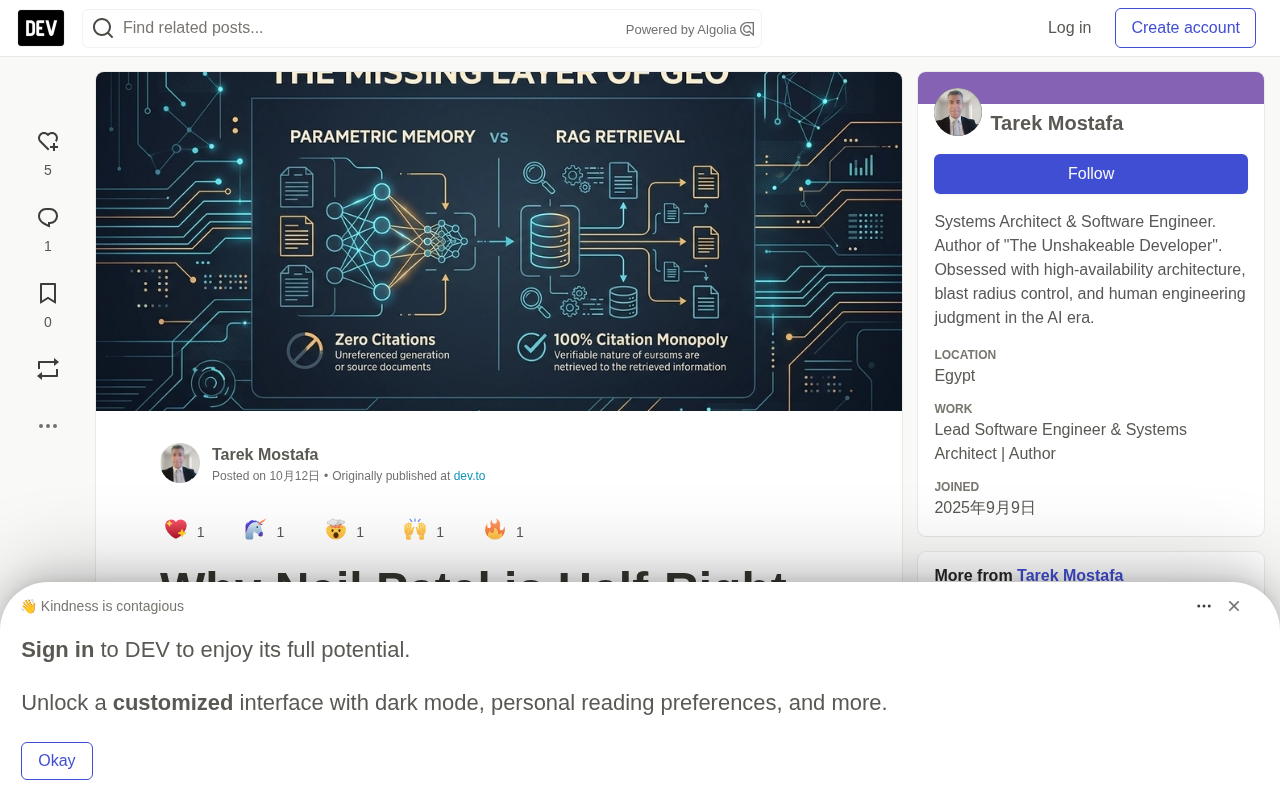
Parametric Memory Boundary: The Part Neil Patel Got Right
Neil Patel's empirical observation is accurate at the business level: when a user asks "what is a CRM," the AI model generates an answer directly from pretrained weights—zero clicks, zero citations. When a user asks "a HIPAA-compliant CRM for a 50-bed pediatric clinic that needs Epic EHR integration," the model's internal confidence collapses, and the query router is forced to trigger real-time retrieval-augmented generation (RAG), scraping information from external web pages.
From a computer science perspective, this describes the boundary between parametric memory and non-parametric retrieval. The model maintains high confidence on general questions (P>0.95), with answers coming directly from frozen weights. Facing high-entropy, multi-attribute queries, confidence drops below 0.60, and only then does the system initiate web retrieval and citation. Neil's core judgment—that your real operational knowledge is the only proprietary data absent from LLM pretrained weights—holds up commercially.
But the problem is that his advice on "how to get content cited" precisely exposes the gap between marketing thinking and retrieval engineering.
Retrieval-augmented generation (RAG) refers to retrieving relevant document fragments from external knowledge bases (such as web pages and vector databases) before an LLM generates an answer, then splicing them into the prompt as context so the model organizes its response based on those fragments. It transforms the model from "can only rely on parameters frozen at training time" to "can dynamically pull real-time, proprietary, or long-tail information." Whether RAG is triggered is usually determined by query routing logic: when the model's confidence in an answer falls below a threshold, or when a query contains many proprietary entities and has high timeliness requirements, the system turns to external retrieval. This explains the phenomenon described in the article—general questions fall within parametric memory, while high-entropy multi-attribute queries get routed to web retrieval and citation.
Parametric memory refers to knowledge compressed into the model's weights during pretraining from massive amounts of text. It is static, frozen, has a knowledge cutoff date, and is weak in covering low-frequency, proprietary, and highly localized facts. Therefore, a company's unique operational knowledge, internal processes, and niche product parameters are often absent from any model's parametric memory and can only be obtained through external retrieval. Understanding the division of labor between these two layers is the prerequisite for understanding why AI search only cites specific content.
Why Marketing Content Fails: The Missing Engineering Layer
Telling marketers to "write content that answers tough questions" typically produces 2,500-word blog posts: conversational introductions, keyword-stuffed subheadings, and narrative filler. Such content is mercilessly diluted in the ingestion pipeline of generative engines.
Generative engines (such as Google Gemini, which powers AI Overviews, and Perplexity's sonar model) do not browse web pages the way humans read them. Their ingestion process follows strict mathematical constraints: a crawler parses HTML into fixed-token semantic chunks (typically 250–500 tokens); each chunk is converted into a high-dimensional vector; when an AI agent needs an answer, it selects the chunk with the highest cosine similarity and the densest entity coverage.
If your specific answer is scattered across three narrative paragraphs, vector density is severely diluted. A competitor that provides a precise answer in a dense structured 45-word definition or table can steal the citation—even if its domain authority is lower.
| Vector retrieval dimension | Traditional content marketing | Generative engine optimization (GEO) |
|---|---|---|
| Information structure | Narrative stories, conversational paragraphs | Atomic answers: 45-word standalone semantic chunks |
| Retrieval target | Whole-page URLs ranked by PageRank | Fine-grained chunk vectors ranked by entity density |
| Entity anchoring | Keyword mentions in body text | JSON-LD schema graphs bound to knowledge graph entities |
| Model ingestion | Human reading flow | Single-pass vector extraction, no narrative dependency |
| Output metrics | Organic clicks and impressions | Citation monopoly and automated summary inclusion |
Semantic chunks and vectorization are the core processes by which generative engines ingest web pages. The crawler first splits HTML into fixed-length chunks (commonly 250–500 tokens) by heading hierarchy and paragraph boundaries, then uses an embedding model to map each chunk into a high-dimensional vector. During retrieval, the system vectorizes the user query in the same way, uses metrics such as cosine similarity to find the closest chunks, and prioritizes chunks with high entity density and semantic self-consistency as citation sources.
The engineering implication of this mechanism is that the competitive unit of content is no longer the "whole-page URL" but the "individual chunk." If an answer is split across multiple narrative paragraphs, each chunk's vector carries only partial information, and similarity is diluted. Conversely, a 40–50 word, self-contained, entity-dense chunk will have a vector closer to the target query. Entity density refers to the proportion of explicitly named entities (products, standards, organizations, technologies) per unit of text. It is an important signal for vector retrieval ranking and the reason for "ranked by entity density" in the table above.
Rule One: Atomic Answer Architecture
The first paragraph under every H2 heading must be an atomic answer: a 40–50 word self-contained semantic chunk that independently conveys a definite fact without needing surrounding context.
Traditional SEO writers are used to creating suspense—first setting up the problem, telling a customer story, and finally revealing the solution to extend dwell time. Generative engines punish this structure. Retrieval crawlers look for answers that can be quickly verified, directly discard narrative ambiguity, and select semantically clear chunks.
Invariants of an atomic answer: placed immediately below the H2 or H3 tag; length strictly 40–50 words (250–350 characters); structure is [core entity] + [definite action/definition] + [specific technical mechanism] + [quantifiable business impact]; zero pronouns—never begin with "this article will explore...", and the chunk must be 100% logically self-contained when extracted alone by an AI summarizer.
Rule Two: Multi-Attribute Ontology Mapping
Structuring comparisons and product data as multi-attribute ontology tables forces AI search models to directly generate structured diagnostic cards attributed to your source domain.
When AI engines process complex B2B buyer queries, they rarely return raw text. Instead, they output structured bullet points or automatically generated comparison matrices. If your content is unstructured prose, the model must expend compute to reconcile your claims, increasing the probability of hallucination or omission. Providing explicit multi-attribute mappings in HTML tables and accompanying JSON-LD is equivalent to handing the query router a pre-digested computation graph: [symptom/query entity] → [root-cause invariant] → [technical mechanism] → [quantifiable consequence].
According to empirical research published by the author in The Unshakeable GEO Expert, after applying multi-attribute ontology structures to a full algorithmic audit, the case study captured Google AI Overviews' global number-one source card, and the search interface automatically generated an interactive diagnostic table directly from its published chunk data, achieving 100% citation monopoly.
JSON-LD (JavaScript Object Notation for Linked Data) is a format for embedding structured data in web pages, declared via the <script type="application/ld+json"> tag, allowing machines to understand entities, attributes, and relationships on a page without parsing the body text. Schema.org provides common vocabularies (such as Organization, Product, FAQPage), based on which AI engines and search engines can bind content to knowledge graph nodes.
When a page explicitly declares "who the author is, when it was published, and how entities are defined" with JSON-LD, retrieval agents can verify source identity and timeliness, thereby adjusting authority weights. A knowledge graph is a structured network composed of entities and their relationships. As an external fact-checking layer, it can reduce the model's hallucination risk on unfamiliar content. Therefore, multi-attribute ontology tables combined with JSON-LD essentially provide retrievers with both "computable structure" and "verifiable identity," which improves citation probability more than simply piling up keywords.
The Four-Step Technical Protocol: From Keywords to System Architecture
Capturing citation monopoly in generative search requires abandoning traditional keyword clustering and adopting a four-step engineering protocol aligned with LLM retrieval constraints.
Step One: Mine high-entropy queries, not keywords. Do not target "CRM software"; target "an open-source CRM for European GDPR compliance with a self-hosted PostgreSQL backend." Such queries guarantee that the LLM query router bypasses parametric memory and triggers real-time retrieval.
Step Two: Build 45-word standalone decision chunks. Answer the question directly on the first line under the heading, eliminate all conversational fluff, and state the decision with mathematical precision.
Step Three: Deploy a multi-attribute entity matrix. Present competitive advantages, technical limitations, and workflow architecture in clean HTML tables. AI engines prioritize tabular data because tables greatly reduce inference latency and token synthesis costs.
Step Four: Inject canonical schema anchoring. Use explicit JSON-LD markup to bind author identity, publication timestamps, and entity definitions to established knowledge graph nodes. When the LLM verifies that the publisher is a recognized entity, authority weight is amplified exponentially.
From Marketing Intuition to Systems Engineering
Marketing intuition identifies customer pain points, but systems engineering determines whether AI engines can parse, trust, and cite your answers.
Neil Patel's core argument still holds: generic content is dead, and firsthand, highly specific domain experience is the only currency AI search engines respect. But without the engineering layer of generative engine optimization, even the best firsthand experience remains invisible to LLM retrieval agents.
The future of organic search does not belong to the loudest content marketers, but to architects who build ground truth with mathematical precision. When content teams begin organizing information using the logic of vector space rather than the logic of human reading, citation monopoly becomes an engineerable goal.
One-line Summary
AI search only triggers external retrieval for high-entropy queries; content must be restructured along vector engineering logic to earn citations.
Paragraph Summary
The article argues that Neil Patel's observation about AI search is only half right: high-entropy multi-attribute queries do trigger external RAG retrieval, but "writing in-depth long-form articles answering tough questions" alone cannot earn citations. The problem is the missing engineering layer—generative engines chunk content into 250–500 token segments and vectorize them, then rank by cosine similarity and entity density. Narrative long-form articles dilute the vector density of answers and are overtaken by dense structured answers. To address this, the article proposes atomic answer architecture, multi-attribute ontology mapping, and a four-step protocol covering high-entropy query mining, 45-word decision chunks, entity matrices, and JSON-LD anchoring. It argues that content teams should organize information using vector-space logic rather than human reading logic to achieve citation monopoly.
Related articles

Should U.S. College Fraternities Be Banned? A Researcher's Incisive Observations
Why not just ban U.S. college fraternities? A researcher finds the key resistance comes from decision-makers' own fraternity identities and schools' "willful ignorance."

Microsoft Discovery: Accelerating Scientific Discovery with AI Agents
Microsoft's Discovery platform runs specialized AI agents to help researchers screen and prioritize the most promising compounds and experimental paths, reducing experiments and accelerating scientific discovery.

Cambridge Heavy Industries Secretly Develops Desktop-Scale Nuclear Fusion Device
Cambridge Heavy Industries is secretly developing a desktop-scale laser-driven nuclear fusion device, targeting the equipment supply market for fusion power plants. This article analyzes its miniaturization technology path, commercialization logic, and unique positioning in the fusion startup wave.