NestJS + LangChain + Tauri 2: A Practical AI Full-Stack Development Solution

NestJS + LangChain + Tauri 2 for building enterprise-grade AI full-stack applications
This article targets frontend developers transitioning to AI, proposing an enterprise-grade AI full-stack solution based on NestJS (enterprise backend framework), LangChain/LangGraph (AI application orchestration), and Tauri 2 (cross-platform desktop delivery). It covers three core layers — full-stack services, AI applications, and cross-platform delivery — while emphasizing the necessity of MonoRepo engineering architecture for multi-module collaboration.
Introduction: The Frontend Developer's Path to Transformation in the AI Era
In an era where AI and frontend development are deeply converging, pure frontend roles are continuously shrinking, while the emerging direction of "AI Frontend" is rapidly gaining traction in mid-to-large tech companies. Leading enterprises like ByteDance and Alibaba now list LangChain, LangGraph, RAG Flow, and other AI orchestration tools as essential skills when hiring for AI frontend positions.
For frontend developers, this represents both a challenge and a rare window of opportunity. This article outlines an enterprise-grade AI full-stack development solution based on NestJS + LangChain + Tauri 2, helping you build a complete pipeline from frontend to backend, from AI applications to cross-platform delivery.

Why Choose the NestJS + LangChain + Tauri 2 Tech Stack?
Three Core Pillars
This solution is designed around three dimensions:
-
Full-Stack Service Layer: NestJS — An enterprise-grade Node.js framework built on IoC (Inversion of Control) and AOP (Aspect-Oriented Programming), naturally suited for building AI service platforms.
IoC and AOP: NestJS's Enterprise Design Philosophy
IoC (Inversion of Control) and AOP (Aspect-Oriented Programming) are two core design paradigms in enterprise software engineering. The essence of IoC is to strip the responsibility of object creation and dependency management away from business code, delegating it to the framework container for unified orchestration — developers only need to declare "what I need" without worrying about "how to create it." This pattern dramatically reduces coupling between modules, making unit testing and module replacement effortless. AOP focuses on abstracting cross-cutting concerns, separating code unrelated to business logic — such as logging, permission checks, and performance monitoring — from the main flow, weaving them into the execution chain via Decorators. NestJS deeply integrates these two paradigms with TypeScript's type system, bringing the engineering benefits previously exclusive to the Java Spring ecosystem into the Node.js world.
It provides modular architecture, dependency injection, middleware pipelines, and other capabilities to elegantly manage databases, authentication, API gateways, and other backend infrastructure.
-
AI Application Layer: LangChain / LangGraph — Currently the most mature AI application development framework. LangChain handles core capabilities like model invocation, Tool Calling, and Function Calling; LangGraph further supports advanced scenarios such as Multi-Agent collaboration and complex workflow orchestration.
LangGraph and Multi-Agent Orchestration: Technical Background
LangGraph is a complex AI workflow orchestration framework released by the LangChain team in 2024, drawing design inspiration from Directed Graph and State Machine theory. Unlike traditional linear Chains, LangGraph abstracts AI workflows into a graph structure of "Nodes + Edges + State": each node represents an independent processing unit (which can be an LLM call, tool execution, or human review), edges define the transition logic between nodes, and global state is continuously passed and updated throughout the graph's execution. This architecture natively supports conditional branching, loop iteration, and parallel execution, enabling elegant implementation of complex Agent behaviors like "plan-execute-reflect-revise" that require multi-step reasoning. In multi-Agent collaboration scenarios, LangGraph can serve as a "Supervisor" role, dynamically dispatching multiple specialized Agents (such as search Agent, code Agent, writing Agent) to collaboratively complete tasks — this is the key technological leap from "point intelligence" to "system intelligence" in current AI applications.
-
Cross-Platform Delivery Layer: Tauri 2 + ShadCN UI — With Rust as its foundation, Tauri 2 offers smaller bundle sizes and superior performance compared to Electron, making it an ideal choice for building desktop AI applications.
Tauri vs Electron: Technical Advantages of the Rust Foundation
Since its release by GitHub in 2013, Electron has dominated cross-platform desktop development for a decade with its philosophy of "building desktop apps with web technologies" — VS Code, Slack, and Discord are all built on it. However, Electron's architectural flaws have become increasingly apparent: it bundles a complete Chromium rendering engine and Node.js runtime for each application, resulting in minimum installation packages typically exceeding 100MB and memory usage often reaching hundreds of MB. Tauri takes a fundamentally different technical approach — it reuses the operating system's native WebView components (WebKit on macOS, WebView2 on Windows, WebKitGTK on Linux) as the rendering layer and uses Rust for its core runtime, completely eliminating the bloat of bundled Chromium. Rust's memory safety mechanisms (ownership system, borrow checker) eliminate common security vulnerabilities like null pointers and data races at compile time, while delivering runtime performance close to C/C++. Tauri 2 further improves its plugin ecosystem and mobile support on this foundation, making it an ideal choice for scenarios like AI desktop applications that demand high performance and security.
Paired with the ShadCN UI component library, you can quickly build aesthetically pleasing and consistent user interfaces.
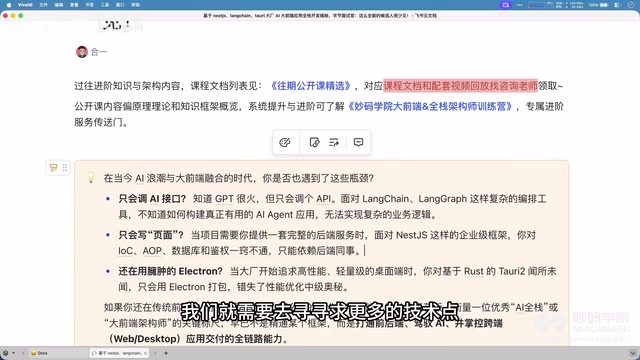
The Necessity of MonoRepo Engineering Architecture
In real enterprise AI projects, frontend applications, backend services, and AI modules often need to share type definitions, utility functions, and configurations. A MonoRepo-based engineering architecture brings the following benefits:
MonoRepo Engineering: From Concept to Toolchain
MonoRepo (single code repository) is not a new concept — tech giants like Google, Facebook, and Twitter have managed billions of lines of code in unified repositories for over a decade. Its core value lies in breaking the "multi-repo silo" dilemma: when frontend, backend, and AI modules are scattered across different repositories, a single interface change often requires cross-repo coordination and multiple releases, and out-of-sync type definitions are a common source of production incidents. In the JavaScript ecosystem, there are two mainstream MonoRepo implementations: pnpm workspace achieves efficient dependency sharing through hard links, avoiding the duplicate installation issues of the npm/yarn era, making it the go-to choice for lightweight MonoRepo setups; Turborepo builds on this with intelligent task orchestration and incremental build caching — it analyzes the dependency topology between packages and only rebuilds modules that have actually changed, reducing CI build times by over 60% in large projects. For AI full-stack projects like NestJS + LangChain + Tauri 2 where multiple tech stacks coexist, MonoRepo is not just a guarantee of engineering efficiency but also the infrastructure foundation for standardized team collaboration.
- Unified Dependency Management: Avoi
Related articles
 Tutorials
ChatGPT Plus Subscription Guide: Are GPT-5.5, image-2, and Codex Worth the Upgrade?
A detailed look at ChatGPT Plus features — GPT-5.5, image-2, and Codex — with a Plus vs Pro comparison and a complete step-by-step subscription guide for users outside the US.
 Tutorials
Harness AI Engineering in Practice: Using Claude Code to Master Enterprise-Level E-Commerce Development
Deep dive into Harness AI Engineering: master enterprise e-commerce development with Claude Code using the Rules, Skills, Wiki, and Changes framework.
 Tutorials
Cursor + Codex Dual-IDE Collaboration: A Practical Methodology for Open-Source Project Customization
A complete methodology for open-source project customization based on real-world experience, detailing the Cursor+Codex dual-IDE workflow, seven-stage process, MVP validation, and AI source code reading techniques.