Netflix AI Voice Search Feature Explained: A New Way to Discover Streaming Content

Netflix is testing an AI-powered native voice search feature to improve content discovery.
Netflix is testing a native AI voice search feature with a small group of users, allowing them to describe what they want to watch in natural language. The system uses semantic search and large language models to understand user intent and match results. By building the feature natively rather than relying on third-party voice assistants, Netflix achieves a closed data loop, deep integration, and competitive differentiation — marking the evolution of streaming recommendations from "guessing what you like" to "listening to what you say."
Overview
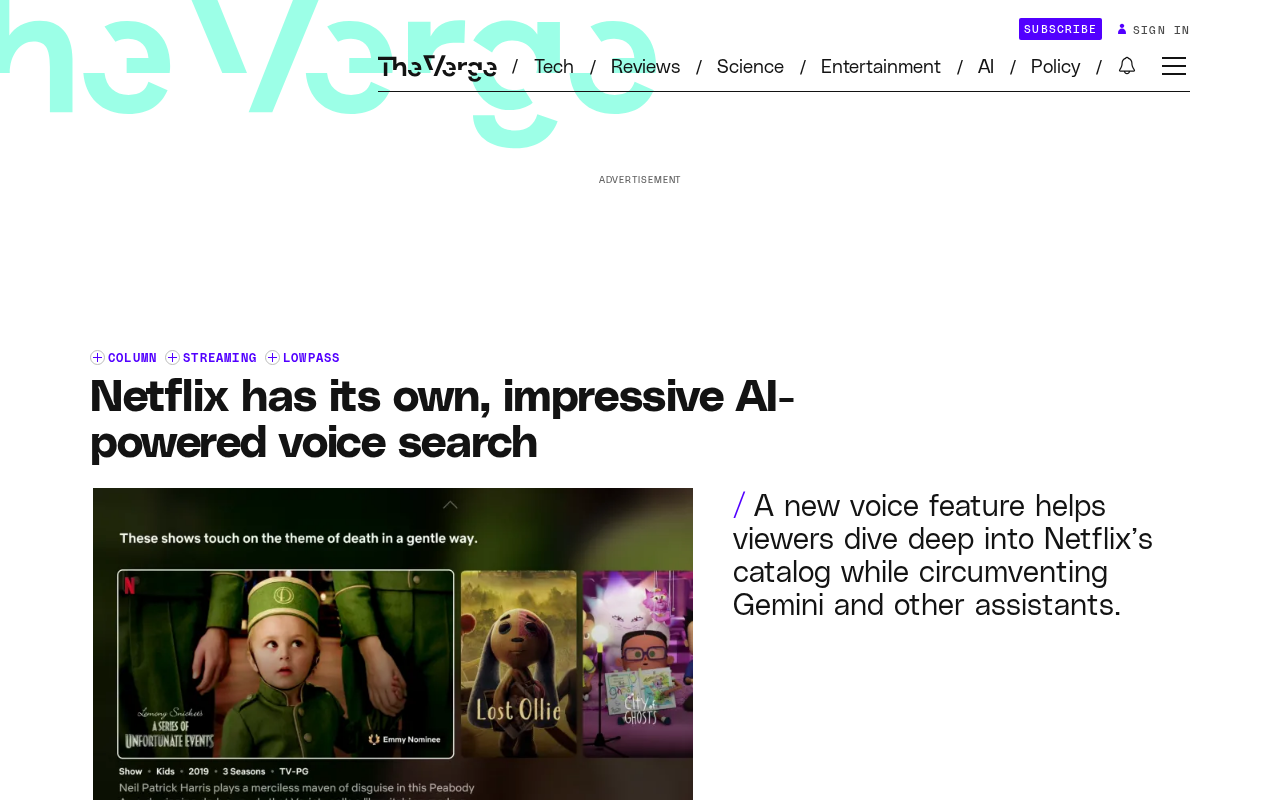
Netflix is testing a brand-new AI-powered native voice search feature, marking a significant step forward for the streaming giant in content discovery and user experience. According to Janko Roettgers, a veteran tech and entertainment reporter, who covered the story in his Lowpass newsletter, the feature is currently available to a small group of test users, and its real-world performance is impressive.
What Problem Does Netflix AI Voice Search Solve?
A Long-Standing Pain Point in Content Discovery
For Netflix, with its massive content library, helping users quickly find what they want to watch has always been a core challenge. Traditional category browsing, recommendation algorithms, and text search are effective but often fall short when user needs are vague or expressed in complex ways.
The introduction of AI voice search means users can describe the type of content, mood, or scenario they're looking for in natural language, without needing to remember exact titles or actor names. For example, saying "recommend a comedy for a relaxing weekend" or "that Korean drama about time travel" — the system can understand and deliver matching results.
Behind this capability lies the latest advances in Natural Language Processing (NLP) and semantic search. Traditional keyword search relies on exact matching, while semantic search converts text into "embeddings" in high-dimensional vector space, capturing the semantic relationships behind words. The system needs to simultaneously understand "time travel" as a sci-fi concept, "Korean drama" as a content type label, and map both onto the metadata in the content database. This typically relies on Large Language Models (LLMs) or specially trained Retrieval-Augmented Generation (RAG) architectures to perform cross-modal matching between user intent and the content library's structured metadata. Netflix began publicly recruiting NLP and recommendation system researchers as early as 2022, and this voice search feature is the product of that long-term technical investment.
Unique Advantages of Native Integration
You may not have noticed, but Netflix chose to develop a "native" voice search feature rather than relying on third-party voice assistants like Siri or Google Assistant. This strategy involves deep technical architecture considerations: third-party voice assistants typically interact with apps through standardized Intent APIs, meaning Netflix can only receive commands that have been filtered and abstracted by the platform, without access to raw voice data or complete conversational context. A native solution allows Netflix to directly control the entire pipeline of three core modules — Automatic Speech Recognition (ASR), Natural Language Understanding (NLU), and Dialogue Management (DM) — and fuse users' real-time search behavior with historical viewing records at millisecond-level latency.
This strategy delivers several clear advantages:
- Data Closed Loop: All search data stays within the Netflix ecosystem, available for further optimization of recommendation algorithms, rather than handing over core business assets to potential competitors
- Deep Integration: Deeply tied to Netflix's content metadata, resulting in more accurate search results
- Experience Consistency: No need to jump to an external assistant, making the user experience smoother
- Competitive Differentiation: In today's fiercely competitive streaming landscape, unique AI features become a powerful tool for retaining users
The AI Race in the Streaming Industry
The Evolution of Recommendation Systems
To understand the strategic significance of Netflix's AI voice search, it helps to review the evolution of streaming recommendation systems. The first generation (2000s) was dominated by collaborative filtering, generating recommendations by analyzing "what users with similar tastes also watched." Netflix's famous million-dollar algorithm competition (Netflix Prize, 2006–2009) was a landmark event of that era. The second generation (2010s) introduced deep learning, fusing user behavior sequences, content features, and contextual signals into neural networks, significantly improving recommendation accuracy. The third generation (2020s onward) has begun incorporating large language models, attempting to understand narrative structure, emotional tone, and thematic depth rather than relying solely on tags and ratings. AI voice search represents the front-end interaction layer of this third-generation recommendation system — it upgrades the system from "guessing what you like" to "listening to what you say," a natural extension of the entire technology stack's evolution.
Comparing AI Strategies Across Platforms
Netflix isn't the only streaming platform investing in AI. In recent years, all major platforms have been actively exploring AI applications:
- Amazon Prime Video: Already has voice interaction capabilities through the Alexa ecosystem, but relies more on a general-purpose voice assistant
- Disney+: Continuously investing in machine learning for content recommendations, with a focus on personalization
- YouTube: Enhances search and recommendations through Google's AI capabilities, leading in video understanding
However, Netflix's native AI voice search directly connects natural language understanding with its vast content library, potentially creating a new competitive moat at the user experience level.
From Passive Recommendations to Active Dialogue
The traditional streaming content discovery model is "platform recommends, user chooses" — users passively receive content lists pushed by the system. The emergence of AI voice search is transforming this model into "user expresses, AI understands and matches."
Related articles
 Tech Frontiers
A Rare Quiet Day in AI: Recursive Self-Improvement Stirs Beneath the Surface
A rare quiet day in AI sees multiple sources go silent simultaneously. Behind the calm, Recursive Self-Improvement (RSI) research continues. What this means for the industry.
 Tech Frontiers
Reve 2 vs. Ideogram 4: A Deep Dive into Layout Control in AI Image Generation
A deep comparison of Reve 2 and Ideogram 4's layout control capabilities, covering technical approaches, real-world use cases, and industry trends for designers and creators.
 Tech Frontiers
In the Weights: Check Your Influence Score in the AI World
In the Weights is an AI influence search engine that quantifies your presence in the AI world with a score. Explore how it evaluates practitioners and what it means for digital identity.