Netflix Cuts 1,000 Jobs: The Streaming Giant's Growing Pains and Transformation

Netflix announces layoffs of about 6%, affecting 1,000 people, exceeding earlier expectations.
Netflix co-CEOs Ted Sarandos and Greg Peters announced via internal email that the company will cut approximately 6% of its workforce, affecting around 1,000 positions — higher than the 5% rumored last week. The escalation reflects management's cautious assessment of the cost structure and business outlook. Amid intensifying competition from Disney+, HBO Max, and Apple TV+, and slowing subscription growth, Netflix is shifting from land-grabbing to cultivating, controlling content and operating costs to free up space for its next-phase profit model. This also reflects the broader efficiency-first transformation across the tech and media industries.
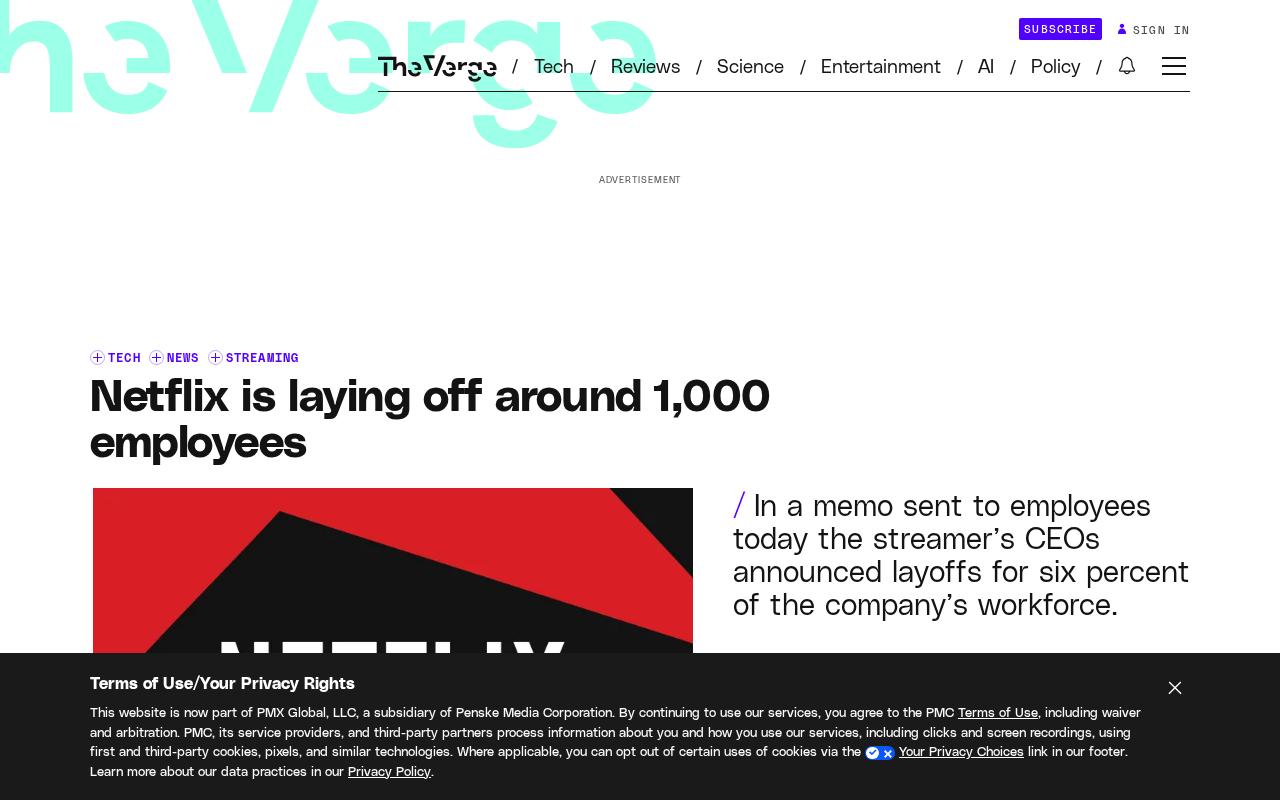
Streaming giant Netflix is going through a significant round of personnel upheaval. According to internal emails obtained by Variety, co-CEOs Ted Sarandos and Greg Peters announced to employees that the company will cut approximately 6% of its workforce, affecting around 1,000 positions. This figure is higher than the 5% layoff ratio rumored in the media last week, signaling that Netflix is intensifying its business restructuring efforts.
Why Did the Layoff Scale Exceed Expectations?
Last week, reports suggested Netflix planned to cut 5% of its staff; that ratio has now risen to 6%, meaning approximately 1,000 employees will leave the company. The shift from 5% to 6% may seem minor, but given Netflix's workforce of several thousand, it translates to hundreds of additional families affected.
This kind of "escalating" layoff adjustment typically reflects management's reassessment of the cost structure and business outlook. When a company first leaks word and then expands the scope of layoffs, it often indicates that internal expectations for revenue growth and user retention are more cautious than what the outside world perceives.
Slowing Subscription Growth and Intensifying Competition
Netflix's layoffs are not an isolated event. In recent years, the competitive landscape of the streaming sector has shifted dramatically: platforms like Disney+, HBO Max, and Apple TV+ have all entered the fray, highly fragmenting user attention. Then again, Netflix's subscriber growth has shown signs of slowing in multiple markets.
Layoffs typically coincide with a shift in business priorities. When the user growth dividend weakens, platforms need to move from "land-grabbing" to "cultivating" — making cost control in content and operations an inevitable choice. A layoff of 1,000 people is essentially about freeing up space for the next phase of the profit model.
Major Players in the Streaming Race: The global streaming market has formed a "one superpower, multiple strong contenders" landscape led by Netflix. Disney+ rapidly accumulated users through its IP library spanning Disney, Marvel, and Star Wars; HBO Max (now Max) relies on Warner Bros.' film and TV resources to focus on premium content; Apple TV+ entered the market leveraging the Apple ecosystem and an original premium content strategy; alongside these are regional or ecosystem-bound platforms like Amazon Prime Video, Paramount+, and Peacock. Multiple platforms simultaneously competing for limited user time and subscription budgets has directly driven up content acquisition and original production costs, making "slowing subscription growth" a common industry phenomenon rather than a problem unique to Netflix.
Common Metrics for Slowing Subscription Growth: Measuring streaming health typically involves several indicators — Net Subscriber Additions, Average Revenue Per User (ARPU), Churn Rate, and content cost per user. When net additions slow and churn rises, platforms are often forced to shift from "acquiring new users" to "retention and monetization" — for example, launching ad-supported lower-priced subscription tiers, cracking down on account sharing, and raising membership prices. These moves are also frequently accompanied by organizational and personnel restructuring.
Implications for the Industry and Professionals
For professionals in the streaming industry, Netflix's adjustment sends a clear signal: even the industry's top player cannot avoid organizational optimization driven by growth pressure. Roles in content production, technology R&D, and marketing operations may all be affected.
From a broader perspective, this round of layoffs once again confirms the "efficiency-first" shift that the tech and media industries are undergoing. The redundancies accumulated during expansion periods are being replaced by more refined resource allocation. For readers following AI and tech industry trends, Netflix's case also reminds us that technology-driven efficiency gains are reshaping the employment logic of the traditional content industry.
Industry Context of the "Efficiency-First" Shift: Since 2022, the global tech and media industries have broadly experienced a strategic shift from "growth-first" to "profit-first." Over-expansion during the pandemic, tightening capital conditions, and macroeconomic uncertainty have collectively pushed companies to re-examine labor costs and business boundaries. Meta, Google, Amazon, Disney, and others have all undergone multiple rounds of layoffs, and Netflix's move is a typical case within this industry-wide adjustment. For professionals, this means job security is no longer directly tied to company size, and cross-disciplinary skills and quantifiable output have become more important.
One-line Summary
Netflix announces layoffs of approximately 6%, affecting 1,000 people — a scale exceeding earlier expectations.
Paragraph Summary
Netflix co-CEOs Ted Sarandos and Greg Peters announced via internal email that the company will cut approximately 6% of its workforce, affecting around 1,000 positions — higher than the 5% rumored last week. The escalation reflects management's cautious assessment of the cost structure and business outlook. Amid intensifying competition from Disney+, HBO Max, Apple TV+, and others, and slowing subscription growth, Netflix is shifting from "land-grabbing" to "cultivating," freeing up space for its next-phase profit model by controlling content and operating costs. This also reflects the broader efficiency-first transformation across the tech and media industries.
Related articles

OpenAI Partners with Shield: How the Astra Agent Revolutionizes IT Troubleshooting
OpenAI and Shield launch the Astra agent, which autonomously logs into computers and legacy systems to fix IT issues in real time, 35-40% faster than traditional models, with humans involved only when judgment is needed.

iPhone Duo Battery Life Tested: One Charge a Day Is Unavoidable, and the Large Screen Is the Culprit
iPhone Duo battery test: heavy use needs at least one charge a day, and about 30% remains after 6.5 hours of screen-on time. How often the large screen is unfolded is key; a MagSafe battery pack helps, and long-term degradation is also worth watching.

Kimi K3.1 Pro Open-Sourced: 2.8 Trillion Parameters Close In on Opus
Moonshot releases the open-source MoE model Kimi K3.1 Pro, with 2.8T total parameters and 104B activated, trailing Opus 5.5 by under 1 point on Terminal Bench 4.0.