Netflix Lays Off 1,000 but Can't Escape Trouble: Streaming Giant Caught in a Downward Spiral

Netflix reassures investors while laying off 1,000 and losing executives, exposing streaming's growth predicament.
Netflix sent contradictory signals this week: co-CEOs assured investors all was well while the company announced 1,000 layoffs and dismissed its Chief Content Officer, Film Division Chairman, and VP. The article argues executive departures reveal deep strategic reassessment of costly original content. With streaming competition intensifying and user growth saturated, layoffs only cut short-term costs and cannot fix fundamental growth problems.
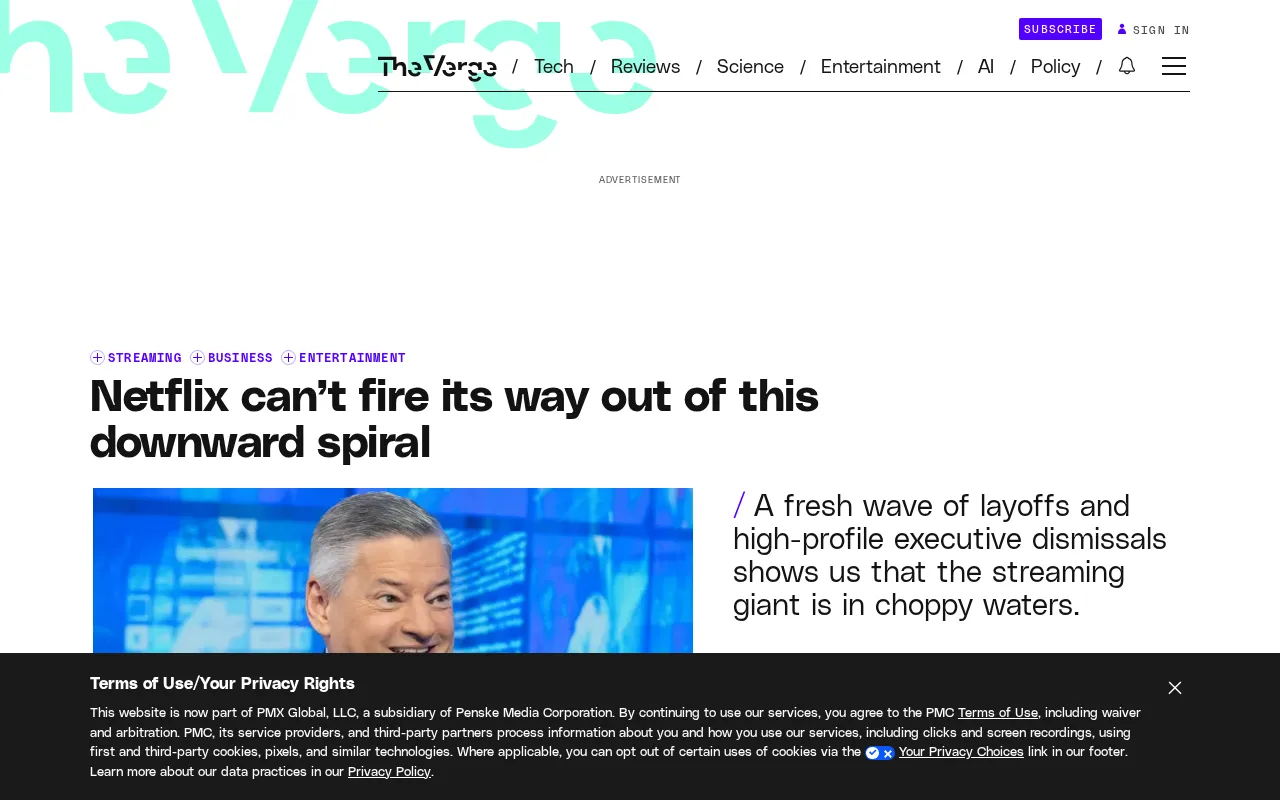
Netflix co-CEOs Ted Sarandos and Greg Peters assured investors this week that the company has nothing to worry about. Yet in the same week, the streaming giant announced it would lay off 1,000 employees across product, technology, and legal departments, and dismissed its Chief Content Officer, Chairman of the Film Division, and Vice President of the Film Division. With executives reassuring the market on one hand and large-scale restructuring on the other, this contradictory situation has left outsiders deeply uncertain about Netflix's future.
Layoffs and Executive Departures: Netflix's "Amputation to Survive"
According to the original report, Netflix's layoffs this time reached 1,000 people, concentrated mainly in product, technology, and legal departments. More notably, the company also announced the departure of three heavyweight executives: the Chief Content Officer, the Chairman of the Film Division, and the Vice President of the Film Division. This kind of restructuring involving both technology and senior content leadership is rare in Netflix's history, suggesting the company is undergoing a deep strategic adjustment.
Executive departures often reflect a company's difficulties more than ordinary layoffs do. The departure of the content chief and film division executives may signal a reassessment of Netflix's original content strategy. In recent years, Netflix has invested heavily in original content, but the quality of output has been uneven, and some high-cost projects have failed to deliver expected returns.
Chief Content Officer (CCO) is one of the most central creative decision-making roles on a streaming platform, responsible for overseeing the production and acquisition of all content, including original series, films, and documentaries. Netflix's CCO has long been seen as the operator of the company's "content is king" strategy, with authority spanning the entire chain from project greenlighting and budget approval to negotiations with top creators. The Chairman of the Film Division focuses specifically on the strategic direction of the film business, while the Vice President of the Film Division typically oversees execution and production management of specific projects. The simultaneous departure of these three positions means a vacuum at both the top and middle levels of Netflix's content decision-making chain—potentially causing delays in project approvals and loosening relationships with creators in the short term, and possibly reflecting a rethinking of content investment scale or organizational structure in the long term. In Hollywood, such executive changes often accompany signals of strategic shifts, such as moving from "volume first" to "quality-focused" or from "global self-production" to "licensed acquisition."
Investor Reassurance and Market Doubts
Sarandos and Peters addressed investors at the same time as the layoff announcement, trying to stabilize market sentiment. This "report the good, not the bad" communication strategy is not uncommon among tech companies, but it often backfires. When a company lays off employees while saying "everything is under control," the market is more likely to interpret it as executives underestimating or covering up difficulties.
From an industry perspective, streaming competition is intensifying, with rivals such as Disney+, HBO Max, and Amazon Prime Video continuously eroding market share. Netflix's user growth is saturating in multiple markets, room for price increases is limited, and the ad-supported low-price tier faces profitability pressure. The costs saved by layoffs are likely insufficient to offset the long-term impact of stagnant growth.
The Collective Predicament of the Streaming Industry
Netflix's troubles are not isolated. After years of cash-burning expansion, the entire streaming industry is collectively entering a period of adjustment. High content costs, slowing user growth, and increasing profitability pressure are problems every platform must face. As the industry leader, Netflix's layoffs and executive changes carry bellwether significance.
But the problem is that layoffs can only cut short-term costs and cannot solve the fundamental growth problem. Netflix needs to find new growth engines—whether gaming, advertising, or other derivative businesses—all of which require time and investment. With core business growth weak, relying solely on layoffs to improve financial statements could well lead to a vicious cycle of "the more you cut, the weaker you get."
The cash-burning expansion model is the key background for understanding the streaming industry's adjustment period. From the late 2010s to the early 2020s, major platforms spared no expense in trading huge losses for content library expansion and user growth in order to seize market share. Take Netflix as an example: its content spending climbed from about $8 billion in 2017 to nearly $17 billion in 2022, with free cash flow negative for a long time. Disney+ lost more than $8 billion in its first three years after launch, and Warner Bros. Discovery, the parent company of HBO Max, also carried heavy debt due to streaming investments. The logic of this model was "scale first, profitability later," but the premise was that user growth could continuously cover content costs. When market penetration in North America and Europe approached saturation after 2022 and user growth plummeted, the fragility of the cash-burning model was fully exposed—content investment is rigid, while revenue growth hit the brakes, forcing the entire industry to shift from "growth first" to "profitability first," with layoffs, content budget cuts, and business line consolidation becoming common choices.
Can It Escape the Downward Spiral?
The original headline gets straight to the core of the problem: Netflix can't fire its way out of this downward spiral. This judgment is worth pondering. Layoffs and executive departures are symptoms, not the cure. If the company cannot rediscover its rhythm of content innovation and user growth, similar adjustments may continue.
For readers following the streaming industry, this round of turmoil at Netflix is an important window for observation. It reveals that even industry leaders face difficult choices when growth slows. And the tension between executive reassurance and layoff actions precisely reflects the company's wavering between short-term financial pressure and long-term strategic investment.
One-line Summary
Netflix reassures investors while laying off 1,000 and losing executives, exposing the streaming growth predicament.
Paragraph Summary
Netflix sent contradictory signals this week: co-CEOs Sarandos and Peters assured investors the company was fine, while simultaneously announcing 1,000 layoffs and dismissing the Chief Content Officer, Film Division Chairman, and Vice President. The article argues that executive departures reflect deeper strategic adjustments more than ordinary layoffs, suggesting Netflix is reassessing its high-investment original content strategy. Amid intensifying streaming competition and saturated user growth, layoffs can only cut short-term costs and cannot solve the fundamental growth problem. The headline directly states that "Netflix can't fire its way out of this downward spiral," arguing that layoffs and executive departures are symptoms rather than the cure, and that similar adjustments will continue if the company cannot rediscover its rhythm of content innovation and user growth.
Related articles

Hermes Agent Beginner's Guide: A Self-Evolving AI Assistant
Hermes Agent beginner's tutorial: how to install and use the 41.7K-star self-evolving AI Agent. We break down its learning loop, three-tier memory, and Skill self-improvement, compare it with Claude Code and OpenClaw, and include WSL installation steps.

RAG Interview Essentials: Breaking Down the Full Offline Indexing and Online Retrieval Pipeline
A complete breakdown of the RAG retrieval-augmented generation workflow: offline document loading, chunking, vectorization, and indexing; online query rewriting, vector retrieval, reranking, and generation, plus core interview points and system optimization directions.

AI Large Models for Absolute Beginners: Principles and API Calling in Practice
From AI's evolution to large model training principles and core concepts like Token, Temperature, and Top-P, this article explains system prompts, Function Call, RAG, and memory with hands-on examples and four API call scenarios—ideal for beginners.