NeurIPS Sellout Sparks Concern: When Do Area Chairs Get Their Free Passes?

NeurIPS Area Chairs waiting for free passes risk missing registration as tickets sell out instantly.
A NeurIPS Area Chair's Reddit post highlights a real operational flaw at top AI conferences: complimentary passes for volunteer reviewers are confirmed too late relative to when general registration sells out. Caught between paying out of pocket early or waiting and losing their spot, ACs face an unfair dilemma. As AI drives explosive demand for NeurIPS attendance, organizers need clearer timelines and reserved slots to properly support the peer review volunteers who keep the conference running.
Background: NeurIPS Complimentary Pass Policy
NeurIPS (Conference on Neural Information Processing Systems), one of the world's premier AI and machine learning conferences, draws thousands of researchers, academics, and industry professionals each year. In the peer review process, Area Chairs (ACs) play a critical role — organizing paper reviews, coordinating reviewer feedback, and making acceptance recommendations.
To recognize the contributions of these volunteers, NeurIPS has in recent years offered complimentary passes to a portion of Area Chairs. This practice acknowledges their reviewing work while helping offset the cost of attendance for those serving the academic community.
Founded in 1987, NeurIPS has grown into one of the most influential AI conferences in the world, alongside ICML and ICLR — often referred to as the "Big Three" in the field. Fueled by the deep learning boom, submission counts have skyrocketed from under 1,500 in 2012 to over 10,000 in 2023, making acceptance increasingly competitive and conference tickets increasingly scarce. It has become common for registration slots to sell out within minutes of opening.
Area Chairs occupy a middle-tier role in the peer review hierarchy: each AC typically oversees the full review process for 10 to 20 papers, including assigning reviewers, monitoring review quality, facilitating discussions, writing meta-reviews, and submitting acceptance recommendations to the Program Committee. This responsibility can demand dozens of volunteer hours over several months and represents a foundational contribution to the academic community.
The Anxiety of a Sellout
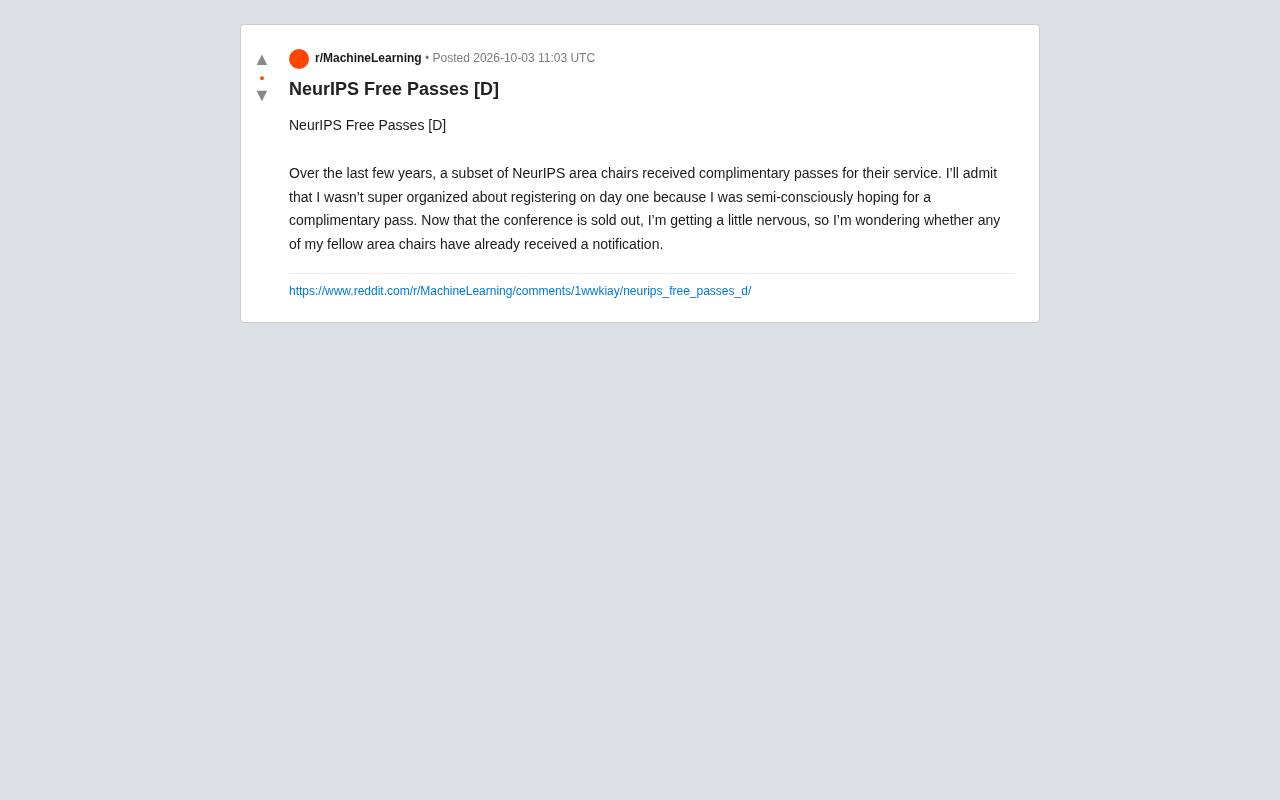
An Area Chair who posted on Reddit's machine learning community admitted that they didn't register on the first day registration opened — partly because they were "semi-consciously" hoping to receive a complimentary pass. Once the conference announced that tickets had sold out, that wait-and-see approach created new uncertainty.
The core question in the post was straightforward: had other Area Chairs already received notifications about their complimentary passes? The situation reflects a genuine organizational issue — a potential timing mismatch between when complimentary passes are distributed and when the standard registration window is open.
Why This Is a Real Problem
For academics contributing to the review process, the dilemma is this:
- If you register and pay out of pocket early, and later receive a complimentary pass, you face the hassle of a potential refund process.
- If you wait for a complimentary pass, you risk missing your chance to attend once tickets sell out.
This information asymmetry puts volunteers in a difficult position. The original poster's experience is a perfect illustration: delaying registration in anticipation of a free pass, then ending up at risk of not attending at all.
The Deeper Issue With Top-Conference Attendance
As AI continues to surge in prominence, securing a spot at conferences like NeurIPS has become increasingly difficult, and sellouts are now the norm. This places greater demands on conference organizers in terms of communication and scheduling.
For a peer review system that depends on academic volunteers — such as Area Chairs and reviewers — a clear and timely complimentary pass policy is essential. If pass confirmations arrive after tickets have already sold out, the very people who deserve recognition are left in an awkward and unfair position.
Lessons for Conference Organizers
This discussion points to several practical improvements worth considering:
- Publish a clear timeline in advance: Notify Area Chairs of when complimentary pass confirmations will be issued before or at the start of registration.
- Reserve slots for volunteers: Ensure that academics fulfilling review responsibilities aren't shut out just because general registration sold out.
- Simplify refund or conversion processes: For those who paid out of pocket and later received a pass, provide a straightforward resolution path.
The scarcity of NeurIPS tickets has become a structural issue widely discussed in the academic community. To manage on-site capacity and safety, the conference imposes hard limits on in-person attendance — but global demand from AI researchers and industry professionals is outpacing any capacity expansion. Starting in 2018, NeurIPS introduced a lottery system for some tickets; in 2019, lottery win rates dropped below 30%. While this eased the "race to register" problem, it raised new fairness concerns — even authors of accepted papers had to enter the lottery, creating the absurd risk of having a paper accepted but being unable to attend. Organizers subsequently gave accepted authors priority registration access, but policies for contributors like Area Chairs — who may not have accepted papers — remain insufficiently transparent and consistent.
Conclusion
What looks like a minor community complaint actually touches on a genuine pain point in running large-scale AI academic conferences. As attendance demand explodes, balancing commercial ticketing with meaningful recognition of academic volunteers is something NeurIPS and similar conferences need to continually improve. For Area Chairs and prospective attendees, the most practical approach for now remains staying closely attuned to official announcements and carefully weighing the timing of registration decisions.
Related articles

Trump's Request to Rename the Atlantic Rejected by Google; 1Password Lets AI Agents Log In Securely
The Vergecast roundup: Trump's request to rename the Atlantic the 'Trump Ocean' was politely declined by Google's CEO; 1Password's new feature lets AI agents log into accounts without touching passwords; OPPO launches the world's first 200-megapixel phone, the Find X10 Pro Max. All three point to the boundaries of tech authorization and trust.

The Truth About American College Party Culture: The Risks Schools Won't Admit
Behind American college party culture, the administration's "don't ask, don't tell" attitude is amplifying freshman risks. This article analyzes how the pandemic strengthened Greek dominance, freshmen's difficulty accessing safety information, and the chain reactions caused by a culture of denial.

OpenAI Reportedly Raising $30B at $1.25T Valuation Ahead of IPO
OpenAI is planning a $30B funding round at a possible $1.25T valuation, paving the way for an IPO. If completed, it would set a private company valuation record. This article analyzes the funding size, pre-IPO logic, and industry signals.