NeurIPS Submissions Reveal New Trends in Research Collaboration in the AI Era

A Reddit post seeking NeurIPS Workshop collaborators reveals how AI tools and global networks are transforming academic research.
A European student's Reddit post seeking NeurIPS 2026 Workshop collaborators — requiring Codex or Claude subscriptions — reveals how AI programming tools are becoming essential research infrastructure. The post illustrates three major shifts: Workshops as accessible entry points to top conferences, AI tools redefining collaboration standards and productivity, and internet-enabled decentralized research teams challenging traditional academic hierarchies.
A New Research Ecosystem Behind a Recruitment Post
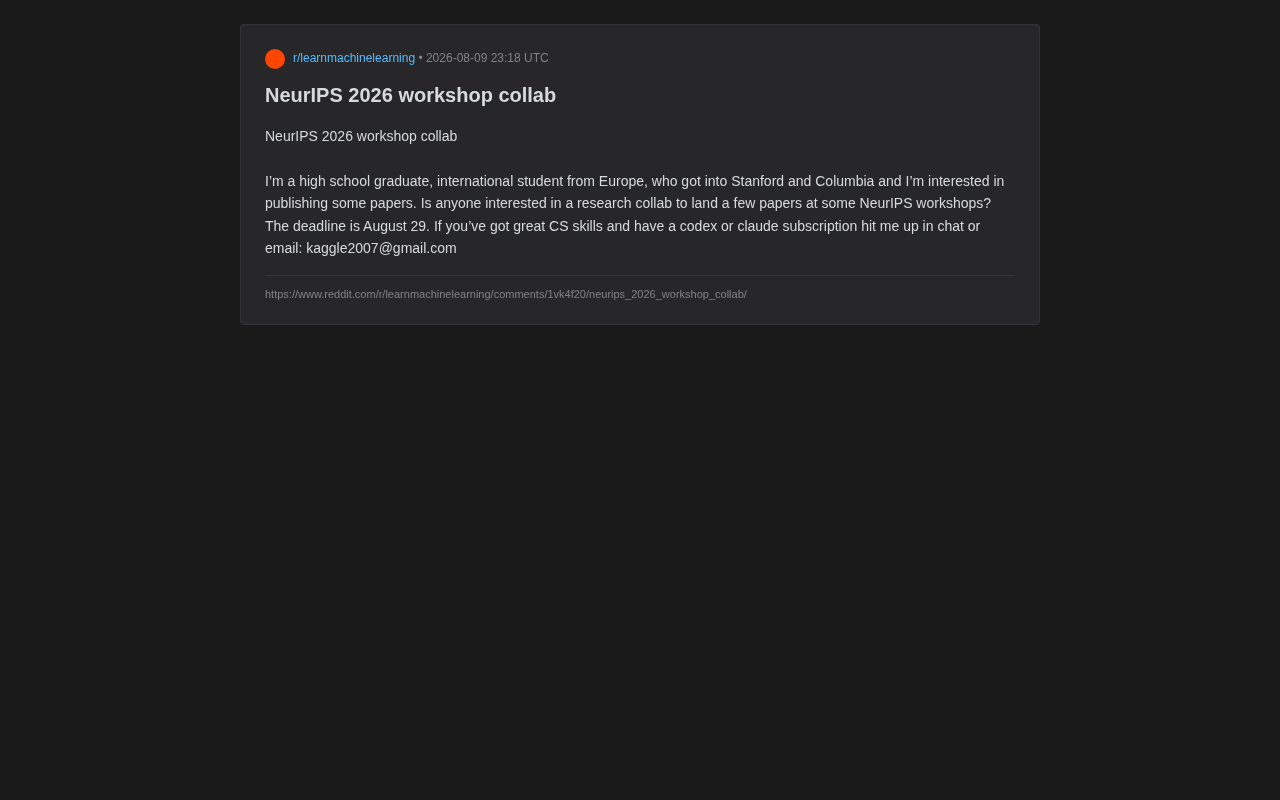
Recently on Reddit, a European international student who had just been admitted to Stanford and Columbia posted a message that is remarkably characteristic of our times: he was looking for research collaborators to jointly submit to multiple NeurIPS 2026 Workshops, with a deadline of August 29th. His requirements for collaborators were straightforward — "have excellent CS skills and a subscription to Codex or Claude."
This seemingly ordinary recruitment post actually reflects profound changes currently taking place in the AI academic community: the submission threshold for top machine learning conferences, the organizational model of research collaboration, and the role AI programming tools play in academic production are all being redefined.
NeurIPS Workshops: The Underestimated Academic Entry Ticket
The Core Difference Between the Main Conference and Workshops
When most people hear NeurIPS, they think of the main conference with its roughly 25% acceptance rate and fierce competition. NeurIPS (Neural Information Processing Systems) is one of the world's top academic conferences in machine learning and artificial intelligence, alongside ICML (International Conference on Machine Learning) and ICLR (International Conference on Learning Representations) — collectively known as the "Big Three" in AI. The conference began in 1987, initially focusing on computational neuroscience, and has since evolved into a comprehensive academic event covering deep learning, reinforcement learning, optimization theory, natural language processing, and more. In recent years, main conference submissions have exceeded ten thousand papers, illustrating the intensity of competition.
However, NeurIPS Workshops are actually a relatively more accessible publication channel. Each year, NeurIPS hosts 50-60 Workshops, each focusing on specific frontier topics, organized and reviewed by senior researchers in the field. Workshop papers are typically shorter (4-8 pages), with review criteria emphasizing novelty of ideas rather than a complete experimental system, and they welcome exploratory work at early stages. More importantly, Workshop papers are usually non-archival, meaning the same work can subsequently be submitted to the main conference or journals without constituting duplicate publication — this characteristic makes Workshops an ideal venue for testing new ideas and getting early feedback.
This is why this high school graduate who hasn't yet formally enrolled has set his sights on Workshops. For young researchers hoping to apply for PhDs or build academic credentials, Workshop papers offer an excellent cost-benefit ratio. They provide exposure associated with a top conference without requiring the complete and lengthy research cycle of a main conference paper. In applications to top PhD programs, a NeurIPS Workshop paper, while not equivalent to main conference acceptance, is sufficient to demonstrate research capability and sensitivity to frontier problems, providing significant added value.
The Strategic Significance of the Late-August Deadline
The August 29th deadline mentioned in the post is a typical submission window for many NeurIPS Workshops. Main conference papers usually have a May deadline, while Workshop calls for papers are concentrated in the latter part of summer. This timing provides a supplementary opportunity for researchers who missed the main conference or want to quickly produce results. For international students, concentrating efforts during the gap before school starts is a common strategy. The roughly three months from May to August are just enough to complete a small but valuable research project.
AI Programming Tools Are Reshaping Research Productivity
"Having a Codex or Claude Subscription" as a Hard Collaboration Requirement
The most thought-provoking aspect of this post is that the author explicitly listed "having a Codex or Claude subscription" as a criterion for finding collaborators. This would have been unimaginable a few years ago — research collaboration used to value mathematical foundations, domain knowledge, and experimental skills, yet now, whether one possesses a powerful AI programming assistant has become one of the standards for measuring collaboration value.
It's worth understanding what each of these tools represents. Codex is a code generation model developed by OpenAI, originally fine-tuned from the GPT-3 series, serving as the underlying engine for GitHub Copilot. In 2025, OpenAI launched a completely new Codex agent product capable of autonomously completing complex software engineering tasks such as code writing, debugging, and testing in cloud sandbox environments, handling multiple programming tasks in parallel. Claude is a large language model series developed by Anthropic, whose programming capabilities saw dramatic improvement in the Claude 3.5/4 series. Paired with the Claude Code command-line tool, it can directly collaborate with developers in the terminal to create, modify, and deploy code projects, excelling particularly at understanding complex codebase context and performing large-scale refactoring. The two represent the two mainstream paths of current AI-assisted programming tools: one deeply integrated into the GitHub developer ecosystem, the other distinguished by general conversation and autonomous agent capabilities.
This reflects a reality: in machine learning research, a large portion of the work is engineering. Building experimental frameworks, reproducing baseline models, debugging training scripts, generating visualization charts — these tasks used to consume enormous amounts of researchers' time, and can now be dramatically compressed with AI programming tools like Claude Code and GitHub Copilot. A researcher proficient in AI programming tools may be several times more productive than one using traditional methods. This efficiency advantage is especially pronounced under the short-cycle, high-intensity pace of Workshop papers.
Capability Anxiety Behind Efficiency Gains
Of course, this trend also sparks controversy. On one hand, AI tools genuinely lower the engineering barrier to research, enabling more people with ideas but limited programming experience to participate in frontier research. On the other hand, there are concerns that this could lead to "paper assembly lines" — researchers relying on AI to rapidly produce large volumes of Workshop papers of varying quality, threatening the floor of academic standards. In fact, top conferences like NeurIPS have already begun discussing how to address the surge of AI-assisted papers in their review processes, with some conferences requiring authors to disclose AI tool usage.
The poster's phrasing of wanting to "land a few papers" somewhat confirms these concerns: when publication itself becomes the goal, and AI tools make rapid output possible, how academia maintains research rigor will be a long-term issue. This touches on a deeper question — when AI can handle most coding and experimental work, where exactly does the irreplaceable core value of human researchers lie? The answer likely points to problem formulation, intuitive judgment, and deep understanding of research significance.
Young Researchers' New Model of Global Collaboration
Internet-Connected Cross-National Research Networks
Interestingly, this poster hasn't even officially set foot on a university campus, yet is already proactively assembling a cross-national, cross-institutional research team on the internet. His contact information is a Kaggle-style email address, suggesting a background in the data science competition community.
Kaggle is the world's largest data science competition platform, acquired by Google in 2017, with over 15 million active users. Through hosting various machine learning competitions — from image classification and natural language processing to time series forecasting — Kaggle has cultivated a large number of practice-oriented data science talents. In recent years, high-level titles like Kaggle Grand Master have gradually gained recognition in both academia and industry, with some top competitors entering leading research labs such as Google DeepMind and Meta FAIR directly. The path from Kaggle into academic research represents a "practice-first" talent development model, complementing the traditional "coursework-lab-papers" pathway.
This represents the typical profile of a new generation of researchers: they accumulate practical experience through platforms like Kaggle, find like-minded partners in communities such as Reddit and Discord, no longer confined to the traditional advisor-student mentorship structure, but conducting research collaboration in self-organized, decentralized ways. Geographic boundaries, institutional affiliations, and even educational credentials become less important under this model. This collaborative model has long been validated in open-source communities — projects like Linux and PyTorch were built through globally distributed collaboration — and this logic is now permeating the academic research domain.
Opportunities and Risks of Spontaneous Collaboration
This spontaneous collaboration model is undoubtedly vibrant, but it also carries obvious risks. Without guidance from senior mentors, young researchers may make missteps in choosing research directions or maintaining methodological rigor. Temporary teams recruited through the internet also face governance challenges around trust, contribution allocation, and authorship disputes. Academia has strict norms around paper authorship (such as ICMJE standards requiring that authors must have made substantial intellectual contributions to the work), and in loosely organized online collaborations, how to define each person's contribution proportion is often a source of contention.
Additionally, for independent researchers without institutional email addresses and formal affiliations, identity verification during submission is a potential obstacle — some Workshops require at least one author to register for the conference, and NeurIPS registration fees are not cheap for students. For newcomers eager to enter the academic circle, this represents both a rare opportunity and a situation requiring clear-headed judgment.
Conclusion: Reshuffling Research Barriers in the AI Era
This inconspicuous Reddit post serves as a micro-sample, demonstrating how AI is changing the organizational model of research. Top conference Workshops become springboards for young people to quickly enter the field, AI programming tools redefine the value standards for collaborators, and the internet makes global research collaboration readily accessible.
Regardless of how we evaluate "paper sprint" style research, one thing is certain: with the support of generative AI, the barriers to research production are being redrawn. Those who can skillfully use these tools while upholding research quality and integrity will gain an advantage in this transformation. Finding the balance between efficiency and rigor, openness and regulation, will be a challenge the entire AI academic community faces together.
From a broader perspective, this change may represent yet another manifestation of technological democratization — just as the internet once broke barriers to information access, and the open-source movement broke software monopolies, AI tools are now breaking inequalities in research productivity. When a European high school graduate can leverage AI tools and global collaboration networks to submit to top conference Workshops, the walls of academic elitism are being dismantled brick by brick. Is this a victory for the democratization of knowledge, or a crisis of academic rigor? The answer is perhaps both — and how we navigate this tension will define the landscape of AI academic research for the next decade.
Related articles

DIY Air Purifier: Building a Silent CR Box with PC Fans and an Aluminum Frame
Learn how to build a quiet Corsi-Rosenthal air purifier using PC case fans and an aluminum frame, covering fan selection, PWM speed control, and cost analysis.

Universality of Gradient Descent Training: Does Neural Network Architecture Choice Really Matter?
Exploring the universal approximation capability of gradient descent training, analyzing the relationship between neural network architecture choice and learnability, from UAT to NTK theory.

From AI to Large Models: Understanding the Conceptual Landscape and Technological Evolution of Artificial Intelligence
Understand how AI, machine learning, deep learning, large models, and generative AI relate to each other. From Deep Blue to ChatGPT, learn how Transformer architecture gave rise to LLMs.