NeurIPS Sydney Attendees Face Visa Woes: Invitation Letters Fall Short, Month-Long Wait Ends in Rejection

NeurIPS Sydney attendees face month-long visa reviews and rejections while organizers stay silent, sparking community anxiety.
As NeurIPS Sydney approaches, registered attendees are stuck at the visa stage. A Reddit thread shows that even with invitation letters and all valid documents, approval remains difficult—some have been rejected, and processing takes nearly a month. Organizers have given no clear response when visas are unapproved, leaving attendees to share timelines and document checklists through community mutual aid. The article argues invitation letters are only one visa factor, with officers also assessing travel history, finances, and home-country ties; large conferences also have blind spots in visa support responsibility. The incident highlights the hidden costs of cross-border academic exchange and raises questions about venue visa friendliness and organizers' support duties.
Long Visa Processing Times Leave Attendees Anxious
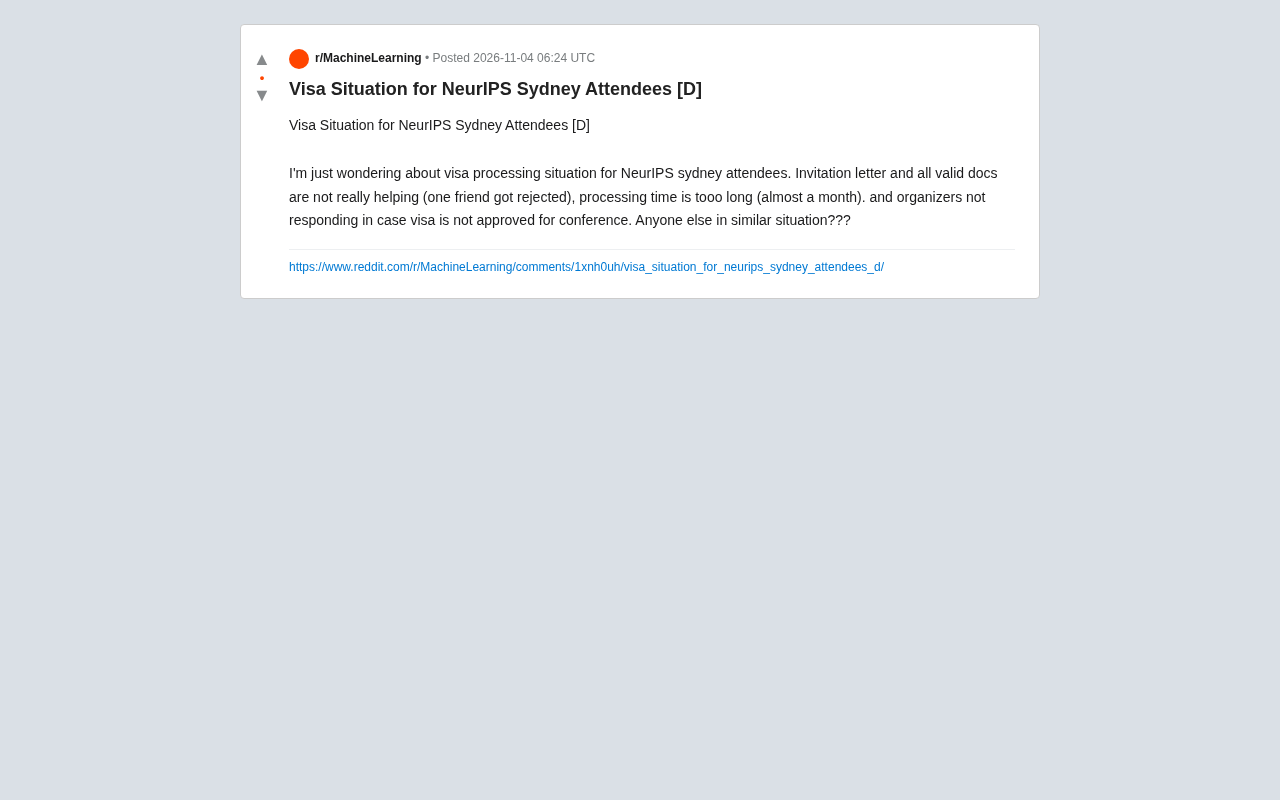
With the NeurIPS Sydney conference fast approaching, a group of registered attendees are stuck at the visa stage. A discussion thread in the Reddit community r/MachineLearning (the [D] tag indicates discussion) has struck a chord: the original poster says that even with invitation letters and all valid documents in hand, visa approval remains fraught with difficulty—one of his friends has already been rejected, and processing times are "so long, almost a month."
What worries attendees even more is that the conference organizers have given no clear response when visas are not approved. The poster asks: "Has anyone else run into a similar situation?"
This is not an isolated case. For AI researchers who need to cross borders to attend conferences, visa issues are evolving from "administrative trivia" into a real barrier affecting academic exchange.
NeurIPS (Conference on Neural Information Processing Systems) is one of the oldest and most influential top-tier academic conferences in machine learning, attracting tens of thousands of researchers from around the world to submit papers and attend each year. The conference uses double-blind review, with an acceptance rate typically around 20%; having a paper accepted is an important milestone in many AI researchers' careers. Precisely because attendees come from all over the world, visa issues have historically been an operational challenge conference organizers must face. Historically, NeurIPS has been held in Montreal, Canada, Long Beach, USA, and other locations; in 2024 it chose Sydney, Australia—the first time the conference is held in the Southern Hemisphere, which also means a large number of researchers from North America, Europe, and Asia need to apply for Australian visas.
Why Don't Invitation Letters "Do the Trick"?
By conventional wisdom, an invitation letter for an international conference is a strong piece of material in a visa application, capable of proving the authenticity of the purpose of travel. In practice, however, an invitation letter is only one of many documents; visa officers also comprehensively consider factors such as the applicant's travel history, financial situation, and ties to their home country.
The poster specifically mentions that "the invitation letter and all valid documents don't really help," suggesting the problem may not lie in missing materials but in the approval logic itself. A one-month processing cycle is quite tight for an academic conference—early-bird registration, hotel bookings, and flight arrangements for many conferences all need to be locked in in advance, and an unresolved visa means all plans are forced on hold.
Judging from community feedback, the emergence of rejection cases further amplifies uncertainty. For researchers applying for an Australian visa for the first time, once rejected, there is almost no time window to reapply.
The Australian visa system is known for its points-based system and strict genuineness review. Common visitor visas (such as the 600 category) require applicants to prove that the purpose of the visit is genuine, that they have sufficient funds to support their stay, and that they intend to return to their home country before the visa expires. Visa officers apply a "holistic assessment" principle, meaning they do not rely on a single document to make a decision but comprehensively consider indicators of "ties to the home country" such as the applicant's employment status, assets, family ties, and past entry and exit records. For applicants from certain countries, Australia may also apply additional risk assessment levels, resulting in longer processing times. In addition, academic conference invitation letters are usually issued by conference management companies or conference chairs, and their legal weight is far lower than an employer sponsorship letter or official invitation, so visa officers may give them limited credence. This is also the structural reason why "complete materials" does not equal "guaranteed approval."
Organizers' Silence and Attendees' Self-Help
Another noteworthy detail in the thread is that the organizers did not respond when visas were not approved. This exposes a blind spot in large academic conferences' support for cross-border attendance—conference official websites usually provide invitation letter templates and visa guidance, but when individuals encounter rejection or extremely long processing, there is a lack of emergency communication channels.
Attendees can currently only rely on mutual community support: finding similar cases on platforms like Reddit and Twitter, and sharing their respective application timelines and document checklists. Although this spontaneous information exchange can ease anxiety, it cannot replace official policy support.
For researchers planning to attend, the implicit advice in community discussions is: start the visa application as early as possible and reserve a longer buffer period than officially recommended; at the same time, keep all records of correspondence related to conference registration and invitation letters in case visa officers inquire.
The organizational structure of large academic conferences is usually divided into a program committee (responsible for paper review) and a local organizing committee (responsible for venue, registration, and logistics). Visa support often falls to the latter and is mostly carried out by volunteers or outsourced conference management companies. This division of labor leads to blurred boundaries of responsibility when visa problems arise: program chairs are not responsible for administrative affairs, and the local committee lacks the authority and resources to handle individual visa crises. By contrast, some conferences (such as ACL and ICML) clearly provide visa support letter application channels and emergency contact emails on their official websites, and even establish communication mechanisms with local embassies and consulates. As a mega-conference with more than 10,000 registrants, NeurIPS faces greater pressure on the responsiveness of its visa support process, which is also an institutional root of community dissatisfaction.
The Hidden Costs of Cross-Border Academic Exchange
This discussion thread reflects a broader issue: top AI conferences are increasingly held in various locations around the world, but attendees' visa convenience has not improved in tandem. For researchers from regions with strict visa review, the hidden cost of a conference is not only registration fees and airfare but also weeks of waiting, uncertain approval outcomes, and irrecoverable sunk costs after rejection.
When organizers of academic conferences choose a venue, should visa friendliness be a consideration? At least judging from this thread, what attendees want is not just an invitation letter but substantive support and transparent communication from organizers on visa issues.
At present, the discussion is still soliciting more attendees' experiences. If you are also going through a similar visa process, you may want to follow the thread's subsequent updates—outside official channels, peers' experience may be the most timely source of information.
One-line Summary
NeurIPS Sydney attendees face nearly month-long visa processing and some rejections, while organizers' silence fuels community anxiety.
Paragraph Summary
As the NeurIPS Sydney conference approaches, a group of registered attendees are stuck at the visa stage. A Reddit discussion thread shows that even with invitation letters and all valid documents, approval remains difficult; some have already been rejected, and processing takes nearly a month. The conference organizers have given no clear response when visas are not approved, leaving attendees to turn to mutual community support and share timelines and document checklists. The article argues that invitation letters are only one factor in visa consideration, with officers also assessing travel history, financial situation, and ties to the home country; large conferences also have blind spots in visa support responsibility. The incident reflects the hidden costs of cross-border academic exchange and prompts reflection on the visa friendliness of conference venues and organizers' support responsibilities.
Related articles

How Accurate Are Sci-Fi's Predictions About AI?
How accurate are sci-fi's predictions about AI? Drawing on a Hacker News discussion, this article analyzes sci-fi's foresight and blind spots in AI development, arguing its true value lies in inspiring thought rather than precise prediction.

SwarmEvolve: Latent-Space Agent Swarms Accelerate Evolutionary Search
SwarmEvolve lets hundreds of low-cost agents swarm-reason in latent space, sharing info via KV caches to achieve fast evolutionary search for math and science problems—reaching in a median of 3–8 minutes the best scores other frameworks need 60 minutes for.

trainlint: Static Checks Catch ML Training Bugs That Don't Crash
trainlint is a static analysis tool that finds ML training bugs that don't throw errors, including data leakage, leftover eval mode, and softmax/CrossEntropyLoss conflicts across 14 categories. This article covers its principles, validation results, and limitations.