Never Boring AI: The AI Agent That Writes LinkedIn Posts in Your Voice

Never Boring AI writes and auto-publishes LinkedIn posts in your voice, built for freelancers and founders.
Never Boring AI is an AI agent focused on LinkedIn content operations. Its core differentiator is a complete loop: interview, memory, voice learning, and auto-publishing. It starts by learning your real experiences, stores them in long-term memory as a personal content library, learns from every edit you make, and ultimately schedules and publishes posts weeks in advance in your voice. Targeting freelancers, consultants, and founders — people whose personal brand drives business but who lack a content team — it supports English and French and earned 77 upvotes on Product Hunt, representing a clear trend of AI shifting from single-use tools to long-term agents.
An AI Assistant Built for LinkedIn Content Anxiety
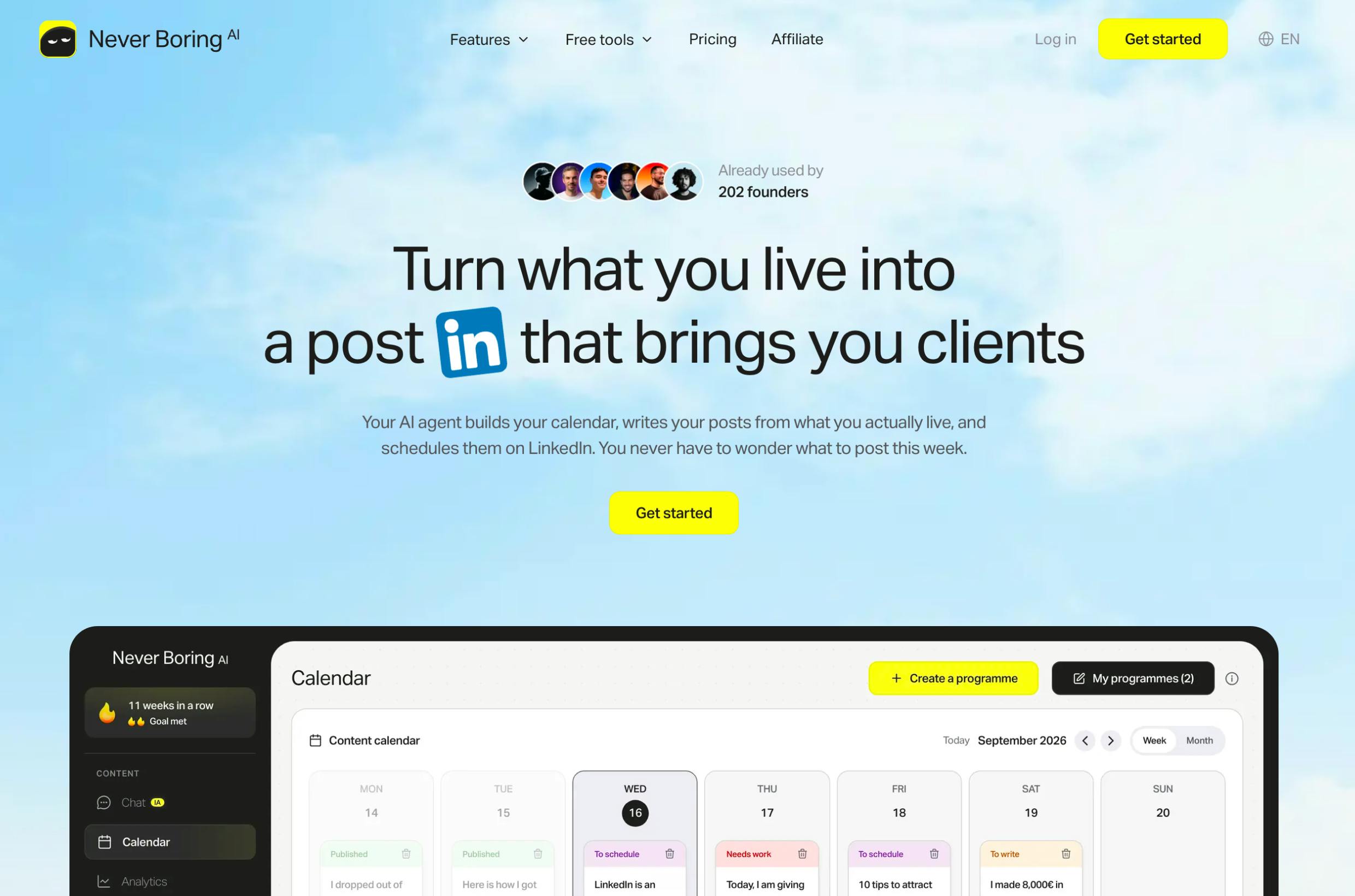
For many freelancers, consultants, and founders, LinkedIn is a critical platform for personal branding — but the real struggle isn't "not knowing what you do." It's "not knowing what to post this week." Never Boring AI is designed precisely for this pain point. Launched on Product Hunt, it's an AI content agent whose core promise is writing LinkedIn posts in your voice.
By the numbers: it ranked #17 on its launch day, earning 77 upvotes and 3 comments across the Social Media, Artificial Intelligence, and LinkedIn categories. Built by Maxence VROILANT, it currently supports English and French.
How It Differs from Ordinary AI Writing Tools
Most AI writing tools work as one-shot interactions: give a prompt, get copy. Never Boring AI takes a different approach — it's designed more like a long-term "content operations agent." Its workflow has several key stages:
Interview First, Then Write
The product doesn't generate content out of thin air. It starts by interviewing you to understand your work and experiences. This step determines how authentic the output is — it writes your story, not generic motivational filler.
Build Your Content Library Through Memory
The stories you share get "stored in memory," forming a personalized content asset pool. This means the longer you use it, the deeper its understanding of you becomes, and the more real-world examples it can draw from. This memory mechanism is a key feature that distinguishes modern AI agents from traditional generative tools.
A Note on Memory in AI Agents
Memory in AI agents typically falls into two categories: short-term memory (conversation history within a context window) and long-term memory (persistent user information stored across sessions). The "stored memory" Never Boring AI emphasizes belongs to the latter — personal experiences, professional backgrounds, and case studies saved in a structured or vectorized format, retrieved when generating future content. This is fundamentally different from tools like ChatGPT, which start fresh with every conversation. Long-term memory is one of the core mechanisms AI agent products use to build user retention — the longer you use the platform, the harder it is to leave, because your accumulated content library and voice model are embedded in the platform and can't easily be exported or ported elsewhere.
Learn Your Voice — and Keep Learning from Your Edits
The product emphasizes outputting content "in your voice." More importantly, every time you edit a generated draft, it learns from those changes, progressively closing in on your actual writing style. This feedback loop means output quality should, in theory, improve with use.
AI Agents vs. Traditional AI Tools
The core distinction between AI agents and traditional AI tools lies in autonomy and continuity. Traditional generative tools (like prompting GPT for copy) are stateless and single-turn: the user inputs a prompt, the tool produces output, and the interaction ends. AI agents, by contrast, have goal-awareness, memory, and the ability to execute multi-step tasks — they can autonomously plan sequences (interview → generate → schedule), accumulate context across interactions, and continuously refine their behavior. In content creation, the agent model shifts the tool from "respond on demand" to "proactively manage operations" — making it less of a productivity plugin and more of a virtual collaborator capable of independently owning a workflow.
A Complete Loop from Planning to Publishing
If voice matching solves "does this sound like me," content planning and automation solves the harder problem: actually posting consistently.
Never Boring AI plans your content calendar weeks in advance and automatically publishes to LinkedIn on schedule. For people who know their professional value but simply don't have time to maintain a consistent presence, this end-to-end loop — from topic ideation to writing to scheduled publishing — eliminates the most willpower-draining parts of content creation.
The target user profile is sharply defined: freelancers, consultants, and founders — people who wear multiple hats, whose personal brand directly drives client acquisition, and who lack a dedicated content team.
Weighing the Value and the Limits
Never Boring AI represents a textbook example of AI applications evolving from "tools" to "agents": rather than serving a single generative function, it aims to take over an entire content operations pipeline. The combination of memory, voice learning, and auto-publishing forms its differentiated moat.
That said, it's worth being clear-eyed about the boundaries. The real value of LinkedIn content lies in genuine insight and authentic expression. AI can approximate your style — the "form" — but whether it can consistently produce content with real perspective and depth still depends on the quality of your input and your level of engagement. Additionally, auto-publishing to a social platform requires users to grant account authorization, which raises questions around content authenticity and consistency worth keeping in mind.
The product currently supports only English and French, making it less accessible to non-English speakers — but its underlying product logic offers valuable reference points for content creators and AI product practitioners alike. For professionals long haunted by "what should I post this week," this kind of AI agent offers a genuinely promising path forward.
Related articles

Should U.S. College Fraternities Be Banned? A Researcher's Incisive Observations
Why not just ban U.S. college fraternities? A researcher finds the key resistance comes from decision-makers' own fraternity identities and schools' "willful ignorance."

Microsoft Discovery: Accelerating Scientific Discovery with AI Agents
Microsoft's Discovery platform runs specialized AI agents to help researchers screen and prioritize the most promising compounds and experimental paths, reducing experiments and accelerating scientific discovery.

Cambridge Heavy Industries Secretly Develops Desktop-Scale Nuclear Fusion Device
Cambridge Heavy Industries is secretly developing a desktop-scale laser-driven nuclear fusion device, targeting the equipment supply market for fusion power plants. This article analyzes its miniaturization technology path, commercialization logic, and unique positioning in the fusion startup wave.