New Advances in EEG Feature Sets: A Data Standardization Attempt for ADHD Classification Research

The study curates the BALLADEER dataset with a unified time window and seven EEG feature categories, improving the comparability and reproducibility of ADHD classification research.
This article introduces an infrastructure-type effort addressing methodological heterogeneity in ADHD EEG research. Researchers curated 669 recordings from 156 participants in the BALLADEER dataset across five task conditions, computed seven major categories of EEG features over a unified time interval, linked them with 115 feature definitions or templates, and documented quality decisions. Technical validation showed a median retained-time proportion of 100%. A reuse example compared eight-second-window XGBoost against a recruitment-group prevalence baseline, finding stronger recruitment-group discrimination on the Robots task than under three Slackline conditions, though the authors stress the results are only descriptive. The core value lies in treating feature engineering comparability as a first-class citizen.
Why ADHD EEG Research Needs a "Unified Yardstick"
Attention-deficit/hyperactivity disorder (ADHD) is a neurodevelopmental condition affecting attention, activity level, and impulse control. Electroencephalography (EEG) can record brain activity while children and adolescents perform cognitive tasks, and has long been considered a candidate tool for exploring ADHD biomarkers. However, different studies use different signal preprocessing pipelines, analysis time windows, and feature definitions, making direct comparison between features difficult. This fragmentation is one of the root causes of why EEG classification research on ADHD is hard to reproduce and accumulate.
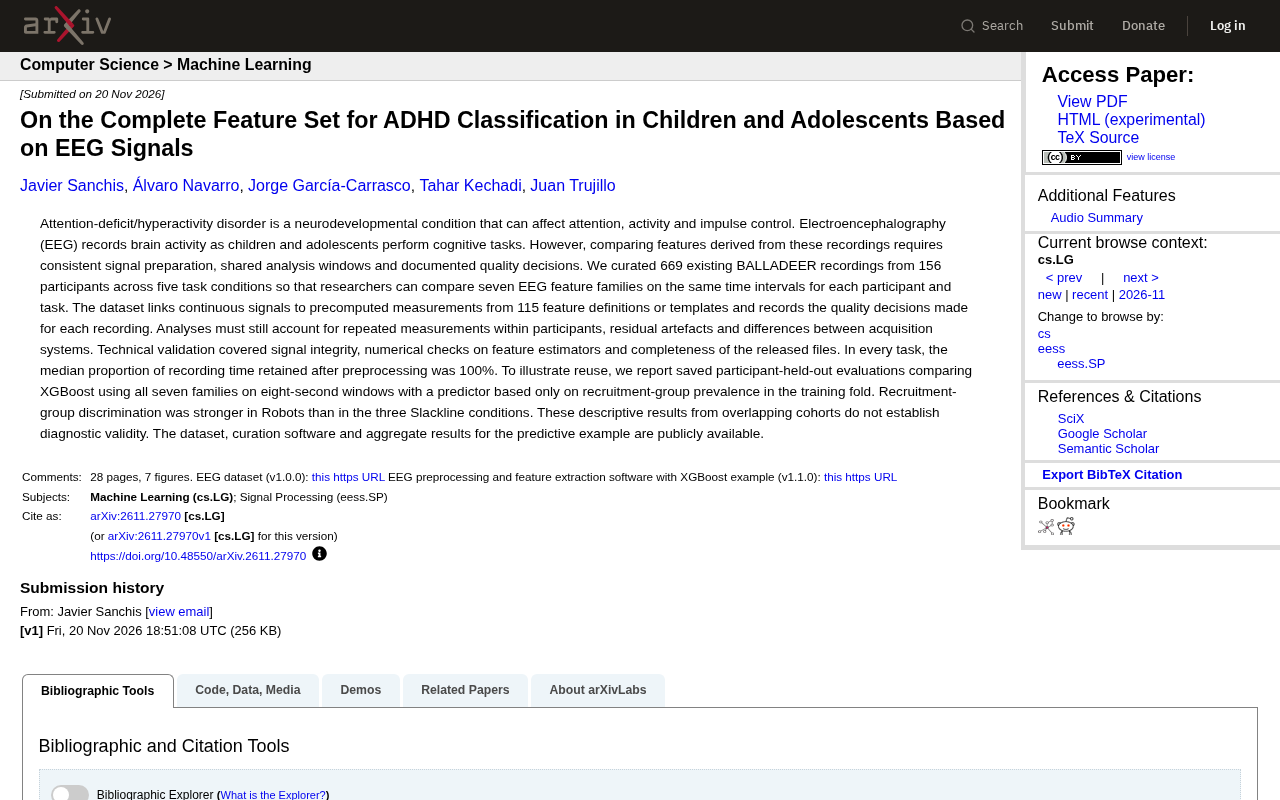
A recent work attempts to change this situation: researchers curated 669 existing recordings from 156 participants in the BALLADEER dataset, covering five task conditions, and computed seven major categories of EEG features for each participant's each task within a unified time interval. This means that features originally scattered across different analytical conventions have, for the first time, been aligned under the same "yardstick." For a field long plagued by methodological heterogeneity, this standardization attempt itself is more valuable than any single classifier's performance number.
EEG features are typically divided into several major categories by signal properties: time-domain features (e.g., mean, variance, skewness, kurtosis), frequency-domain features (power in each frequency band, power spectral density), time-frequency features (wavelet coefficients, short-time Fourier transform energy), nonlinear/complexity features (sample entropy, Lempel-Ziv complexity, Hurst exponent), connectivity features (coherence, phase-locking value), and the amplitude and latency of event-related potential (ERP) components. Different software packages (such as MNE-Python, EEGLAB, Brainstorm) often differ in default parameters and implementation details for the same feature—for example, frequency band boundaries, window function choices, and artifact rejection thresholds can all lead to values that are not directly comparable. This is precisely the technical root of "feature heterogeneity" in the ADHD EEG literature: even features with the same name may correspond to different statistics under different pipelines. Therefore, precomputing features under unified preprocessing and a unified time window essentially takes "implementation freedom" away from the analyst, giving cross-study and cross-feature-family comparisons an operable foundation.
The Core of Data Curation: The Same Time Window, Seven Feature Categories
The key design of this dataset lies in "consistency." The researchers did not re-acquire signals; instead, they performed unified preparation of existing recordings: consistent signal preprocessing, a shared analysis window, and documented quality decisions. The dataset links continuous signals with precomputed measurements from 115 feature definitions or templates, and retains a quality judgment record for each recording.
This approach solves a practical pain point. In the past, researchers who wanted to compare the merits of different feature families often had to reimplement each feature category themselves, and differences in implementation details would contaminate the comparison results. Now, the seven feature categories are computed over the same time interval, greatly narrowing the variables being compared. Technical validation covered signal integrity, numerical checks of feature estimators, and the completeness of released files. You may not have noticed that across all tasks, the median proportion of recording time retained after preprocessing was 100%, indicating that quality control achieved a good balance between retaining data volume and ensuring signal usability.
Reproduction Example: XGBoost vs. a Baseline Predictor
To demonstrate the reusability of the data, the researchers reported a set of leave-subject-out evaluation results: an XGBoost model using all seven feature categories based on eight-second windows, compared with a predictor that relies only on the recruitment-group prevalence in the training folds.
The results showed that recruitment-group discrimination was stronger on the Robots task than under the three Slackline conditions. This descriptive result reveals the influence of task conditions on classification signals, but the researchers explicitly caution that these results come from an overlapping cohort, are descriptive in nature, and do not establish diagnostic validity. This restraint is commendable—in the ADHD EEG classification literature, the tendency to overinterpret classification accuracy is not uncommon, and this work proactively draws a boundary between "feature comparability" and "clinical diagnostic validity."
XGBoost (eXtreme Gradient Boosting) is an ensemble learning method based on gradient-boosted decision trees. It fits the residuals of the previous step by progressively adding tree models and controls overfitting through regularization terms. It performs robustly on small- and medium-scale tabular features and is therefore often used as a benchmark model for EEG feature classification. "Leave-subject-out" evaluation refers to splitting the training and test sets by participant, ensuring that recordings from the same participant do not appear in both training and testing, thereby avoiding optimistic bias caused by repeated measurements within participants. The "recruitment-group prevalence baseline" is the simplest possible predictor: for each test sample, it directly outputs the proportion of each group (e.g., ADHD group and control group) in the training set as the predicted probability, without using any EEG features. Comparing XGBoost with this baseline can determine whether the features provide information gain beyond "guessing the prior"; if the model only matches the baseline, it indicates that the features or task conditions fail to provide a generalizable discriminative signal.
Three Limitations That Must Be Confronted When Using the Data
The dataset itself also candidly lists issues that still need to be addressed in analysis. The first is repeated measurements within participants: the same participant contributes multiple recordings, and statistical models must account for this non-independence. The second is residual artifacts: even if preprocessing retained all time, artifacts may not be completely eliminated. The third is differences between acquisition systems: signal characteristic differences brought by different devices may affect feature distributions.
These limitations are not defects but inherent properties of real EEG data. Explicitly recording them in the dataset actually reduces the risk of misuse by subsequent researchers. The curation software and aggregated results are released together, providing a foundation for methodological reuse.
Implications for ADHD Classification Research
The most noteworthy aspect of this work is not how a particular classifier performs, but that it treats "comparability of feature engineering" as a first-class citizen. When seven feature categories share the same time window and quality records, researchers can truly answer questions like "which feature category is more informative for ADHD classification" rather than guessing amid the noise of methodological differences.
Of course, standardized data curation is only the first step. Establishing diagnostic validity still requires independent cohorts, prospective designs, and comparison against clinical gold standards. But an open, reproducible feature set with documented quality decisions at least gives subsequent research a more solid starting point. For researchers and developers focused on EEG and neurodevelopmental conditions, this kind of infrastructure-type work deserves continued attention.
One-line Summary
A study curates the BALLADEER dataset with a unified time window and seven EEG feature categories, improving the comparability and reproducibility of ADHD classification research.
Paragraph Summary
This article introduces an infrastructure-type effort addressing methodological heterogeneity in ADHD EEG research. Researchers curated 669 recordings from 156 participants in the BALLADEER dataset, covering five task conditions, computed seven major categories of EEG features over a unified time interval for each recording, linked them with precomputed measurements from 115 feature definitions or templates, and documented quality decisions for each recording. Technical validation showed a median retained-time proportion of 100% after preprocessing. The reuse example compared an eight-second-window XGBoost against a recruitment-group prevalence baseline and found that recruitment-group discrimination on the Robots task was stronger than under the three Slackline conditions, but the authors emphasize that the results are merely descriptive and do not claim diagnostic validity. The article notes three limitations that must be confronted in analysis—repeated measurements within participants, residual artifacts, and differences between acquisition systems—and argues that the core value of this work lies in treating the comparability of feature engineering as a first-class citizen.
Related articles

Nothing CMF Buds 2A Drops to $17.89 on Black Friday: A New Low for ANC Earbuds
Nothing CMF Buds 2A wireless earbuds Black Friday deal: just $17.89 on Amazon, about $11 off retail and a record low. ANC earbuds at an entry-level price.

When AI Creation Gets Accused of "Spitting": Hacker News Heats Up Over the Glaude Controversy
A Hacker News post, "Spitting in the Face of Glaude," sparks debate on AI creation transparency and attribution ethics. This analysis examines the blurred creator identity behind the controversy and offers practical advice for AI content production.

Akai Embraces Custom Firmware: MPC Sample 1.4 Lets Users AI-Program Their Sampler
Akai embraces the modding community with MPC Sample 1.4 firmware, supporting vibe-coded custom firmware and effects. We analyze the impact of this open strategy on music hardware and AI-assisted programming.