New Air-Gap Breach Technique: RAM Radio Signals Spell Out Secrets

Study reveals that malware alone can manipulate RAM electromagnetic radiation to breach air-gaps and steal data.
The article discusses a study hotly debated on Hacker News, noting that air-gapping is not absolutely secure. Attackers can use malware to precisely control memory read/write patterns, making RAM emit electromagnetic pulses at specific frequencies and encode secrets into radio signals, which are captured and decoded by software-defined radio at the receiving end. The method requires no hardware modification and is highly stealthy, but faces challenges such as weak signals, limited range, and environmental noise. Defense must shift to electromagnetic shielding like Faraday cages, though these are costly and inconvenient. The article stresses incorporating electromagnetic leakage into threat models and guarding against multiple side channels, noting that the barrier to such attacks is lowering as SDR devices become widespread.
Air-Gapping Is Not Absolutely Secure
For a long time, air-gapping has been regarded as the ultimate means of protecting highly sensitive data — a physically isolated computer connected to no network is, in theory, immune to remote attack. However, a study hotly discussed on Hacker News shatters this illusion once again: attackers can manipulate the radio signals generated by memory (RAM) to "spell out" and transmit secret data, thereby breaking through the air-gap barrier.
According to the research described in that discussion, this method requires neither implanted physical hardware nor a network connection. Merely by using software to manipulate a computer's RAM activity, confidential information can be received at a distance and reconstructed. This means that even if a computer is completely disconnected from the network, data may still leak out in the form of radio waves.
Attack Principle: How RAM Becomes a Transmitting Antenna
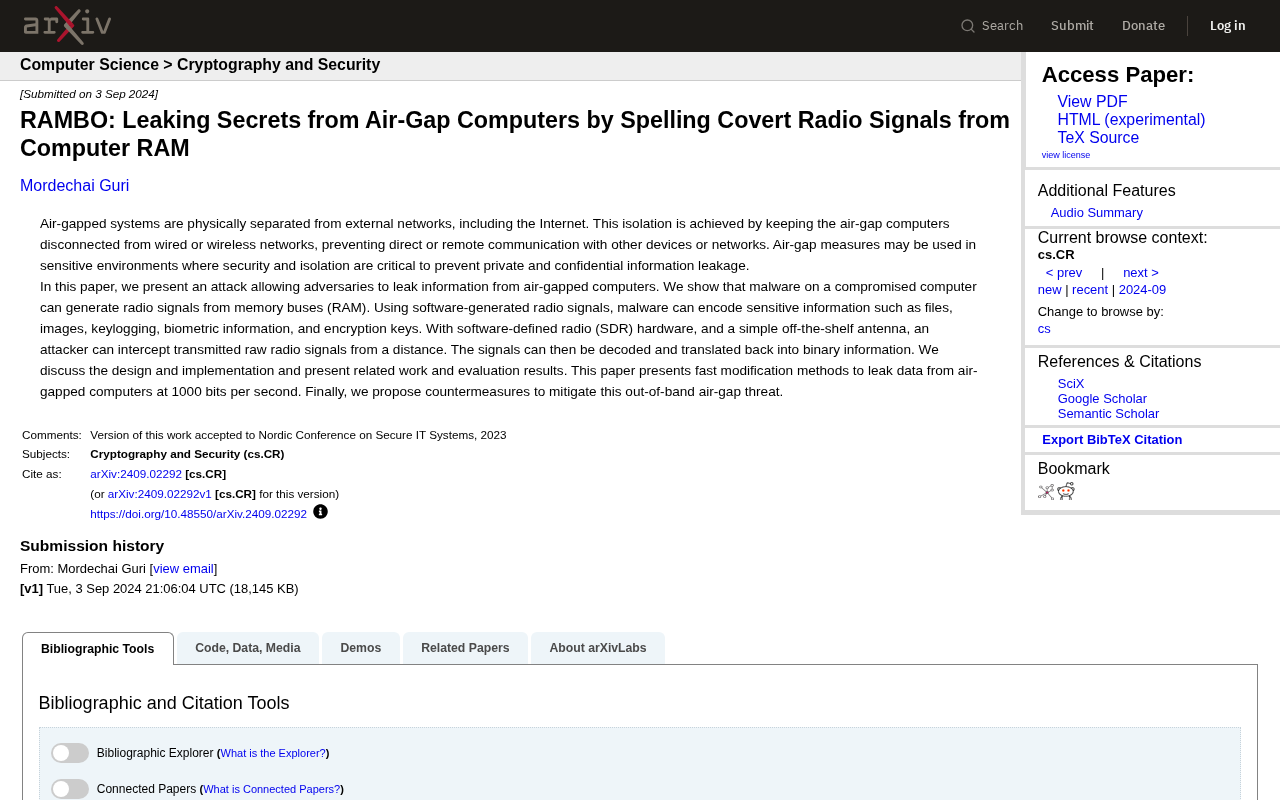
Computer memory (RAM) emits electromagnetic radiation while operating; this is an inherent property of electronic devices. Normally, this radiation is extremely weak and chaotic, making it hard to exploit. But researchers found that carefully designed software can control memory read/write patterns, causing it to produce radio signals at specific frequencies and patterns.
The key is that an attacker can write a program to directly control the access behavior of memory modules — for example, by repeatedly reading and writing specific memory addresses to generate regular electromagnetic pulses. These pulses can be modulated to "spell out" binary data. At the receiving end, the attacker uses a software-defined radio (SDR) device to capture these signals and then decodes them to reconstruct the original information.
According to the discussion on Hacker News, this attack requires no physical modification of hardware and is implemented entirely through software, making it extremely stealthy. The attacker only needs to run malicious code on the target computer (for example, through a supply chain attack or an insider implant) to activate the exfiltration channel.
Software-defined radio (SDR) is a technology that implements wireless communication functions through software rather than dedicated hardware. The functions of traditional radio equipment (such as modulation, demodulation, filtering, and mixing) are performed by fixed circuits, whereas SDR hands the digitized signal after analog-to-digital conversion to a general-purpose processor or FPGA for digital signal processing, thereby flexibly supporting multiple frequencies, modulation schemes, and protocols. In the attack scenario described in this article, the attacker uses SDR equipment to scan a wide frequency band and capture the weak electromagnetic radiation produced by RAM, then applies software algorithms for demodulation and decoding. The cost of SDR equipment has dropped substantially (entry-level devices cost only a few hundred yuan), which significantly lowers the barrier to deploying the receiving end of such side-channel attacks and explains why researchers are concerned about their practical threat.
Technical Details and Challenges
Although the principle sounds simple, implementing this attack faces many technical challenges. First, the radio signals generated by RAM are very weak; the receiving end needs highly sensitive equipment and must be within a relatively short distance (for example, within a few meters) to capture them effectively. Second, electromagnetic noise in the environment interferes with the signal, so the attacker needs to adopt interference-resistant modulation schemes.
In addition, the attacker must precisely control memory access patterns, which requires malicious code to directly manipulate the memory management unit (MMU) or exploit specific instruction sequences. Research shows that carefully designed code can produce stable signals without being noticed by the operating system.
You may not have noticed that this kind of attack is not new. Past research has used electromagnetic radiation from CPUs, GPUs, and even USB interfaces for air-gap data exfiltration, but cases of using RAM for signal transmission are relatively rare, and this study may have improved signal stability and transmission distance.
The memory management unit (MMU) is a hardware component in a computer's CPU responsible for translating virtual addresses to physical addresses, while also handling memory access permission checks and cache control. If malicious code can directly or indirectly affect the MMU's page table configuration or exploit specific memory access instruction sequences, it can more precisely control the rhythm and address distribution of physical memory reads and writes, thereby producing more regular electromagnetic radiation patterns. For example, by repeatedly accessing the same physical page or alternately accessing different memory banks, it can create pulse trains at specific frequencies. Note that modern operating systems typically isolate processes through virtual memory mechanisms, so malicious code generally cannot directly manipulate the MMU. However, research shows that techniques such as huge page allocation and cache eviction can indirectly influence physical memory access patterns, which forms the technical basis of RAM electromagnetic leakage attacks.
Defense Approaches and Limitations
Faced with such physical-layer exfiltration methods, traditional cybersecurity measures (such as firewalls and antivirus software) are almost useless. The focus of defense needs to shift to the physical layer and electromagnetic shielding. For example, placing sensitive devices in a Faraday cage can block the propagation of radio signals. In addition, strict hardware and software supply chain reviews to prevent the implantation of malicious code are also necessary.
However, completely shielding electromagnetic radiation is costly in practice and may affect the device's normal heat dissipation and wireless communication needs. For most organizations, a trade-off must be made between security and convenience.
The study also reminds us that air-gapping is not absolutely secure; high-security environments need to comprehensively consider multiple side channels such as electromagnetic leakage, acoustic leakage, and thermal leakage.
A Faraday cage is an enclosed space made of conductive material (such as metal mesh or metal plates). Its principle is that an external electromagnetic field induces charges on the conductor surface, canceling the electromagnetic field inside the space and thereby blocking the entry and exit of electromagnetic waves. In air-gap scenarios, placing sensitive devices inside a Faraday cage can effectively suppress radio leakage produced by components such as RAM. However, the actual effectiveness of a Faraday cage depends on the conductivity of the shielding material and the quality of treatment of seams and openings (such as vents and cable penetrations); high-frequency signals are especially likely to leak through gaps. In addition, a fully enclosed metal space affects heat dissipation and daily operation, and usually requires waveguide ventilation panels and filtered connectors, which increases cost. For terminals that need displays or manual operation, shielded glass viewing windows are also required, further increasing deployment complexity.
Industry Impact and Future Outlook
This research has sparked discussion on Hacker News about the effectiveness of air-gapping. Although this attack method is still at the laboratory stage and remains some distance from actual weaponization, it reveals the inherent fragility of physical isolation. With the proliferation of software-defined radio equipment and advances in signal processing technology, the barrier to such attacks is decreasing.
For security researchers, this is a reminder that we need to pay more attention to the diversity of side-channel attacks. For enterprises and government agencies, it is necessary to reevaluate protection strategies for high-security environments and incorporate electromagnetic leakage into threat models.
In the future, we may see more innovative attack methods targeting air-gapped systems, and defenders will also need to develop more advanced electromagnetic shielding materials and signal jamming technologies. This offense-defense contest is far from over.
Side-channel attacks refer to attacks that infer confidential information by exploiting byproducts generated during the physical implementation of a system (such as electromagnetic radiation, power consumption, timing delays, acoustic noise, and heat), as distinct from direct attacks that exploit software vulnerabilities. Side-channel attacks in air-gap scenarios deserve particular attention because, although physical isolation cuts off network paths, it cannot eliminate the physical effects of device operation. Famous historical examples include extracting encryption keys through CPU power analysis, leaking data through high-frequency signals played by speakers that are inaudible to humans, and reading air-gapped devices via thermal sensors. The common feature of such attacks is that they bypass traditional cybersecurity boundaries, and defense requires comprehensive consideration across multiple dimensions such as the physical layer, hardware design, and operating environment, rather than relying solely on software patches or firewalls.
One-line Summary
Research reveals that malware alone can manipulate RAM electromagnetic radiation to breach air-gaps and steal data.
Paragraph Summary
The article centers on a study hotly discussed on Hacker News, pointing out that air-gapping is not absolutely secure. Attackers can use malware to precisely control memory read/write patterns, causing RAM to generate electromagnetic pulses at specific frequencies and encode confidential data into radio signals for transmission, which are captured and decoded at the receiving end using software-defined radio equipment. This method requires no physical hardware modification and is highly stealthy, but it faces challenges such as weak signals, limited distance, and environmental noise. Defense must shift to electromagnetic shielding measures such as Faraday cages, but these are costly and reduce convenience. The article emphasizes that electromagnetic leakage should be incorporated into threat models and that multiple side channels should be comprehensively guarded against, and notes that with the proliferation of SDR equipment, the barrier to such attacks is decreasing.
Related articles

On-Device LLM + ESP32: Build a DIY Calorie Reminder
A Bilibili creator open-sourced a calorie intake reminder: a phone app uses the open-source miniCPM model to locally recognize food photos and estimate calories, while an ESP32 mini screen syncs data and shows intake status with green/yellow/red rings — magnetically attachable to the fridge door for constant reminders.

Running 125B MoE on a 12GB GPU? Inside Strata's Three-Tier Cooperative Engine
Open-source C++ engine Strata runs 125B MoE models locally on 12-16GB consumer GPUs at 40-95 tokens/s. Here's how its VRAM/memory/SSD three-tier pipeline works.

Running Audio and Vision Locally with a 2B Model: LFM3 Hands-On Revealed
A blogger tests Liquid AI's LFM3 Audio 2B and Omni 2B on a MacBook Air: 2B parameters run speech and vision offline, tool calling exceeds expectations, but noise transcription and hallucination issues are evident.