New Anthropic Research: How Can AI Memory Avoid "Misremembering"?

Anthropic's experiments reveal that AI cross-session memory can both improve performance and entrench errors—the key lies in evidence-driven maintenance.
A report released by Anthropic on November 6 tested agents that save notes between sessions and found that memory mechanisms have two sides. In a database task, notes saved across sessions significantly improved average benchmark scores, and stronger models could record tested rules and correct wrong answers; but in a game experiment, notes contained an incorrect location, and the agent only discovered and corrected the error by checking against the original conversation transcript. The report proposes three practical recommendations: preserve evidence, test rules in memory, and correct outdated notes. Anthropic emphasizes that these are internal evaluations and cannot be extrapolated as proof of general reliability, but they point developers toward a clear direction—a useful memory system is not passive storage but an evidence-driven, continuously maintained knowledge base.
The Two Sides of Memory: From "Remembering" to "Remembering Correctly"
Can AI assistants learn from yesterday's mistakes? A report released by Anthropic on November 6 explored the key factors that make memory useful. The study tested agents that save notes between sessions and found that memory mechanisms can both improve performance and entrench errors—the key lies in how memory is designed and used.
According to a morning news report from AI Uncovered Lab HQ, in a database task, saved memory significantly improved Claude 5.5's average benchmark score; stronger models were able to record tested rules and correct wrong answers. However, memory can equally preserve errors.
This reveals a neglected engineering problem: memory is not simply "the more stored, the better"—it requires accompanying verification and error-correction mechanisms.
Experimental Evidence: When Memory Helps and When It Hurts
Anthropic's tests covered different types of tasks, demonstrating the double-edged sword effect of memory.
Database Task: Memory Brings Performance Gains
In the database task, agents used notes saved across sessions as context, and their average benchmark scores improved. Stronger models performed even better—they not only recorded rules but also tested them and corrected them when errors were found.

This indicates a positive correlation between model capability and memory quality: the more capable the model, the more effectively it can use memory rather than being misled by noise within it.
Game Experiment: Correcting Errors Against Original Records
Memory is not always reliable. In a game experiment, an agent's saved notes contained an incorrect location. When it checked the notes against the original conversation transcript, it corrected the error and thereby advanced the task.

The core insight from this case is: memory needs a traceable source of evidence. Original records (such as conversation transcripts) provide a baseline for verifying memory, enabling agents to discover and correct outdated or erroneous notes.
Cross-session Memory refers to the mechanism by which agents persist information across multiple independent conversations and recall it in subsequent sessions. Common engineering implementations include: writing summaries or notes to external storage (such as vector databases, key-value stores, or files), and injecting them as system prompts or retrieval context at the start of the next session. Unlike temporary memory that relies on a single context window, cross-session memory faces the risks of information staleness, accumulated conflicts, and entrenched errors, and therefore requires accompanying write strategies, retrieval strategies, and verification mechanisms. The "saved notes" in Anthropic's experiments are precisely a simplified form of this mechanism.
Benchmark Score is a quantitative metric measuring a model's performance on a standardized task set, typically composed of a set of tasks with standard answers or automatically judgeable outcomes, with average accuracy or pass rate as the score. The value of benchmark scores lies in their reproducibility and comparability, but their limitations are also obvious: fixed task distribution and a single scoring standard mean that a high score does not necessarily represent reliability in open scenarios. Therefore, the score improvements brought by cross-session memory should be understood as "effective within that task distribution" rather than proof of general capability—which is one reason Anthropic emphasizes that its results are internal evaluations.
Transcript refers to the complete raw log of an agent's interaction with its environment, including user inputs, model outputs, tool calls, and their returned results. Compared with compressed or summarized "notes," the transcript preserves a complete chain of evidence that can be traced back, retrieved, and compared. In memory systems, the transcript is typically used as the ground truth: when conclusions in notes conflict with the original records, the transcript prevails for correction. This also explains why "preserve evidence" became the first practical recommendation—without traceable original records, errors in memory cannot be discovered.
Practical Recommendations for Builders
These findings come from Anthropic's own evaluations and do not constitute proof of universal reliability. But the report offers actionable lessons for agent developers.

Preserve evidence: Memory entries should be linked to their original sources, not just store conclusions. This provides a basis for verification in subsequent sessions.
Test rules in memory: Do not assume that saved rules are always valid; agents should verify them before use.
Correct outdated notes: When memory conflicts with current evidence, prioritize the original records and promptly update or delete invalid content.
These principles point in a common direction: a useful memory system is not passive storage but an actively maintained, evidence-driven knowledge base.
The Boundaries of Memory Reliability and Open Questions
Anthropic explicitly states that these results are internal evaluations and cannot be extrapolated to universal reliability. Different tasks and different models may utilize memory in different ways.
From an engineering perspective, the reliability of memory is essentially a knowledge management problem: how to represent, verify, and update knowledge across sessions. Current experiments provide preliminary evidence, but there is still a distance to a general solution. For teams building AI assistants, treating memory as an asset requiring continuous maintenance rather than a one-time write cache may be a more pragmatic attitude.
AI Uncovered Lab HQ's report concludes with a concise summary: save evidence, test the rules in memory, and correct outdated notes. These three recommendations may well be the starting point for making AI "remember the right things."
Memory from a Knowledge Management Perspective draws on the framework by which humans organize and manage knowledge: knowledge needs to be represented (structured storage), verified (compared against evidence), updated (eliminating outdated content), and retrieved (recalled at the right moment). In the context of AI agents, this means memory systems should not focus solely on write throughput but also design version control, conflict detection, and expiration policies. Treating memory as an asset requiring continuous maintenance rather than a one-time write cache is the core proposition of this perspective, and it also explains why the experimental conclusions emphasize "active maintenance" rather than "storing more."
One-line Summary
Anthropic's experiments reveal that AI cross-session memory can both improve performance and entrench errors—the key lies in evidence-driven maintenance.
Paragraph Summary
A report released by Anthropic on November 6 tested agents that save notes between sessions and found that memory mechanisms have two sides. In a database task, notes saved across sessions significantly improved average benchmark scores, and stronger models could record tested rules and correct wrong answers; but in a game experiment, notes contained an incorrect location, and the agent only discovered and corrected the error by checking against the original conversation transcript. The report thus proposes three practical recommendations: preserve evidence, test rules in memory, and correct outdated notes. Anthropic emphasizes that these are internal evaluations and cannot be extrapolated as proof of general reliability, but they point developers in a direction—a useful memory system is not passive storage but an evidence-driven, continuously maintained knowledge base.
Related articles

Claude Code Quotas Not Enough? We Tested Which Tricks Actually Save Quota
Testing Claude Code's $20 plan: switching to Sonnet or Haiku or lowering effort can halve quota for the same tasks, while /clear, /compact, plan mode and other popular tricks save almost nothing in short sessions—and can even cost more.
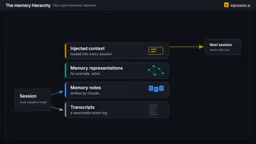
Agent Memory Explained: The Four-Layer Architecture and the 'Dreaming' Mechanism
Anthropic's agent memory research explained: the four-layer architecture, CLBench and Pokémon experiments testing what to remember, and the 'dreaming' mechanism that fixes notes, builds wikis, and improves context injection—plus its limits.
Anthropic's Agent Memory Architecture: The Memory Philosophy of Less Is More
Anthropic's Pokemon Red experiment reveals a counterintuitive conclusion about agent memory: a Claude saving 413 files performed worse than one maintaining a short dashboard. This article analyzes the four-layer memory architecture, the Dreams offline correction mechanism, and CLAUDE.md best practices.