New Apple TV 4K Review: Pricey But Still the Best Streaming Box
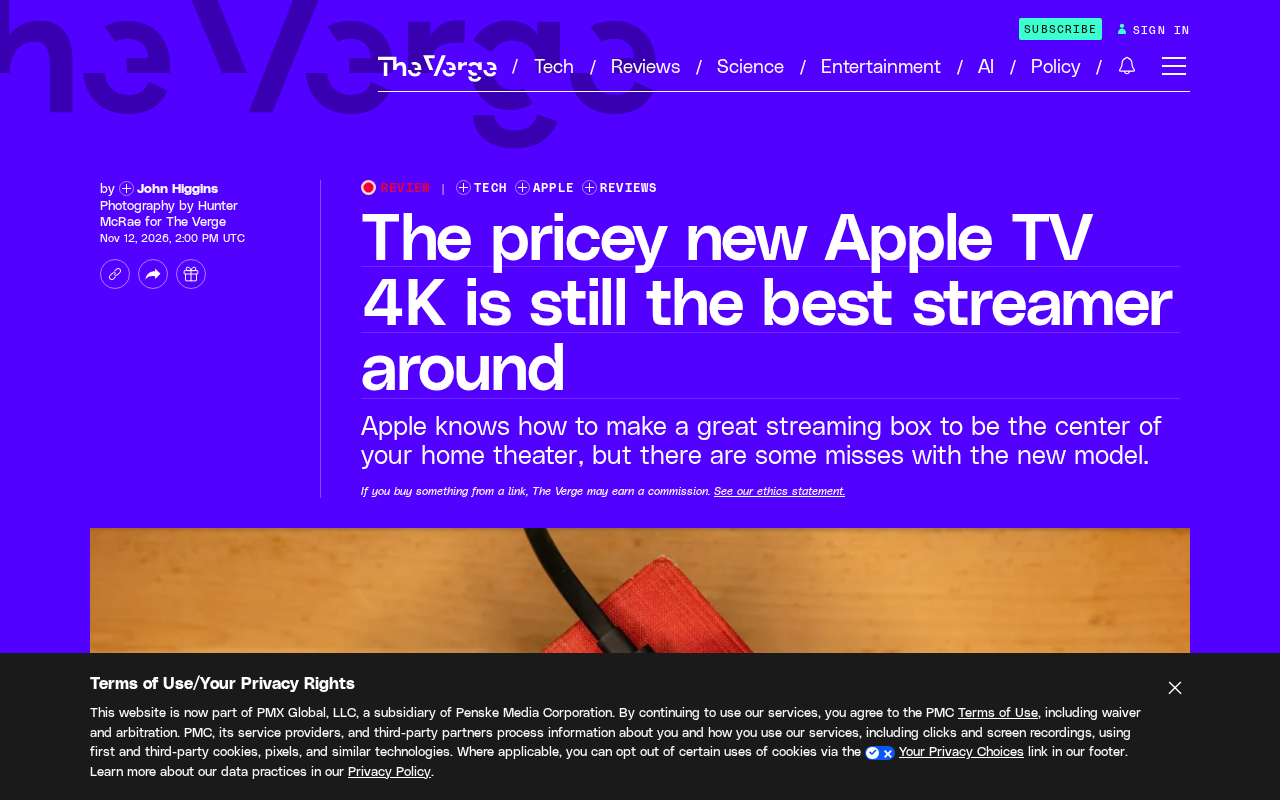
Although pricey, the Apple TV 4K remains the best streaming box thanks to HomePod networking, smooth tvOS, and privacy protection.
Based on Engadget's review, this article analyzes how the new Apple TV 4K holds its position as the "best streaming box" despite its price disadvantage. Its core advantages include spatial audio via multi-HomePod networking through eARC, an A-series chip ensuring smooth interface and 4K HDR decoding, support for Dolby Vision and HDR10+, and an ad-free tvOS system with stricter privacy protection. Reviewers believe the high price corresponds to ecosystem synergy and an experience premium—a natural extension for Apple ecosystem users, but for budget-sensitive users, competitors like Roku or Fire TV are more pragmatic.
In today's fiercely competitive streaming device market, Apple has updated its Apple TV 4K lineup. Despite the still-high price, multiple reviewers believe it remains the best overall streaming box available today. Based on Engadget's in-depth hands-on and industry analysis, this article explores why this new model can hold the throne despite its price disadvantage.
Immersive Audio Experience: HomePod Networking Is the Killer Feature
The reviewer describes a highly immersive scene: sitting in front of the TV with a dog snuggled nearby, four HomePods in the living room—two flanking the TV and two at either end of the sofa—connected to the new Apple TV 4K. When young Anakin Skywalker in Star Wars hits the accelerator and speeds across the room, sound comes from all directions, creating an enveloping sound field.
This multi-HomePod networking capability is a unique advantage of the Apple ecosystem. Through eARC (Enhanced Audio Return Channel) support, the Apple TV 4K can wirelessly forward audio from all TV input sources to HomePods, allowing traditional TV programs, game consoles, and even Blu-ray players to deliver a spatial audio experience. For users who have already invested in Apple audio hardware, the synergy value of this combination far exceeds the price tag of the device itself.
According to Engadget's review, latency is well controlled in real-world use, with no noticeable audio-video sync issues. It should be noted, however, that the barrier to entry is not low—users need at least one Apple TV 4K and two HomePods, a considerable total investment.
eARC (Enhanced Audio Return Channel) is a key feature introduced by the HDMI 2.1 standard, intended to replace traditional ARC (Audio Return Channel). Standard ARC is bandwidth-limited and can only transmit compressed 5.1-channel audio; eARC greatly increases bandwidth and can losslessly transmit object-based immersive audio formats such as Dolby Atmos and DTS:X. In the Apple TV 4K scenario, the TV sends the original audio signal from external devices such as game consoles and Blu-ray players back to the Apple TV 4K via the eARC interface, and the latter uses its processing power to wirelessly forward the audio to HomePods. The key to this chain is that eARC ensures the audio signal is not degraded before reaching the Apple TV 4K, thereby achieving a true spatial audio experience. Without eARC, users only get compressed audio quality, and the surround effect is significantly compromised.
Performance and Picture Quality: The Confidence of the A-Series Chip
The new Apple TV 4K is equipped with an upgraded A-series chip, with graphics processing power noticeably improved over the previous generation. The review mentions that interface scrolling, app launching, and game loading are all smoother, and 4K HDR content decoding is handled with ease.
In terms of picture quality, the device supports Dolby Vision, HDR10+, and Dolby Atmos, covering mainstream high dynamic range formats. For home theater enthusiasts who prioritize picture quality, this means that regardless of which HDR standard a streaming platform uses, the Apple TV 4K can output it correctly.
One detail: Apple has added a screen calibration feature using an iPhone, leveraging the phone's ambient light sensor to adjust the TV's color output. Although this feature is not exclusive to the new model, its deep integration with tvOS remains a differentiating selling point of the Apple ecosystem.
Dolby Vision and HDR10+ are the two mainstream dynamic HDR formats today, and the core difference lies in how metadata is delivered. Dolby Vision uses proprietary dynamic metadata to optimize brightness and contrast frame by frame, but it requires licensing fees and has strict hardware requirements; HDR10+ is an open standard that also supports frame-by-frame dynamic metadata but is royalty-free, and has been adopted by an increasing number of streaming platforms and TV manufacturers in recent years. The Apple TV 4K supports both, meaning that whether users watch Netflix (Dolby Vision) or Amazon Prime Video (HDR10+), they get optimal picture output. In addition, Dolby Atmos is an object-based audio technology that creates an overhead sound field by positioning sound objects in three-dimensional space, fundamentally different from traditional channel-based surround sound.
Price Controversy: Justified Expensiveness or Brand Premium?
Engadget's headline bluntly says "pricey," reflecting the general market view. Compared with competitors such as Roku and Amazon Fire TV, the Apple TV 4K costs considerably more and comes with no accessories beyond a remote.
But the reviewer's conclusion is that it is "still the best streaming box." This judgment is based on several dimensions: first, system smoothness and the ad-free tvOS experience—unlike many competitors whose home screens are packed with recommendations, tvOS's interface is relatively restrained; second, privacy protection, as Apple imposes stricter limits on tracking users' viewing behavior; third, ecosystem integration—if you use an iPhone, iPad, or Mac, the seamlessness of AirPlay casting and HomeKit smart home control is hard for other platforms to replicate.
In other words, the premium of the Apple TV 4K corresponds to an "experience tax" rather than mere hardware cost. For Apple ecosystem users, it's money well spent; for ordinary users seeking value for money, competitors may be a more pragmatic choice.
tvOS is the dedicated operating system Apple developed for the Apple TV series, based on a trimmed iOS kernel. Unlike open platforms such as Android TV, tvOS uses a closed ecosystem where apps must pass App Store review and the system interface is strictly controlled by Apple. This closed nature brings two direct results: first, greater system smoothness and consistency, because Apple has full control over hardware and software; second, very few ads and recommendations, since Apple does not rely on home-screen ad slots for revenue, making the interface relatively restrained. In addition, tvOS follows Apple's unified privacy policies, such as limiting cross-app tracking (App Tracking Transparency), and users' viewing behavior data is not shared with third-party advertisers by default. These features constitute important support for the Apple TV 4K's premium.
Competitor Comparison and Buying Advice
In the streaming box market, the Apple TV 4K's main rivals include the Roku Ultra and the Amazon Fire TV Cube. Roku is known for content neutrality and affordability, while the Fire TV Cube deeply integrates the Alexa voice assistant.
According to Engadget's analysis, the Apple TV 4K's advantage lies in "not favoring any streaming service"—Apple's recommendation algorithm will not deliberately elevate content from a certain platform due to business partnerships. This neutrality benefits users, but it also means Apple is less aggressive in content curation than competitors.
On buying advice: if you already own HomePods or multiple Apple devices, the Apple TV 4K is a natural extension, and the experience boost from multi-device synergy is enough to offset the price disadvantage; if you just need a box to watch Netflix and YouTube and have a limited budget, entry-level models from Roku or Fire TV may be more suitable.
Conclusion
The new Apple TV 4K continues Apple's "high price, high quality" product logic. Its advantages in audio networking, system smoothness, and privacy protection are hard for competitors to replicate, but the price barrier also keeps some users out. Engadget's review conclusion is representative: it is the best streaming box, but "best" does not mean "suitable for everyone."
One-line Summary
Although pricey, the Apple TV 4K remains the best streaming box thanks to HomePod networking, smooth tvOS, and privacy protection.
Paragraph Summary
Based on Engadget's review, this article analyzes how the new Apple TV 4K holds its position as the "best streaming box" despite its price disadvantage. Its core advantages include: spatial audio via multi-HomePod networking through eARC, an A-series chip ensuring a smooth interface and 4K HDR decoding, support for Dolby Vision and HDR10+, and an ad-free tvOS system with stricter privacy protection. Reviewers believe the high price corresponds to ecosystem synergy and an experience premium—a natural extension for Apple ecosystem users, but for budget-sensitive users, competitors like Roku or Fire TV are more pragmatic.
Related articles

Jensen Huang Returns to Nvidia: The Power Game Behind an "Aggro Reset"
Nvidia's board reappointed Jensen Huang as CEO less than two weeks after his scandal-driven resignation. This analysis explores the board's decision-making, Trump's political intervention, media power failure, and market reaction behind the dramatic return.

Why Voice AI Can't Understand Kenyans' Everyday Conversations
Swahili speech recognition hits 3.24% error on read text, but everyday Kenyan speech mixes English, Sheng slang, and accents—leaving mainstream voice AI struggling.

Data Centers Build Their Own Natural Gas Plants: AI Compute's Breakout Around a Decade-Long Grid Wait
Grid interconnection approvals can take a decade, so xAI and others are building off-grid natural gas plants to power AI clusters. This article analyzes the drivers, costs, and impact of behind-the-meter generation on AI infrastructure.