New Benchmark for Singapore Legal Reasoning: SG-LegalClarify Released, Top LLM Among 19 Reaches Only 69.8%

Singapore legal benchmark SG-LegalClarify reveals LLMs are strong at legal reasoning but weak at clarification awareness.
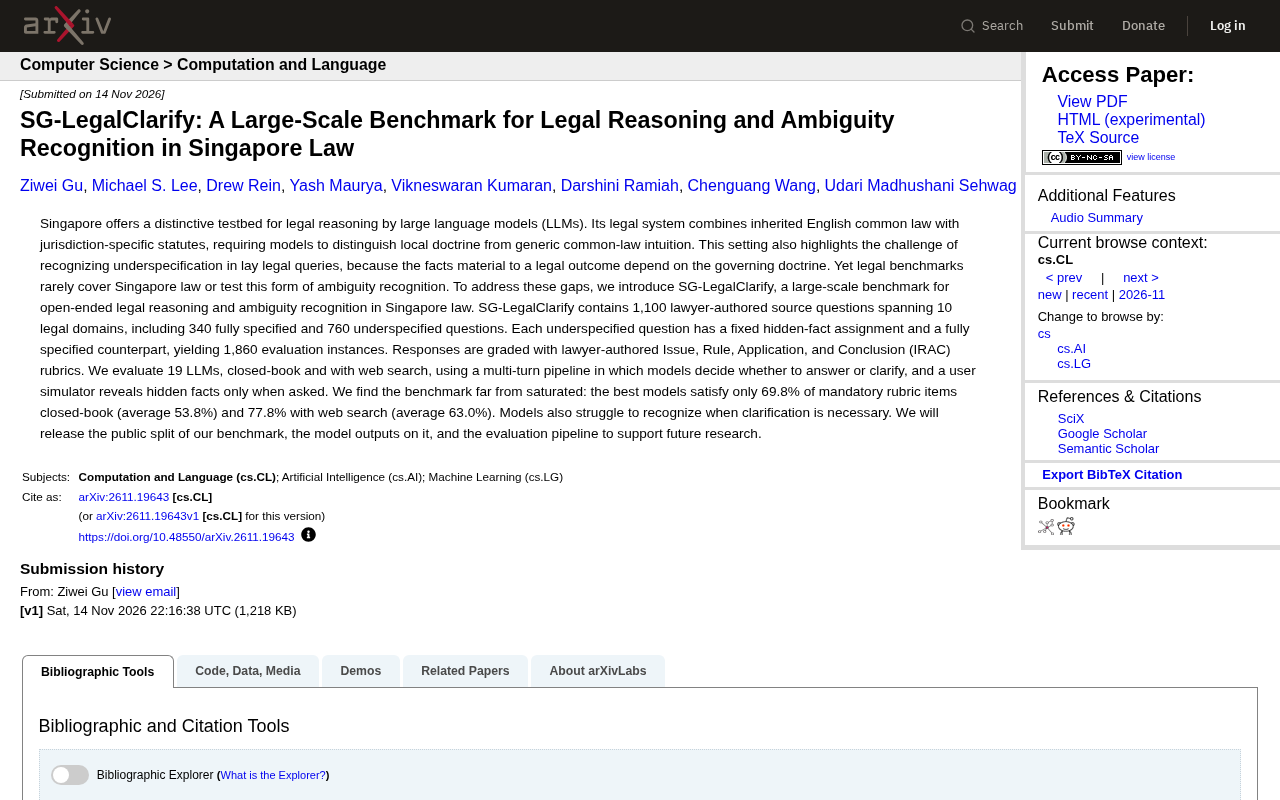
SG-LegalClarify is the first large-scale benchmark for Singapore law, containing 1,100 lawyer-written questions across 10 legal domains. Through underspecified–complete question pairs and IRAC rubrics, it tests both legal reasoning quality and ambiguity recognition. The team used multi-turn interaction and a user simulator to evaluate 19 LLMs, finding that the best model meets only 69.8% of mandatory rubric items closed-book, rising to 77.8% with web search, with overall averages of 53.8% and 63.0%—far from saturated. The key weakness is models' poor ability to recognize when clarification is needed, often giving definitive answers with incomplete facts. The benchmark provides a multi-source cross-validation tool for legal AI development, emphasizing the need to specifically train the meta-capability of "when to ask and what to ask."
Why Singapore Law Is a Unique Touchstone for LLM Reasoning
Singapore's legal system combines English common law inherited from Britain with local statutes. This hybrid nature poses a special challenge for large language models: models must not only understand general common law principles but also distinguish Singapore-specific statutes and precedents. More critically, under the common law system, the key facts on which legal conclusions depend are often determined by jurisdiction-specific doctrines. This means that open-ended legal questions aimed at general users commonly exhibit "factual underspecification." Whether a model can recognize insufficient information and proactively request clarification directly affects the reliability of legal AI applications. However, existing legal benchmarks rarely cover Singapore law and almost never test this ambiguity-recognition capability. According to the arXiv paper "SG-LegalClarify: A Large-Scale Benchmark for Legal Reasoning and Ambiguity Recognition in Singapore Law," the team built a large-scale benchmark to fill this gap.
Common Law System and Factual Underspecification: Common Law is a case-based legal system in which judges adjudicate cases by interpreting precedents and statutes. Unlike civil law systems, legal conclusions under common law depend heavily on specific facts, because the applicability of a precedent depends on how similar the current case facts are to those of the precedent. This "fact sensitivity" means that in open-ended legal questions, users often fail to provide sufficient facts, and models must identify information gaps and proactively seek clarification—otherwise they may give erroneous conclusions based on incomplete facts. Singapore law inherits the English common law tradition while incorporating local statutes, further increasing the complexity of jurisdiction-specific knowledge.
SG-LegalClarify Design: 1,100 Lawyer-Authored Questions, 1,860 Evaluation Instances
The core of SG-LegalClarify is a set of 1,100 source questions written by lawyers, covering 10 legal domains. Of these, 340 are information-complete questions and 760 are factually underspecified questions. Each underspecified question is paired with a fixed hidden fact set and an information-complete counterpart, ultimately generating 1,860 evaluation instances. This "underspecified–complete" paired design enables the benchmark to simultaneously test models' legal reasoning quality and clarification judgment.
All answers are assessed using lawyer-written IRAC (Issue, Rule, Application, Conclusion) rubrics, ensuring that scoring dimensions align with the reasoning structure of legal practice. This design makes the benchmark focus not only on the correctness of final answers but also on the completeness of the reasoning process.
IRAC Framework: IRAC is the classic structure for legal reasoning and writing, standing for Issue, Rule, Application, and Conclusion. In legal education and practice, IRAC helps lawyers systematically analyze problems. This benchmark's use of lawyer-written IRAC rubrics means that model responses must cover all four dimensions to satisfy mandatory rubric items, thereby evaluating not only the final answer but also the completeness of the reasoning chain.
Evaluation Methodology: Multi-Turn Interaction and User Simulator
The research team evaluated 19 LLMs using a multi-turn pipeline under two settings: closed-book and web search. In the multi-turn process, the model must first decide whether to answer directly or request clarification; only when the model proactively asks does the user simulator reveal hidden facts. This design simulates the information exchange between lawyer and client in real legal consultations, turning "recognizing insufficient information" into a quantifiable behavioral indicator.
The core metric is the model's satisfaction rate of mandatory rubric items. Results show that the benchmark is far from saturated: the best model satisfies only 69.8% of mandatory rubric items in closed-book mode, with an average of 53.8%; with web search, the best model improves to 77.8%, with an average of 63.0%.
Multi-Turn Interaction and User Simulator: Multi-turn interaction refers to multiple rounds of dialogue between the model and user (or simulator), in which the model can proactively ask questions to obtain missing information. The user simulator is a programmatic component that answers model questions based on preset hidden facts, simulating a real client. This design turns "recognizing insufficient information" into observable behavior: the model must decide whether to ask and what to ask, and the simulator reveals facts only when asked. By counting the frequency and quality of model questions, clarification awareness can be quantitatively evaluated, addressing the deficiency of single-turn evaluation, which cannot test interactive capabilities.
Key Findings: Reasoning Is Adequate, Clarification Awareness Is Weak
The data reveal a clear shortcoming—models struggle to recognize when clarification is needed. Although web search brings significant performance improvements (about 8 percentage points for the best model and about 9 percentage points on average), overall performance remains far from reliable legal assistance. This indicates that current LLMs, when handling open-ended legal questions, tend to give seemingly definitive answers when facts are incomplete rather than first asking about key facts.
From the IRAC framework perspective, differences in satisfaction rates on Rule and Application may reflect varying degrees of mastery of Singapore-specific jurisdiction knowledge. The benchmark covers 10 legal domains, and performance differences across domains warrant deeper analysis in future research.
Implications for Legal AI Development
The release of SG-LegalClarify provides the legal AI field with an evaluation tool for multi-source cross-validation: it tests both jurisdiction-specific knowledge and ambiguity recognition as a meta-capability. For developers, this means that simply scaling up models or adding search access is insufficient to solve reliability problems in legal scenarios; dedicated training and evaluation strategies are needed for "when to ask and what to ask."
The research team states that it will release the benchmark's public split, model outputs, and evaluation pipeline to support future research. For readers interested in legal NLP, benchmark construction, and LLM uncertainty recognition, this benchmark is worth following.
Frequently Asked Questions
Which legal domains does SG-LegalClarify cover? It covers 10 legal domains, with questions written by lawyers, within the Singapore jurisdiction.
How large is the benchmark? 1,100 source questions, of which 340 are information-complete and 760 are factually underspecified, generating 1,860 evaluation instances.
How do the models perform? Among the 19 LLMs, the best closed-book model satisfies 69.8% of mandatory rubric items, and the best web-search model reaches 77.8%, with overall averages of 53.8% and 63.0%, respectively.
Related articles

Jensen Huang Returns to Nvidia: The Power Game Behind an "Aggro Reset"
Nvidia's board reappointed Jensen Huang as CEO less than two weeks after his scandal-driven resignation. This analysis explores the board's decision-making, Trump's political intervention, media power failure, and market reaction behind the dramatic return.

Why Voice AI Can't Understand Kenyans' Everyday Conversations
Swahili speech recognition hits 3.24% error on read text, but everyday Kenyan speech mixes English, Sheng slang, and accents—leaving mainstream voice AI struggling.

Data Centers Build Their Own Natural Gas Plants: AI Compute's Breakout Around a Decade-Long Grid Wait
Grid interconnection approvals can take a decade, so xAI and others are building off-grid natural gas plants to power AI clusters. This article analyzes the drivers, costs, and impact of behind-the-meter generation on AI infrastructure.