New Breakthrough in Diffusion Language Model Distillation: Data-Free Framework Lets Students Surpass Teachers

First systematic study of diffusion language model distillation, revealing forward KL failure and proposing a unified data-free framework.
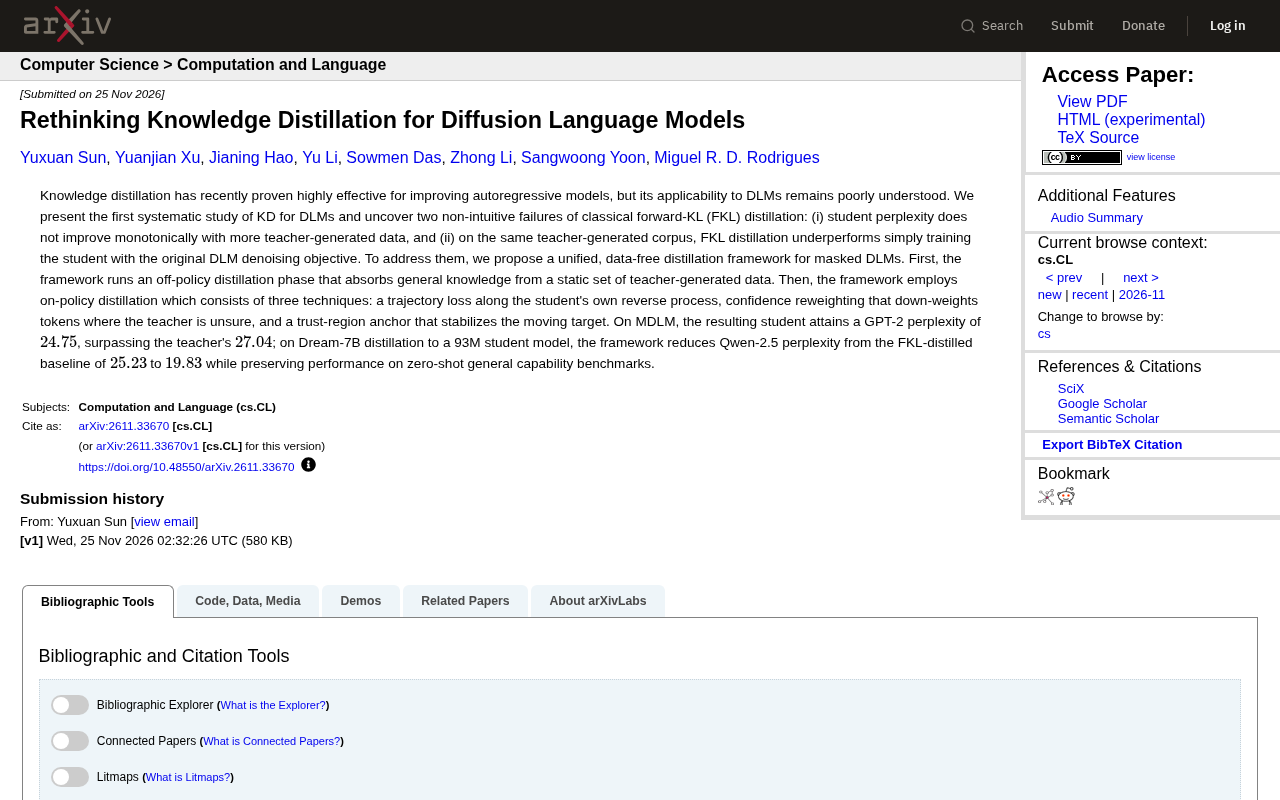
This article systematically examines the applicability of knowledge distillation to diffusion language models (DLMs), finding two counterintuitive failures of classic forward KL distillation: student perplexity does not monotonically improve with more teacher-generated data, and performance is even worse than directly training with the original denoising objective. To address this, the authors propose a unified data-free distillation framework for masked diffusion language models, divided into two stages: off-policy distillation (absorbing general knowledge from static teacher data) and on-policy distillation (combining trajectory loss, confidence reweighting, and trust-region anchor). Experiments show that on MDLM the student model's GPT-2 perplexity of 24.75 surpasses the teacher's 27.04; when distilling Dream-7B into a 93M student model, Qwen-2.5 perplexity drops from the FKL baseline's 25.23 to 19.83 while zero-shot general capabilities are maintained.
Diffusion Language Models (DLMs), as a generative paradigm beyond autoregressive models, have attracted increasing attention in recent years. However, whether and how knowledge distillation (KD) is effective on such models has lacked systematic study. A new work is the first to systematically examine the applicability of KD to DLMs and proposes a unified data-free distillation framework, achieving surprising results on multiple benchmarks.
Two Counterintuitive Failures of Classic Forward KL Distillation on DLMs
The research team found that when the forward KL (FKL) distillation commonly used in autoregressive models is directly transferred to DLMs, two counterintuitive failure modes emerge.
The first failure is that the student model's perplexity does not monotonically improve as the teacher generates more data. In distillation practice for autoregressive models, increasing teacher-generated corpora is generally regarded as a reliable means to improve student performance, but this intuition no longer holds on DLMs.
The second failure is more critical: on the same teacher-generated corpus, FKL distillation performs even worse than directly training the student with the original DLM denoising objective. This means that the classic distillation objective may introduce some mismatch on masked diffusion models, causing the student to "learn astray" from the teacher.
Together, these two findings show that distillation for DLMs needs to be redesigned rather than simply applying the experience from autoregressive models.
The difference between forward KL and reverse KL: There are two directions of KL divergence commonly used in knowledge distillation. Forward KL is written as $D_{\mathrm{KL}}(p_{\text{teacher}} | p_{\text{student}})$, which penalizes the student distribution for insufficient coverage of the teacher's high-probability regions and tends to make the student "cover" all of the teacher's modes, hence it is often called a "mass-covering" objective. Reverse KL is the opposite, tending to make the student focus on only one high-probability mode of the teacher, known as "mode-seeking." In autoregressive models, FKL acts directly on the per-token conditional distribution, and its gradient form is highly consistent with maximum likelihood, so its practical performance is stable. But in masked diffusion models, the teacher distribution is defined on noisy intermediate states, and the student needs to match the teacher at each timestep of its own reverse process. FKL's "covering" tendency incorporates the teacher's uncertainty at different noise levels into the loss, causing the optimization objective to misalign with the student's actual generation path—this is one of the important reasons why FKL fails on DLMs.
A Unified Data-Free Distillation Framework
To address the above issues, the authors propose a unified data-free distillation framework specifically for masked diffusion language models (masked DLMs). The framework is divided into two stages, balancing knowledge absorption and online correction.
Stage 1: Off-Policy Distillation to Absorb General Knowledge
The framework first runs an off-policy distillation stage, absorbing general knowledge from a set of static teacher-generated data. This stage is equivalent to letting the student model first establish a basic understanding of the teacher's output distribution, providing a stable starting point for subsequent online distillation.
Stage 2: Three Techniques for On-Policy Distillation
After the off-policy stage, the framework enters the on-policy distillation stage, which includes three key techniques:
- Trajectory loss: Computes the loss along the student's own reverse process, aligning the distillation signal with the student's actual generation trajectory rather than forcing a match to the teacher's fixed path.
- Confidence reweighting: Downweights tokens on which the teacher is uncertain, preventing the student from learning noise from the teacher's "hesitation."
- Trust-region anchor: Stabilizes the moving target, preventing drastic drift of the target distribution during on-policy distillation that could cause training instability.
These three techniques work together to enable effective on-policy distillation on the student's own distribution while maintaining training stability.
Off-policy vs. on-policy distillation: Off-policy distillation uses a static dataset pre-sampled by the teacher to train the student; the data distribution is determined by the teacher and is independent of the student's current ability. On-policy distillation lets the student generate its own trajectories, and the teacher then provides supervision signals for the states the student actually visits, so the training distribution updates dynamically with the student's ability. Each has pros and cons: off-policy training is stable and data can be reused offline, but there is a mismatch between training and inference distributions—the student may enter states never seen in the teacher's data during generation; on-policy distillation can alleviate this distribution shift but is prone to target drift and training instability. The two-stage design of this framework—off-policy first, then on-policy—is precisely to combine the advantages of both and provide a stable initialization starting point for the second stage.
The reverse process of masked diffusion language models: The generation process of a masked DLM is iterative denoising: starting from a sequence where all or some tokens are replaced by [MASK], the model predicts the true tokens at masked positions at each step and gradually reduces the masking ratio until the full text is restored. Unlike autoregressive models that generate token by token from left to right, each step of a DLM predicts multiple positions simultaneously, and the generation order has some randomness. The so-called "reverse process" is the series of state transitions that gradually restore from a high-noise (high masking rate) state to clean text. Trajectory loss is important because the same piece of text may have multiple denoising trajectories in a DLM; forcing the student to match one fixed path of the teacher would introduce unnecessary constraints. Applying the distillation signal along the student's own reverse process keeps the supervision consistent with the student's actual generation behavior.
Experimental Results: Student Perplexity Surpasses Teacher
In experiments on MDLM, the student model obtained by this framework achieved a GPT-2 perplexity of 24.75, surpassing the teacher model's 27.04. The student model outperforming the teacher in perplexity is a noteworthy phenomenon in distillation research, suggesting that mechanisms such as on-policy distillation and confidence reweighting may help the student avoid some of the uncertainty in the teacher's distribution.
In an experiment distilling Dream-7B into a 93M student model, the framework reduced Qwen-2.5 perplexity from the FKL distillation baseline's 25.23 to 19.83, while maintaining performance on zero-shot general capability benchmarks. This means the distilled student model is not only better on language modeling metrics but also does not sacrifice general capabilities.
Why This Research Is Worth Attention
Making diffusion language models more efficient is one of the key bottlenecks for their practical deployment. This research reveals the failure mechanisms of classic distillation objectives on DLMs and provides an actionable alternative. The data-free distillation setting also reduces dependence on external datasets, making the distillation pipeline more self-contained.
For researchers and engineers interested in the intersection of diffusion models and knowledge distillation, this work provides a clear starting point: distillation on DLMs cannot simply copy the practices of autoregressive models; instead, losses and stabilization mechanisms need to be designed around the student's own reverse process.
One-line Summary
First systematic study of diffusion language model distillation, revealing forward KL failure and proposing a unified data-free framework.
Paragraph Summary
This article systematically examines the applicability of knowledge distillation to diffusion language models (DLMs), finding two counterintuitive failures of classic forward KL distillation: student perplexity does not monotonically improve with more teacher-generated data, and performance is even worse than directly training with the original denoising objective. To address this, the authors propose a unified data-free distillation framework for masked diffusion language models, divided into two stages: off-policy distillation (absorbing general knowledge from static teacher data) and on-policy distillation (combining trajectory loss, confidence reweighting, and trust-region anchor). Experiments show that on MDLM the student model's GPT-2 perplexity of 24.75 surpasses the teacher's 27.04; when distilling Dream-7B into a 93M student model, Qwen-2.5 perplexity drops from the FKL baseline's 25.23 to 19.83 while zero-shot general capabilities are maintained.
Related articles

Nothing CMF Buds 2A Drops to $17.89 on Black Friday: A New Low for ANC Earbuds
Nothing CMF Buds 2A wireless earbuds Black Friday deal: just $17.89 on Amazon, about $11 off retail and a record low. ANC earbuds at an entry-level price.

When AI Creation Gets Accused of "Spitting": Hacker News Heats Up Over the Glaude Controversy
A Hacker News post, "Spitting in the Face of Glaude," sparks debate on AI creation transparency and attribution ethics. This analysis examines the blurred creator identity behind the controversy and offers practical advice for AI content production.

Akai Embraces Custom Firmware: MPC Sample 1.4 Lets Users AI-Program Their Sampler
Akai embraces the modding community with MPC Sample 1.4 firmware, supporting vibe-coded custom firmware and effects. We analyze the impact of this open strategy on music hardware and AI-assisted programming.