New Breakthrough in Hybrid Decision Trees: Selective Case Splitting Balances Interpretability and Accuracy

Hybrid decision trees fuse feature and case splitting, achieving ensemble-level accuracy with shallow structures.
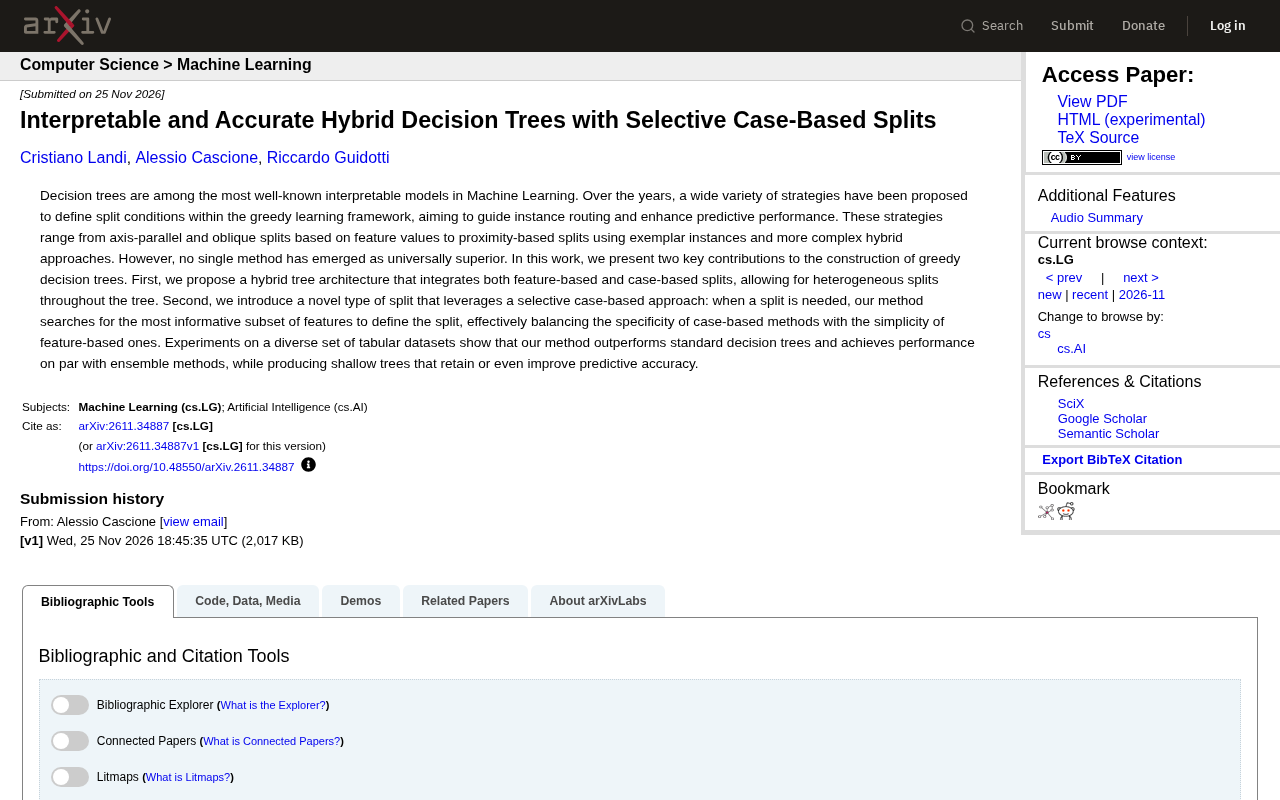
The article introduces a hybrid decision tree architecture that resolves the dilemma of no single splitting strategy universally dominating. It allows nodes to dynamically choose between feature-based and case-based splitting, and introduces selective case splitting that searches for the most informative feature subset to define proximity partitions. Experiments on tabular datasets show hybrid trees significantly outperform standard decision trees and match ensemble methods like random forests and gradient boosting, while producing shallower trees with shorter decision paths—ideal for scenarios requiring both accuracy and interpretability.
Decision trees are among the most well-known interpretable models in machine learning. Over the years, researchers have proposed various splitting strategies to improve their predictive performance—from axis-parallel splits and oblique splits to proximity-based exemplar splits—but no single method has ever emerged as the universal winner. A recent paper proposes a hybrid tree architecture that integrates feature-based and case-based splitting and introduces selective case splitting, achieving accuracy comparable to ensemble methods while maintaining a shallow tree structure.
The Evolution and Dilemma of Decision Tree Splitting Strategies
Traditional decision trees use a greedy learning framework, the core of which lies in defining splitting conditions. Early methods mainly relied on feature values for axis-parallel splits (such as CART and ID3), and later oblique splits emerged to capture linear combinations between features. Another line of thinking is proximity-based splitting, which uses exemplar instances to partition data—typically represented by the combination of case-based reasoning (CBR) and decision trees.
Each of these methods has its strengths and weaknesses: feature splits are simple and efficient but may fail to capture complex instance-level patterns; case splits can handle local structure but are prone to overfitting and costly to interpret. The paper points out that no single method universally dominates across all datasets, which motivates researchers to explore hybrid approaches.
Axis-parallel splitting means using only one feature at a time and selecting a threshold on that feature to divide the data in two. Its decision boundary is parallel to the coordinate axes in feature space, corresponding to a condition of the form x_j ≤ t. Classic algorithms such as CART, ID3, and C4.5 all adopt this form. Its advantage is that each split involves only one variable, making rules intuitive and training efficient; its limitation is that when the true decision boundary is a diagonal combination of features (such as x_1 + x_2 > 1), multiple levels of step-like splits are needed to approximate it, causing the tree to grow deeper.
Oblique splitting allows the condition to be a linear combination of multiple features, i.e., w·x ≤ t. A single split can produce a tilted decision boundary, thereby capturing feature interactions with fewer nodes. The cost is that each node requires solving a linear classification subproblem (such as a perceptron or logistic regression), which incurs greater computational overhead, and the weight coefficients are not as immediately transparent as a single threshold, somewhat reducing interpretability.
Hybrid Tree Architecture: Heterogeneous Fusion of Features and Cases
The first contribution of this research is a hybrid tree architecture that allows both feature-based splits and case-based splits to coexist within the tree. Unlike previous approaches that simply concatenate the two, this architecture dynamically selects the split type at each node of the tree, forming heterogeneous splitting paths.
Specifically, as the tree grows, it can decide based on data characteristics whether the current node should split using a feature threshold or case proximity. This flexibility enables the model to leverage both the simplicity of feature splits and the ability of case splits to handle local anomalies or complex patterns. Experiments show that this heterogeneity helps produce shallower trees while maintaining or improving predictive accuracy.
Case-based splitting differs mechanistically from feature-based splitting: rather than comparing a feature's value against a threshold, it uses several "exemplar instances" as anchors and determines which branch a sample goes to based on its proximity to these instances (e.g., Euclidean distance, Manhattan distance). This essentially embeds a nearest-neighbor-style discriminator at the node, enabling the tree to directly express local patterns such as "if similar to a certain typical sample, go to the left branch."
Since the partition is based on distance relationships between samples rather than a single coordinate axis, case splitting is more sensitive to local structure and small sample clusters, but it also depends more on the choice of distance metric, and in high-dimensional spaces distances tend to concentrate (curse of dimensionality), requiring feature selection or dimensionality reduction. The hybrid tree lets each node autonomously choose between the two splitting mechanisms, essentially unifying "global rule-based partitioning" and "local similarity-based partitioning" within a single tree.
Selective Case Splitting: Balancing Specificity and Simplicity
The second contribution is a novel selective case splitting method. When a split is needed, the algorithm searches for the most informative feature subset to define the split, rather than using all features or a random subset. This process essentially seeks a balance between the specificity of case splitting and the simplicity of feature splitting.
Traditional case splitting typically uses all features to compute distances between instances, making it susceptible to interference from noisy features. The selective method filters feature subsets, preserving case splitting's sensitivity to local structure while reducing the risk of the curse of dimensionality. The paper emphasizes that this splitting approach performs excellently on diverse tabular datasets, outperforming standard decision trees and achieving performance comparable to ensemble methods (such as random forests and gradient boosting).
The curse of dimensionality here specifically means: as feature dimensionality increases, the discriminability of distances between samples rapidly declines, and the ratio of nearest-neighbor to farthest-neighbor distance approaches 1, making "proximity" no longer a reliable indicator of class membership. If case splitting uses all features to compute distances, it will be diluted by numerous irrelevant or noisy features, degrading split quality.
Selective case splitting defines distance by searching for the most informative feature subset, which is equivalent to performing supervised feature selection at the node level—compressing the dimensionality used for distance computation and filtering out noisy dimensions. It should be noted that this subset search increases the computational cost per node, and since the subset is selected on training data, there is a risk of overfitting when the sample size is small, typically requiring cross-validation or penalty terms for control.
Experimental Validation and Performance
The research conducted experiments on multiple tabular datasets, comparing standard decision trees, hybrid trees, and ensemble methods. Results show that hybrid trees maintain a shallow structure (typically of small depth) while achieving predictive accuracy on par with ensemble methods and significantly outperforming standard decision trees.
Interestingly, shallow tree structures are crucial for interpretability—shorter decision paths make it easier for users to understand the model's decision logic. The paper notes that this method has application potential in scenarios requiring a balance between accuracy and interpretability, such as medical diagnosis and financial risk control.
Ensemble methods refer to models that train multiple base learners and aggregate their outputs. Random forests build multiple decision trees through bootstrap sampling and random feature subsets and then vote; gradient boosting sequentially fits each new tree to the residuals of the preceding model. They typically offer higher accuracy and greater robustness to hyperparameters, but a model composed of hundreds or thousands of trees makes it difficult to present a single readable decision path, and its interpretability is clearly weaker than a single shallow tree.
The claim of "comparable to ensemble methods" in the paper means that on the evaluated tabular datasets, the hybrid tree's predictive accuracy falls within a comparable range of ensemble methods—not that it consistently surpasses them on all data. This is a key premise for evaluating the method's value: it trades near-ensemble accuracy for single-tree-level transparency, but whether the advantage holds still depends on the specific data distribution and hyperparameter tuning.
Implications for Explainable AI
The value of this work lies in re-examining the complementarity of feature splitting and case splitting in decision trees. Through heterogeneous fusion and selective feature subset search, the model improves performance without excessively increasing complexity. For practical applications pursuing interpretability, this hybrid strategy offers a new approach: rather than choosing between simple feature splits and complex case splits, let the tree adaptively choose based on the data.
Of course, the method still needs validation on more high-dimensional data and time series tasks. But there is no doubt that it adds a new design dimension to the decision tree family and reminds us that interpretability and accuracy are not necessarily contradictory—clever architectural design can achieve both.
One-line Summary
Hybrid decision trees fuse feature and case splitting, achieving ensemble-level accuracy with shallow structures.
Paragraph Summary
The article introduces a hybrid decision tree architecture aimed at resolving the dilemma that "no single splitting strategy universally dominates" in traditional decision trees. The architecture allows tree nodes to dynamically choose between feature-based splitting and case-based splitting, forming heterogeneous splitting paths; it also introduces selective case splitting, which defines proximity-based partitions by searching for the most informative feature subset, striking a balance between the specificity of case splitting and the simplicity of feature splitting. Experiments on multiple tabular datasets show that hybrid trees significantly outperform standard decision trees, achieve accuracy comparable to ensemble methods such as random forests and gradient boosting, and produce shallower trees with shorter decision paths—making them better suited for scenarios like medical diagnosis and financial risk control that require both accuracy and interpretability.
Related articles

Anthropic Denies Claude Was Trained to Sabotage Work: The Controversy Exposes an AI Trust Crisis
Anthropic denies claims that Claude was trained to sabotage work but gives no specifics. This article examines the AI trust issue and the need for vendor transparency.

Gmail 'Send as' to Be Discontinued in 2027: Email Workflows Face Restructuring
Gmail's 'Send as' feature will be discontinued in January 2027, sparking Hacker News discussion. This article explains the feature's role, three affected user scenarios, and a practical preparation checklist for migrating custom sending addresses and reconfiguring domain authentication.

Character.ai Bankruptcy Auction: 21 Million Users' Private Conversations Up for Auction
Character.ai bankruptcy proceedings are auctioning 21 million users' private conversation records, triggering widespread concerns in the Hacker News community about data governance and user privacy in AI companionship products. This article analyzes the legal gray zone of data assets in bankruptcy liquidation, flaws in user agreements, and the AI industry's trust crisis.