New Breakthrough in Retrosynthesis Planning: Verification-Guided Search Improves Route Feasibility

VGR integrates reaction verification as a search action into retrosynthesis planning, significantly boosting feasible route discovery.
This article introduces Verification-Guided Reflow (VGR), a retrosynthesis planning method that addresses the problem of traditional methods evaluating route feasibility only after search, preventing error correction. VGR integrates reaction verification as a decision action into AND/OR search, using verification results in real time to prune or adjust search priorities. On Retro190, verified solvability rose from 51.1% to 62.6%. Further experiments found that combining early verification with immediate prioritization performs worse, leading the authors to propose an "early pruning, delayed guidance" strategy that raises verified solvability to 71.1%. The article emphasizes that the timing and manner of injecting domain knowledge into search matter more than the injection itself, and discusses limitations and implications.
Title
New Breakthrough in Retrosynthesis Planning: Verification-Guided Search Improves Route Feasibility
Meta Description
New retrosynthesis planning method VGR integrates reaction verification into AND/OR search, increasing verified solvability on Retro190 from 51.1% to 62.6%, and with early pruning and delayed guidance further to 71.1%.
Article Content
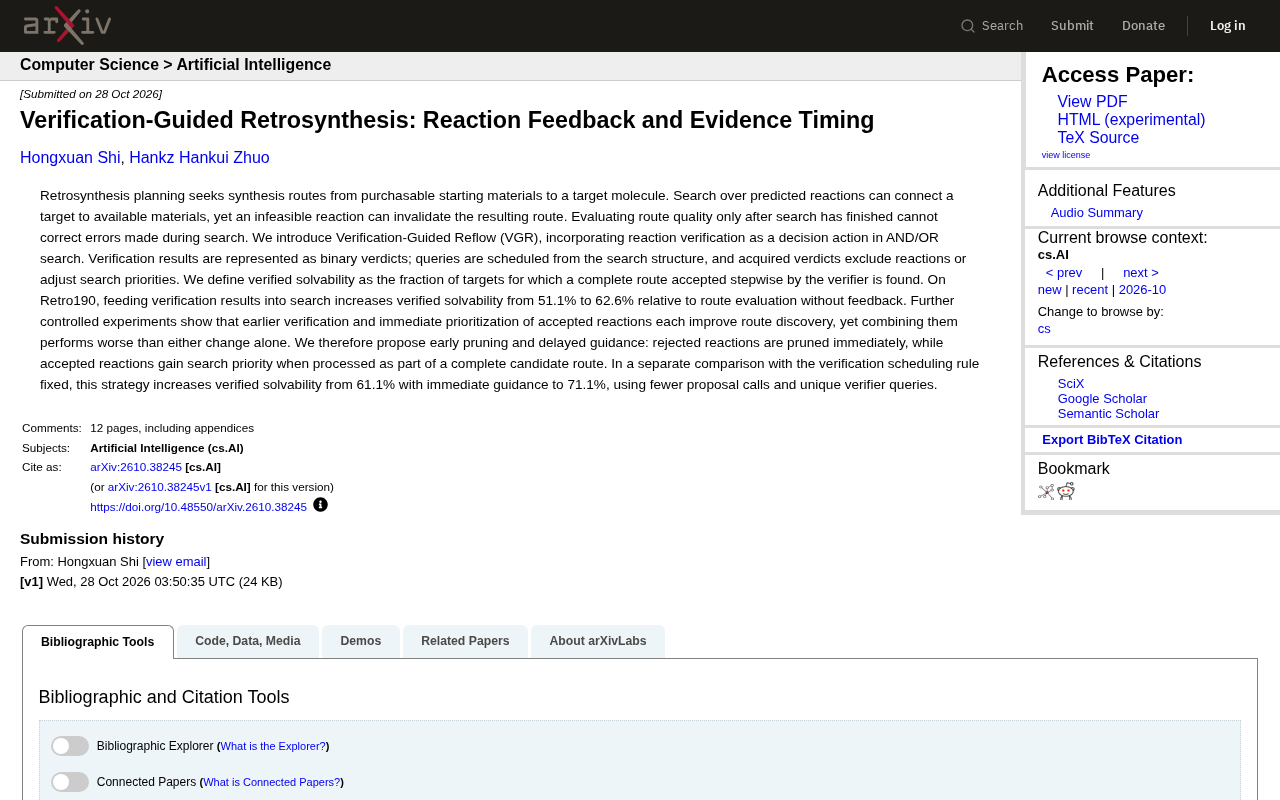
Retrosynthesis planning aims to find synthetic routes to target molecules starting from purchasable starting materials. However, in the search space composed of predicted reactions, a single infeasible reaction is enough to invalidate the entire route. Traditional methods typically evaluate route quality only after the search is complete, by which time errors have already been made and cannot be backtracked or corrected. A recent paper proposes Verification-Guided Reflow (VGR), which integrates reaction verification as a decision action into the AND/OR search process, significantly increasing the probability of finding feasible routes.
Core Problem: The Limitations of Post-hoc Evaluation
The core challenge of retrosynthesis planning lies in the enormous and noisy search space. Model-predicted reactions may appear plausible but are actually infeasible to execute in the lab. If a verifier is used to check routes only after the search is complete, then decisions made during the search based on erroneous reactions cannot be corrected. The paper points out that this "hindsight" approach wastes substantial computational resources and leads to infeasible final routes.
VGR's entry point is straightforward: since a verifier can judge whether a reaction is feasible, why not feed the verification results back to the search in real time?
Retrosynthesis planning is a classic problem in cheminformatics, whose goal is to derive synthetic pathways to a target molecule from known, commercially purchasable starting materials through a series of chemical reactions. This process is typically modeled as an AND/OR search tree: OR nodes represent target molecules, whose children are different reactions that might produce that molecule; AND nodes represent a specific reaction, and all of its children (reactants) must be simultaneously solvable for the reaction to be feasible. Because the number of possible reactions is extremely large and model-predicted reactions often contain infeasible steps, the search space is both vast and noisy. Traditional methods often use a verifier (such as a rule-based feasibility checker or a machine learning model) to evaluate the entire route only after the search is complete, which prevents erroneous decisions from being corrected in time during the search.
How VGR Works: Treating Verification as a Search Action
VGR treats reaction verification as a decision action within AND/OR search. Verification results are returned as binary judgments (feasible/infeasible). Queries are scheduled according to the search structure—that is, which reactions in the search tree are most worth verifying is determined by the current search state. The obtained judgments are used for two operations: directly excluding infeasible reactions, or adjusting search priorities.
This design makes verification no longer an independent post-processing step, but part of the search loop. The paper defines verified solvability as the core metric: the proportion of target molecules for which a complete route accepted step-by-step by the verifier can be found.
AND/OR search is a search algorithm for solving AND-OR graphs. In retrosynthesis, OR nodes correspond to "which reaction to choose to synthesize the target molecule," and AND nodes correspond to "whether all reactants required by that reaction can be synthesized." The goal of the search is to find a complete tree from the target molecule to purchasable starting materials, where all subgoals under each AND node must be solvable. The verifier plays the role of a "judge" here: giving a binary judgment of feasible or infeasible for a reaction. The key innovation of VGR is treating verification queries as a schedulable action during the search process, rather than an independent post-processing step. The search algorithm decides which reactions to verify based on the current state of the search tree, and uses the verification results for pruning (excluding infeasible reactions) or priority adjustment (guiding the search direction).
Experimental Findings: Feedback Works, but Timing Is Critical
On the Retro190 dataset, feeding verification results back into the search increased verified solvability from 51.1% to 62.6% (compared with route evaluation without feedback). This confirms the value of real-time feedback.
But more detailed controlled experiments revealed a counterintuitive phenomenon: earlier verification and immediate prioritization of accepted reactions each improve route discovery, but combining the two is worse than using either alone. The paper speculates that prioritizing accepted reactions too early may cause the search to converge prematurely to a local optimum, ignoring other potential routes.
Early Pruning and Delayed Guidance
Based on this finding, the authors propose an "early pruning, delayed guidance" strategy: rejected reactions are pruned immediately to avoid wasting subsequent search; accepted reactions receive search priority only when they are processed as part of a complete candidate route. In a separate comparison with fixed verification scheduling rules, this strategy increased verified solvability from 61.1% with immediate guidance to 71.1%, while using fewer proposal calls and unique verifier queries.
Retro190 is a benchmark dataset commonly used for evaluating retrosynthesis planning, containing 190 target molecules, each with known synthetic routes. This dataset is typically used to measure an algorithm's ability to find feasible routes under given reaction templates or model predictions. In VGR's experiments, verified solvability is defined as the proportion of target molecules for which a complete route accepted step-by-step by the verifier can be found. This metric directly reflects the search algorithm's ability to produce feasible routes, rather than merely evaluating the accuracy of single-step reactions. Retro190's moderate size makes it suitable for controlled experiments to analyze the impact of the timing of verification signal injection.
Implications and Limitations
The significance of VGR lies in transforming verification from an "evaluation tool" into a "search component." It suggests that in AI-assisted scientific discovery workflows, the timing and manner of injecting domain knowledge (here, reaction feasibility) may be more important than the injection itself. Early pruning is intuitive—infeasible reactions have no retention value; but delayed guidance reminds us that over-trusting feasible reactions may limit the breadth of exploration.
The paper is currently validated only on Retro190, and the coverage of the verifier itself affects the upper bound. In addition, the design of scheduling rules still has room for optimization. But this idea—deeply coupling external verification signals into the search loop—has reference value for broader planning problems.
Note: All data in this article come from the original paper abstract; no additional numerical values were added.
One-line Summary
VGR integrates reaction verification as a search action into retrosynthesis planning, significantly increasing the rate of feasible route discovery.
Paragraph Summary
This article introduces a retrosynthesis planning method called Verification-Guided Reflow (VGR), aimed at solving the problem that traditional methods evaluate route feasibility only after the search is complete, making errors impossible to backtrack. VGR integrates reaction verification as a decision action into the AND/OR search process, using verification results in real time to prune or adjust search priorities. On the Retro190 dataset, verified solvability increased from 51.1% to 62.6%. Further experiments found that combining early verification with immediate prioritization actually performs worse, based on which the authors propose an "early pruning, delayed guidance" strategy, raising verified solvability to 71.1%. The article emphasizes that the timing and manner of injecting domain knowledge into the search are more important than the injection itself, and discusses the limitations and implications of the method.
Related articles

Tencent WorkBuddy Hands-On: How AI Agents Crush Traditional Chat Assistants
WorkBuddy vs Doubao tested: how AI Agents directly operate computers to convert PPT to PDF, archive files and more. Analysis of WorkBuddy's low barrier, domestic ecosystem, pricing and plugin marketplace, plus AI Agent selection advice.

Azure Cross-Tenant Attack Chain: Root Cause Analysis of Five Paths
Binary Security analyzes five full cross-tenant compromise paths in Azure, trending 271 points on HN. This article interprets their shared root cause perspective and offers defense recommendations for cloud tenant isolation and reflections on responsibility boundaries.

Recreating a Real Bubble Tea Station in Isaac Sim: Script-Driven Unitree G1 Brews Tea
Developers recreated a real self-service tea station in NVIDIA Isaac Sim, using scripts to drive a Unitree G1 through a five-step tea-brewing process, exploring whether physics simulation can be a source of synthetic robot demonstration data and discussing contact stability and imitation learning.