New Controversy Around the Riemann Hypothesis: Why Masullo's Proof Is Sparking Debate
New Controversy Around the Riemann Hyp…
Masullo's new work on the Riemann Hypothesis, introduced via Baez's blog, sparked debate on Hacker News, but its mathematical validity awaits peer review.
Discussion around the Riemann Hypothesis has heated up again due to Masullo's new work. Introduced via John Carlos Baez's blog, it gained 163 points and 77 comments on Hacker News, showing sustained interest in this century-old problem. However, the original material only provides a blog link and discussion entry without specific proof details, so the mathematical correctness cannot be judged. Community reactions are not one-sided, with comments likely debating the novelty, rigor, and compatibility with known results. The article emphasizes that breakthroughs require formal verification and peer review, as many past attempts were found flawed. For Masullo's work, cautious optimism is advised while awaiting in-depth review by professional mathematicians.
The mathematical community has recently seen renewed discussion around the Riemann Hypothesis. A new work proposed by Masullo and introduced via John Carlos Baez's blog has gained 163 points and 77 comments on Hacker News, showing sustained public and researcher interest in this century-old problem.
Background
The Riemann Hypothesis is one of the most famous unsolved problems in number theory, concerning the core patterns of prime distribution. Any work claiming to approach a proof or proposing new ideas quickly becomes a focal point. The source of this discussion is an article on John Carlos Baez's blog, which subsequently triggered extensive comments on Hacker News.
According to RSS information, the discussion thread received 163 points and reached 77 comments, indicating that the community has both interest and controversy regarding Masullo's work.
The Riemann Hypothesis was proposed by German mathematician Bernhard Riemann in 1859 and is one of the most famous and important unsolved problems in number theory. Its original formulation centers on the Riemann zeta function: the function is analytic everywhere on the complex plane except for a simple pole at s=1, satisfies a functional equation, and its nontrivial zeros (those lying in the critical strip 0<Re(s)<1) are conjectured to all lie on the line Re(s)=1/2.
Prime distribution is closely related to the zeros of the zeta function. The von Mangoldt formula shows that the oscillatory behavior of the prime counting function π(x) can be determined by the real parts of the nontrivial zeros of the zeta function; if the Riemann Hypothesis holds, the error term in the prime number theorem would have stronger bounds. Since the 20th century, the Riemann Hypothesis has been generalized to various L-functions (the Generalized Riemann Hypothesis) and has become one of the Millennium Prize Problems, with the Clay Mathematics Institute offering a $1 million prize.
To date, mathematicians have computationally verified that the first 10 trillion nontrivial zeros lie on the critical line, but this does not constitute a proof. Historically, the Riemann Hypothesis has deep connections with prime distribution, algebraic number theory, random matrix theory, and even quantum chaos, so any general claim about it receives rigorous scrutiny.
Core Focus of Masullo's Work
Based on available information, Masullo's argument has sparked intense discussion among mathematics enthusiasts and researchers. Since the original material only provides a blog link and discussion entry point without specific proof details, it is impossible to judge the mathematical correctness of the proof.
The heat of community discussion indicates that such new attempts at classical problems typically require careful peer review before conclusions can be drawn. The 77 comments on Hacker News likely include challenges to the proof approach, support, and analysis of technical details.
Community Reaction and Controversy
On Hacker News, the combination of 163 points and 77 comments means the discussion is not one-sided. For problems like the Riemann Hypothesis, any new proof faces rigorous scrutiny. Comments may involve discussion of the novelty, rigor, and compatibility with known results of Masullo's method.
Due to the lack of specific content from the original article, this article cannot relay the mathematical arguments of the proof or the specific technical views of the community. Readers can refer to the original blog and HN discussion thread for complete information.
How to Rationally View Such Claims
Breakthroughs in mathematical problems require formal verification and peer review. Historically, many attempts at the Riemann Hypothesis have ultimately been found to have flaws. For Masullo's work, maintaining cautious optimism is appropriate: on one hand, new ideas deserve attention; on the other hand, we must wait for in-depth review by professional mathematicians.
The popularity of the Hacker News discussion does not itself mean the proof is valid, but it reflects public interest in fundamental mathematics. For readers interested in AI and technology, this event also reminds us: beyond algorithms and computing power, progress in mathematical foundations is equally worth tracking.
Formal verification refers to using computer-assisted proof systems (such as Lean, Coq, Isabelle) to translate mathematical proofs into machine-checkable formal code, thereby eliminating human oversight or hidden assumptions. In recent years, the formal mathematics community has developed rapidly; for example, Lean's mathlib library has covered a large amount of undergraduate and graduate mathematics content, and projects have attempted to formalize major theorems.
Peer review is the review process of traditional mathematics journals, typically involving anonymous evaluation by domain experts, taking months or even years. For major conjectures, even after a paper passes peer review, the mathematical community still requires independent reproduction and long-term testing. For example, Andrew Wiles's proof of Fermat's Last Theorem, announced in 1993, was found to have a gap during review and was only finally published after more than a year of repair.
For core problems like the Riemann Hypothesis, a common path is to first post a preprint on arXiv, receive open community discussion, and then submit to a journal. While comments on platforms like Hacker News may be lively, they usually lack the depth of professional review and therefore cannot replace formal verification and peer review.
Conclusion
Masullo's work on the Riemann Hypothesis has sparked widespread community discussion, but its mathematical validity remains to be verified. Readers are advised to consult John Carlos Baez's original blog post and Hacker News comments directly for first-hand information.
Related articles
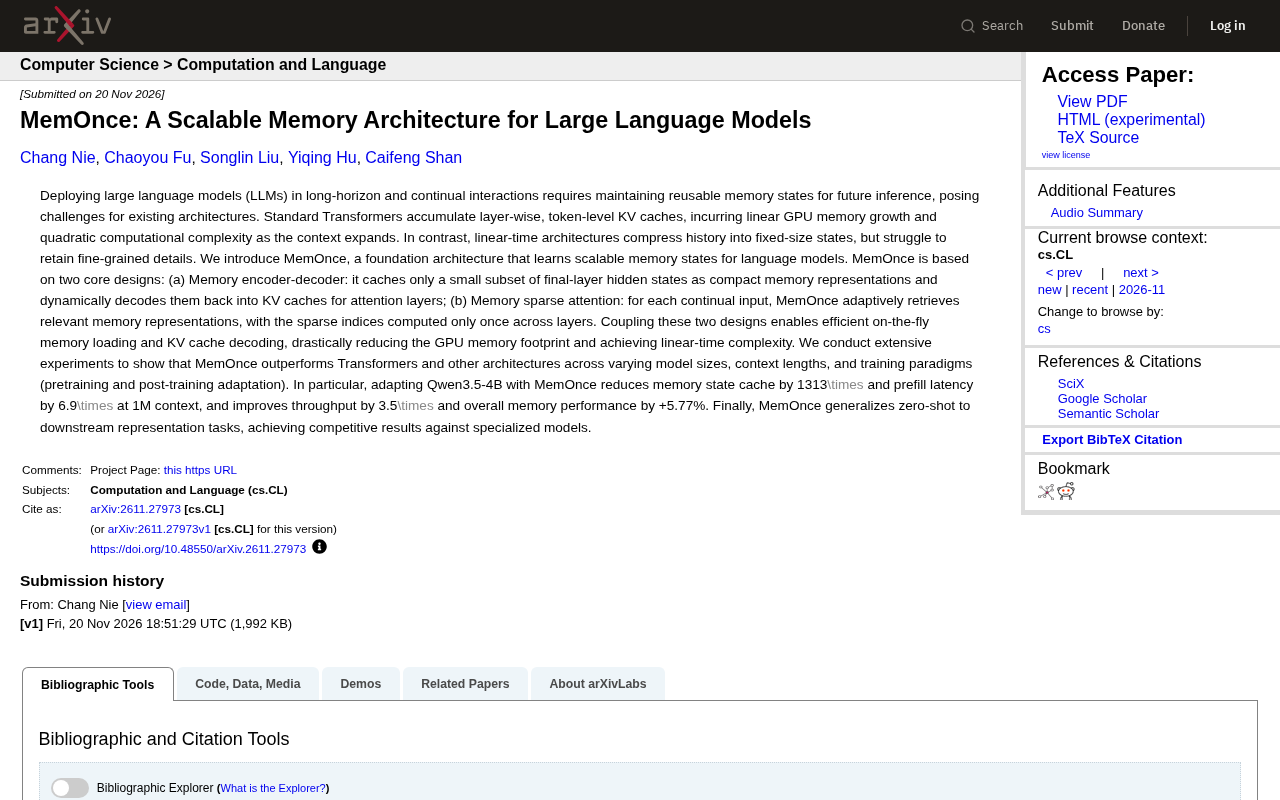
MemOnce: A Scalable Memory Architecture for LLMs That Cuts 1M-Context GPU Memory by 1000x
MemOnce introduces a scalable memory architecture with memory encoding-decoding and sparse attention, cutting Qwen3.5-4B memory cache 1313x and prefill latency 6.9x at 1M context.

COP31 Climate Talks End Without Agreement Over Fossil Fuels and Finance Disputes
COP31 climate talks failed to reach agreement over fossil fuel phase-out and climate finance disputes. This article analyzes the core conflicts behind the breakdown and its impact on global climate governance.

TEA-Bench-BR: Can Coding Agents Turn Branching Clinical Guidelines into Correct Code?
TEA-Bench-BR evaluates coding agents on converting Brazilian autism screening clinical guidelines into code. The 31B model solves over 77%, but drops to 57.4% in English, with input validation as the main failure point.