New Direction for AI Testing Roles: An Introduction to LLM Evaluation and Agent Practice

AI testing shifts from "testing with AI" to "testing AI," requiring evaluation of LLMs, knowledge bases, and agents across three layers, using scores instead of assertions.
The article points out that the assertion logic of traditional software testing fails in AI scenarios, because LLM output falls between right and wrong and needs scores to measure quality—this is why "evaluation" replaces "testing." AI testing objects fall into three layers: LLMs (foundational capabilities), knowledge bases/RAG (rule-driven), and agents (execution loop), each with different evaluation focuses. Hands-on entry requires a Python and Node environment plus an OpenAI-compatible LLM API. The article also provides evaluation methodology and a mind map, pointing the way for developers who want to break into AI testing roles.
Traditional software testing relies on assertions to determine right from wrong, but when it comes to large language models, this black-and-white logic breaks down. AI output often falls somewhere between right and wrong and needs to be measured with scores—this is precisely why "evaluation" replaces "testing." In a technical livestream on Bilibili, the instructor systematically laid out the three major objects of AI evaluation and a hands-on learning path, offering developers who want to break into AI testing roles a clear entry route.
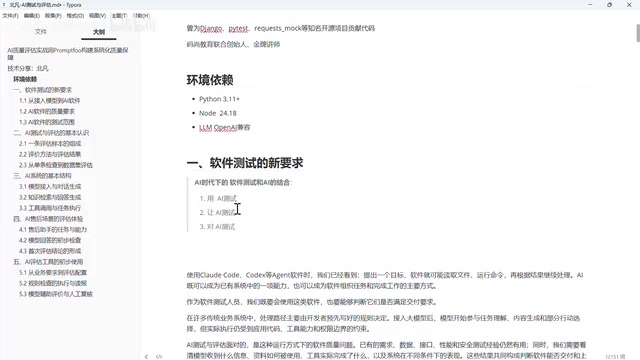
From "Testing with AI" to "Testing AI": A Fundamental Shift in the Testing Role
The instructor reviewed three ways of combining testing and AI discussed previously: testing with AI (AI as an assistant), letting AI test (AI as the main actor executing tests), and testing AI (AI as the object under test). The first two still involve testing traditional software, just with AI tools brought in; the third puts testers and AI on opposite sides of the table—the system under test is itself AI.
This shift is not just theoretical. State-owned enterprise apps such as China Mobile and China Telecom have already built in AI capabilities, and vendors like Tencent and DeepSeekAd are rolling out AI-native software. Even pure manual testers cannot avoid verifying AI features. According to the instructor's observations, 2B software backends commonly integrate agents or intelligent customer service, and demand for testing these systems is growing rapidly.
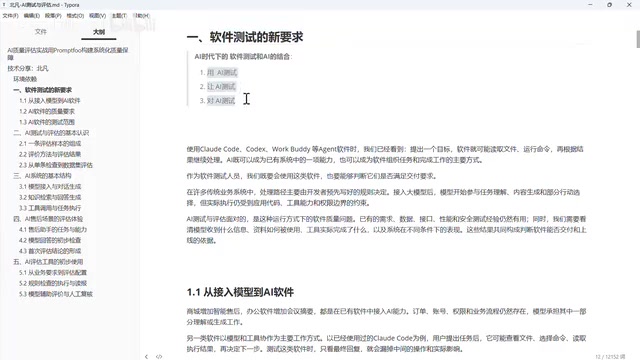
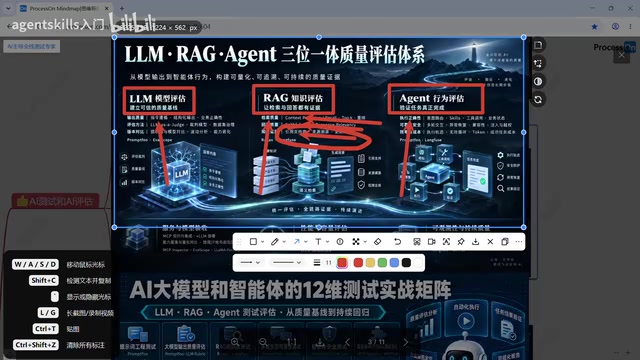
The Three Major Evaluation Objects: LLMs, Knowledge Bases, and Agents
The instructor broke down the targets of AI evaluation into three progressive layers:
Large Language Models (LLMs): Evaluating Foundational Capabilities
Once you connect an LLM, you get basic AI capabilities such as chat, and the barrier to entry is low. But an LLM alone cannot handle specific business rules. The instructor used Pinduoduo's AI chat feature as an example—the experience of chatting with a large number of contact-list-style AI characters was impressive, but the question left behind after the feature went offline was: without business rules to support it, AI cannot complete real tasks such as refunds and after-sales service.
Knowledge Bases (RAG): A Rule-Driven Leap in Capability
RAG (Retrieval-Augmented Generation) gives AI a precise business basis. The instructor used a fresh food refund example to illustrate: if frozen fish arrives partially thawed, should the customer get a full refund or a proportional one? The answer depends on the fresh food after-sales rules in the knowledge base. Evaluating RAG requires attention to three stages—retrieval quality, generation quality, and whether the conclusion has a precise basis.
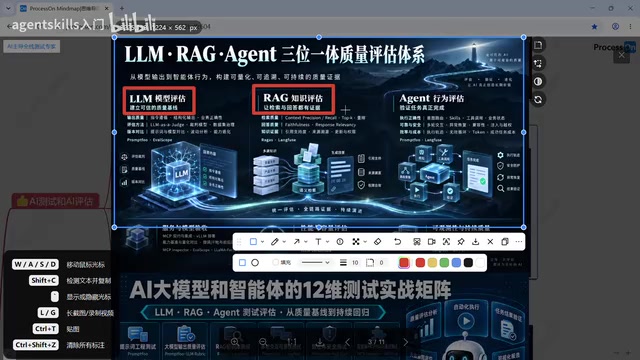
RAG (Retrieval-Augmented Generation) is a technical architecture that combines external knowledge retrieval with LLM generation. Its basic workflow is: when a user asks a question, the system first retrieves the most relevant passages from a knowledge base (such as documents, databases, or FAQs), then feeds these passages as context together with the user's question into the LLM, so the model generates an answer based on this precise material. This compensates for the problem that knowledge fixed in the model's parameters may be outdated or missing, and it makes answers verifiable, significantly reducing the probability of "hallucination." When evaluating a RAG system, the retrieval stage focuses on recall, precision, and ranking quality; the generation stage focuses on whether the answer is faithful to the retrieved content, whether it fully answers the question, and whether the language is fluent.
Agents: Closing the Loop from "Saying" to "Doing"
A knowledge base lets AI clearly state how much should be refunded, but actually initiating the refund and completing the fund transfer requires an agent to execute actions. The evaluation focus then shifts: whether the action is executed, whether it is executed correctly, whether it is complete, and whether there are any extra deviations. The instructor emphasized that even when the knowledge basis is correct, errors can still occur in execution—refunding the full amount when one-third should have been refunded is exactly what evaluation needs to catch.
Hands-On Preparation: Python, Node, and LLM Interfaces
Getting started with hands-on practice requires three things: a Python environment, a Node environment, and an LLM API endpoint. The installers are easy to obtain—just double-click to run. The instructor noted that there are basically no free LLM APIs at present; at work they are usually provided by the company. For personal practice, DeepSeek is an option, with top-ups starting at one yuan.
As for interface requirements, OpenAI compatibility is the de facto standard. Major domestic models—Alibaba, MiniMax, Zhipu, and DeepSeek—all support this protocol, so this condition is automatically met in domestic scenarios.
OpenAI-compatible interfaces refer to API specifications that follow the request and response formats of the OpenAI API (such as the Chat Completions interface). Thanks to OpenAI's broad influence in this field, its interface format has become the de facto standard. Major domestic LLM vendors (such as Alibaba Tongyi, MiniMax, Zhipu, and DeepSeek) all provide API endpoints compatible with OpenAI, so developers only need to replace the base_url and api_key to call different models with the same code. This greatly reduces the development and migration costs of evaluation tools, and also allows evaluation frameworks built on the OpenAI ecosystem (such as LangChain and LlamaIndex) to connect seamlessly with domestic models. For testers, this means an evaluation script written once can flexibly switch between models under test, making horizontal comparisons easy.
Evaluation Methodology: Why Scores Are More Appropriate Than Assertions
AI system output is hard to simply judge as right or wrong, so evaluation expresses quality ranges through scores. This terminological distinction is not wordplay—the assertion logic of traditional software fails in AI scenarios, and a new quality measurement system needs to be established. The instructor provided a mind map covering evaluation objects, tools and methods, and scenario cases, which can serve as a reference framework for a learning path.
From LLMs to knowledge bases to agents, the three progressive capability layers correspond to three types of evaluation focus. For developers who want to enter AI testing roles, this path is more concrete than blind self-study: first understand the principles of each capability layer, then use tools to complete evaluation practice in real scenarios.
Assertion is a basic judgment method in traditional software testing, usually appearing in the form of "does the expected result equal the actual result" or "does it satisfy a certain condition," with a boolean output (pass/fail). However, LLM output is natural language text with diversity, ambiguity, and context dependence; the same question may have multiple reasonable answers, making it difficult to define right or wrong with simple equality checks. Evaluation therefore turns to scoring mechanisms, such as human scoring, rule-based scoring, or using another LLM as a "judge" for automatic scoring (LLM-as-a-judge). Scores can be continuous values or graded labels, capable of expressing intermediate states such as "partially correct," "basically usable," or "slightly off," which better fits the actual quality distribution of AI systems.
Background Notes
Agent refers to a form of LLM application capable of perceiving its environment, planning autonomously, and executing actions to accomplish specific goals. Unlike a plain chat model, an agent typically has capabilities such as tool calling (e.g., calling payment APIs or querying databases), task decomposition, and multi-step reasoning. It transforms the LLM's "language understanding" into "executable operations," thereby completing closed-loop tasks such as refunds, order placement, and after-sales service. When evaluating an agent, in addition to whether the final result is correct, attention should also be paid to whether its action sequence is reasonable, whether there are redundant or missing steps, and whether it can correctly fall back or ask for help under abnormal conditions. This has similarities with functional verification in traditional API testing, but the nondeterminism of agents means evaluation needs to focus more on overall behavioral quality rather than a single return value.
Related articles

Gemini 4 Argon Hands-On: AI Builds Board Games, Constructs Temples, and Trains Robots Autonomously
Gemini 4 Argon hands-on roundup: AI autonomously builds a desk racetrack and temple in Blender, writes a ray tracing engine, trains a humanoid robot to sink 7 shots, plus API pricing and developer access.

The Magic Octagonal Coin: Why Only 9% of People Can Predict Its Flip?
Only 9% of people can correctly predict the Magic Octagon coin flip. This article explains its spatial rotation mechanism, common cognitive pitfalls, and a new hypothesis based on Relevance Theory, exploring the limits of human spatial reasoning.

Sam Altman: AI Is Entering the Era of Scientific Discovery — Math Breakthroughs Will Replicate in Biology and Energy
Sam Altman says AI is entering the era of scientific discovery — math breakthroughs will replicate in biology, materials science, and energy to help develop new drugs and energy sources.