New Framework for Repairing Distilled LLM Trustworthiness: PBRF Achieves 8% Improvement

PBRF framework repairs trustworthiness regressions in distilled models without the original distillation corpus while preserving original capabilities.
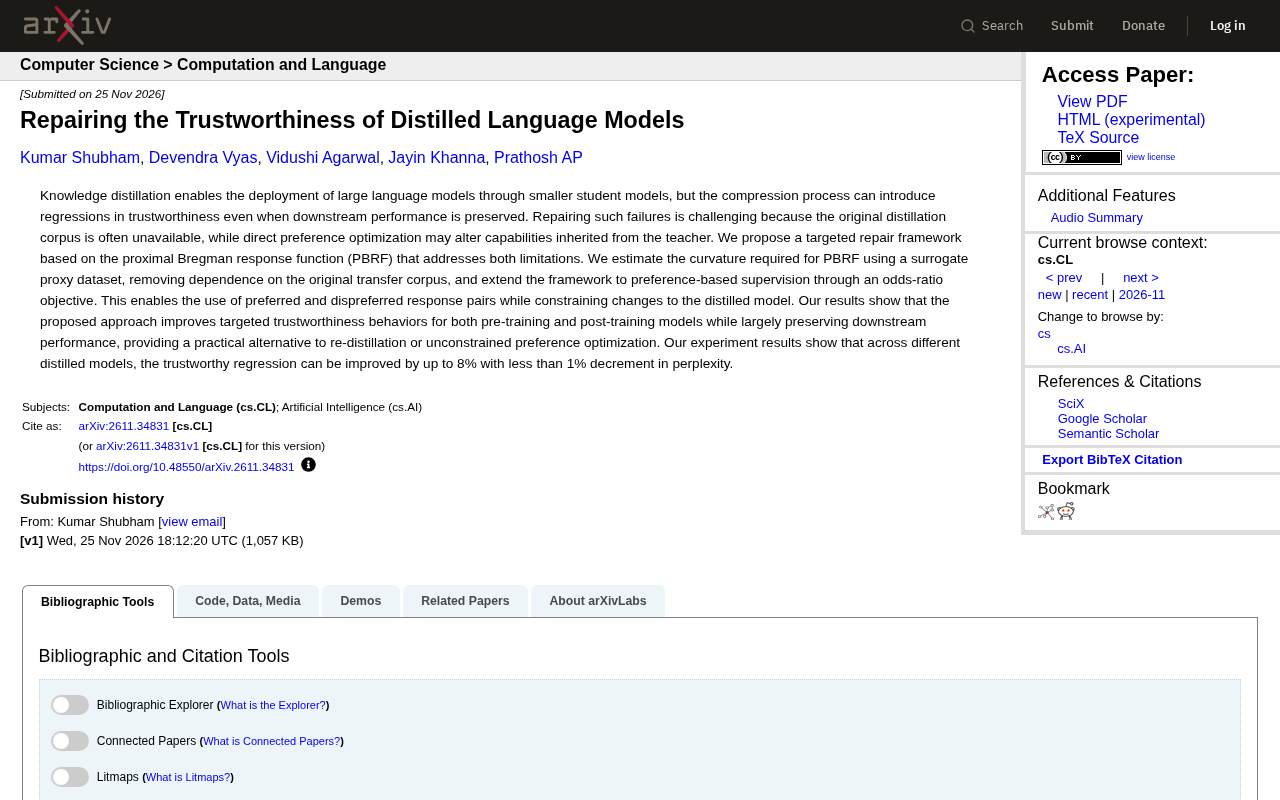
Knowledge distillation compresses large models but can degrade trustworthiness behaviors such as safety and fairness, while the original distillation corpus is often unavailable and direct preference optimization may harm inherited capabilities. Researchers propose a targeted repair framework based on the Proximal Bregman Response Function (PBRF) that uses a surrogate proxy dataset to estimate curvature, eliminating dependence on the original corpus, and extends to preference supervision via an odds-ratio objective. Experiments show the method improves targeted trustworthiness by up to 8% across multiple distilled models with less than 1% perplexity increase, offering a low-cost repair solution without re-distillation.
Knowledge distillation enables large models to be compressed for deployment, but the compression process can impair model trustworthiness even when downstream task performance remains unchanged. To address this pain point, researchers have proposed a targeted repair framework based on the Proximal Bregman Response Function (PBRF), which can effectively repair trustworthiness regressions in distilled models when the original distillation corpus is unavailable, while maximally preserving their original capabilities.
The Trustworthiness Dilemma of Distilled Models
Knowledge distillation enables efficient deployment of large models by having a small student model imitate the behavior of a large teacher model. However, this compression is not without cost: even when the student model performs comparably to the teacher on downstream tasks, its trustworthiness-related behaviors (such as safety, fairness, and honesty) may degrade. This degradation is often insidious because traditional evaluation metrics focus only on task performance while ignoring whether model behavior aligns with human values.
More challenging still, repairing this degradation faces two major obstacles. First, the original distillation corpus is typically unavailable, rendering methods based on fine-tuning with original data ineffective. Second, while Direct Preference Optimization (DPO) can adjust model preferences, it may alter other capabilities inherited from the teacher model, creating side effects where fixing one issue creates another.
The PBRF Framework: Targeted Repair Without Original Corpus
The core of the proposed repair framework is the Proximal Bregman Response Function (PBRF). PBRF was originally designed to make targeted adjustments to model behavior while keeping the model's output distribution close to a reference model. However, directly applying PBRF requires estimating curvature, which typically depends on the original distillation corpus.
The key innovation of this work is using a surrogate proxy dataset to estimate the required curvature, thereby eliminating dependence on the original transfer corpus. This means that even if we do not know what data was originally used to distill the student model, we can still effectively repair it.
Furthermore, the researchers extended the framework to preference-based supervision through an odds-ratio objective, enabling the model to learn from preferred-non-preferred response pairs while constraining the magnitude of model changes to avoid damaging original capabilities.
Bregman Divergence and Proximal Updates: Bregman divergence is a generalized distance measure between two probability distributions, generated by a convex function (such as negative entropy), with KL divergence being a special case. Proximal updates based on Bregman divergence add a penalty term to the optimization objective that prevents the new model's outputs from deviating too far from the reference model, thereby balancing "improving target behavior" and "preserving original capabilities." The "curvature" in PBRF refers precisely to the second-order properties of this Bregman divergence near the reference point, which determine the strength of the penalty and the update step size; it is difficult to estimate accurately without original data, hence the need for a proxy dataset to provide an approximation.
Odds-Ratio Objective: Odds ratio is originally a statistical metric for comparing the probabilities of two groups of events, and in preference optimization it is used to characterize the relative likelihood of "preferred responses" versus "non-preferred responses." With the odds ratio as the objective, the model is encouraged to increase the log-odds of preferred responses and decrease the log-odds of non-preferred responses, while a constraint term limits the overall distribution shift. Compared to directly maximizing the probability of preferred responses, the odds-ratio formulation is insensitive to the absolute probability level of responses and is less likely to disrupt the model's behavior on other inputs, making it suitable for targeted repair when the original corpus is lacking.
Experimental Results: Trustworthiness Improvement with Performance Preservation
Experimental results show that the method can effectively improve targeted trustworthiness behaviors across multiple distilled models. Specifically, across different distilled models, trustworthiness regressions improved by up to 8%, while perplexity decreased by less than 1%. This means the models become more trustworthy while their language modeling capabilities remain virtually unaffected.
This result should not be overlooked: it provides a practical alternative that requires neither re-distillation nor unconstrained preference optimization. For already-deployed distilled models, if trustworthiness issues are discovered, this framework enables low-cost repair.
Perplexity: Perplexity is a common metric in language modeling that measures a model's ability to predict text, with lower values indicating better fit to the distribution of real text. It can be understood as the "average number of candidate words the model hesitates among" at each prediction step. In model repair scenarios, perplexity is often used as a proxy for general language capability: if perplexity rises significantly after repair, it indicates that the model's language modeling ability has been damaged; if the change is small, it suggests that the repair primarily affected targeted trustworthiness behaviors without significantly harming original capabilities.
Technical Details and Implementation Approach
The implementation of the PBRF framework consists of two main stages. First, curvature is estimated using a surrogate proxy dataset, which should be able to represent the general input distribution the model may encounter, thereby providing reliable second-order information for subsequent targeted updates. Second, preference data is integrated through the odds-ratio objective, converting human preferences or rule constraints into the direction of model updates.
Throughout the process, the framework consistently constrains the distance between model outputs and the original distilled model, ensuring that the repair process does not introduce excessive behavioral shifts. This constraint is achieved through Bregman divergence, allowing the updated model to move toward desired trustworthiness directions while maintaining original capabilities.
Industry Implications and Future Directions
As large-scale model deployment expands, trustworthiness issues in distilled models will become increasingly common. The repair approach proposed in this research, which requires no original corpus, provides a new tool for model operations. Future directions worth exploring include extending this framework to more trustworthiness dimensions (such as toxicity, bias, and privacy) and automating the construction of high-quality proxy datasets.
For developers, this method suggests that after distilled models are deployed, trustworthiness metrics should be continuously monitored, and if regressions are detected, PBRF-type methods can be considered for targeted repair rather than retraining. This not only saves computational resources but also enables faster responses to business needs.
Related articles

Nothing CMF Buds 2A Drops to $17.89 on Black Friday: A New Low for ANC Earbuds
Nothing CMF Buds 2A wireless earbuds Black Friday deal: just $17.89 on Amazon, about $11 off retail and a record low. ANC earbuds at an entry-level price.

When AI Creation Gets Accused of "Spitting": Hacker News Heats Up Over the Glaude Controversy
A Hacker News post, "Spitting in the Face of Glaude," sparks debate on AI creation transparency and attribution ethics. This analysis examines the blurred creator identity behind the controversy and offers practical advice for AI content production.

Akai Embraces Custom Firmware: MPC Sample 1.4 Lets Users AI-Program Their Sampler
Akai embraces the modding community with MPC Sample 1.4 firmware, supporting vibe-coded custom firmware and effects. We analyze the impact of this open strategy on music hardware and AI-assisted programming.