New York Times Cooking App Doubles Down on AI Features—Why Aren't Users Buying In?

NYT Cooking doubles down on AI and gets a cold reception on Hacker News, reflecting the trust and value dilemmas of AI-ifying vertical products.
The New York Times has added AI features to its Cooking app, but the discussion on Hacker News drew only low engagement and a negative tone. The article analyzes that recipe scenarios depend on determinism and low error tolerance, and AI-generated content raises users' trust costs. Users' resistance isn't to AI itself but to the fear that new features will encroach on the existing experience and drive up subscription prices. Content organizations face a logic mismatch between editorial-side AI (quietly improving efficiency) and product-side AI (which must be perceived to support subscriptions). For vertical AI products, the key takeaways are: you must answer whether existing pain points are solved, and lower the trust barrier through transparent interactions (such as one-click return to the original recipe or flagging AI-adjusted steps). Early community sentiment is often a leading indicator of hardcore user word-of-mouth.
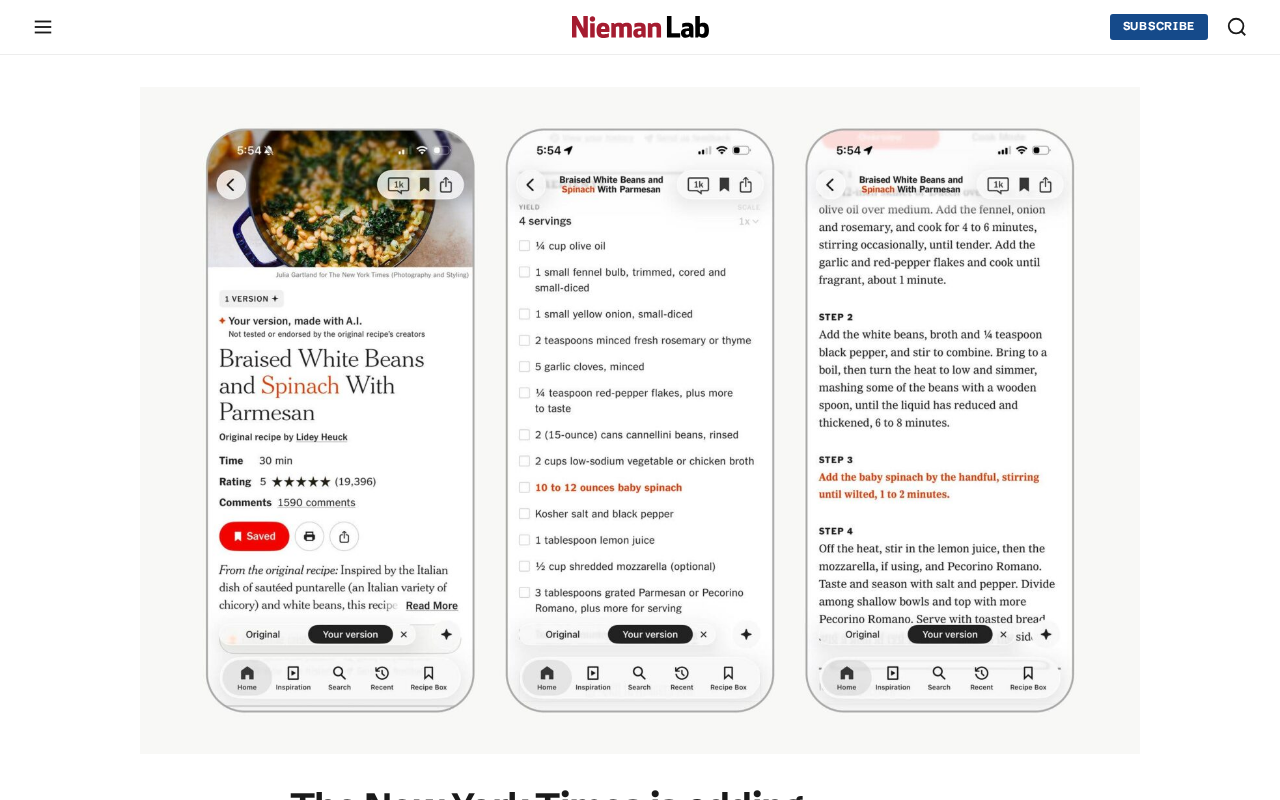
The New York Times is stuffing more AI features into its Cooking app, but the community's response has been lukewarm. On Hacker News, the news garnered only a dozen or so upvotes and a handful of comments, yet the tone of the discussion was remarkably consistent: users aren't opposed to technological progress—they're worried that a cooking tool is turning into yet another feature-laden AI grab bag.
Why does a recipe app need AI?
From a product logic standpoint, the direction isn't hard to understand. Cooking is one of the few vertical products from the New York Times that has genuinely cracked the subscription model. It doesn't sell news—it sells a complete solution for "how to make a good meal": recipes, saved collections, shopping lists, and step-by-step cooking guidance. Slipping AI into this chain sounds like a natural fit: let users describe in natural language what's left in the fridge, and have the system suggest combinations; or automatically adjust recipe portions based on taste preferences.
The problem is that the core experience of cooking depends precisely on determinism. How much salt goes into a dish, how many minutes to roast, what heat level to use—users need accurate, reproducible answers. AI-generated content is inherently uncertain, and placing it in a scenario like "what's for dinner"—where the tolerance for error is extremely low—significantly raises the user's trust cost.
Subscription-based vertical products refer to products that offer deep services in a specific vertical domain (such as cooking, fitness, or finance) and charge on a recurring basis (monthly/yearly). Unlike general content platforms that rely on advertising, their revenue depends directly on user renewal rates. The New York Times Cooking is a typical example of this model: it doesn't monetize through traffic but through users' continued willingness to pay for a "complete solution." This means any feature addition or removal must directly serve retention and renewal, rather than simply pursuing exposure.
Natural language interaction means users express their needs to the system in everyday spoken language (rather than through fixed menus or keywords), and the system parses the intent and returns results. In a cooking context, this means a user can say "I have eggs, spinach, and half a carton of cream in the fridge—what can I make in 20 minutes?" and the system recommends recipes accordingly. This interaction lowers the barrier to use, but it also places higher demands on the system's understanding accuracy and result reliability, especially in low-error-tolerance areas like ingredient substitutions and portion conversions.
Users' real concern: not rejecting AI, but rejecting "AI for AI's sake"
Although the discussion on Hacker News was limited in volume, its direction was clear. This kind of community is no stranger to AI features and isn't hostile to them per se—what they dislike is slapping AI onto mature products as a marketing label.
One implicit worry that came up repeatedly: will the new AI features encroach on the existing experience? A few extra entries in the menu, an additional recommendation section in the interface, a subscription price hike justified by "smart" capabilities—these are the real costs users care about. For subscribers who already pay for Cooking, what they want is faster recipe search and a smoother cooking workflow, not a kitchen assistant that chats.
This sentiment is not an isolated case. Over the past while, several mature utility products have faced similar backlash after adding AI features. User resistance tends to concentrate on two points: whether the feature actually solves an existing pain point, and whether the original functionality has gotten worse as a result.
The AI dilemma of content platforms
The New York Times' situation is more delicate than that of a typical utility product. It is both a content organization and an operator of subscription products. For the former, AI is a productivity tool—assisting journalists, organizing materials, generating summaries. For the latter, AI must become a feature users are willing to pay for.
These two logics don't always align. Editorial-side AI can operate quietly; it's fine if users don't notice it. But product-side AI must be seen and promoted in order to support subscription value. Hence the current situation: features are pushed to the forefront, yet users find they don't actually solve their real problems.
Based on currently public information, the New York Times' AI investment in Cooking is steadily increasing, indicating a clear internal judgment about its commercial value. But community feedback points to another reality: in high-frequency, low-error-tolerance scenarios like recipes, the value-validation cycle for AI will be far longer than for news summaries or content recommendations.
Editorial-side AI and product-side AI are two parallel AI application paths within a content organization. Editorial-side AI serves the content production process—helping journalists retrieve information, generate summaries, and fact-check. Its success criteria are efficiency gains and reduced error rates, and users (readers) are usually unaware of it. Product-side AI, on the other hand, directly faces paying users and must be seen, used, and perceived in order to translate into subscription value. The two have different evaluation systems: the former looks at internal ROI, the latter at user retention and willingness to pay. When the same organization pursues both paths simultaneously, tensions in resource allocation and product prioritization easily arise—especially when the validation cycle for product-side AI is far longer than for editorial-side AI.
Implications for building vertical AI products
This story offers several direct takeaways for those building AI applications.
First, AI additions to mature products must answer "does this solve an existing pain point," not "we have AI too." Users have always judged features by their effectiveness, not their tech stack.
Second, putting AI into high-determinism scenarios requires designing verifiable interactions. For example, letting users one-click back to the original recipe, or flagging which steps were adjusted by AI—transparent designs like these can significantly lower the trust barrier.
Third, community sentiment is an early signal. Low engagement plus a negative tone on Hacker News doesn't necessarily represent the attitude of mainstream users, but it often foreshadows how the first batch of hardcore users will shape word-of-mouth after launch. For subscription products, these users are precisely the most renewal-sensitive demographic.
Whether the New York Times will adjust course remains unclear. But one thing is certain: the AI-ification of recipe apps won't stop because of one round of criticism. What truly determines success is whether these features let users think about one less thing in the kitchen—not one more.
Background notes
AI for AI's sake refers to product teams adding features with AI as a marketing label or strategic gesture, rather than because the feature genuinely solves a user pain point. Typical symptoms of this approach include: prominent feature entry points with low usage rates, promotional language emphasizing "smart" capabilities without clearly articulating concrete benefits, and core existing workflows becoming more complicated due to new features. In mature subscription products, such additions often trigger backlash from existing users, because they've already paid for a deterministic experience, and the added uncertainty is seen as diluting—rather than enhancing—existing value.
Related articles

Ollama+RAG Local Knowledge Base Setup: A Step-by-Step AnythingLLM Tutorial
Based on a Bilibili tutorial, this guide details building a local RAG knowledge base with Ollama + AnythingLLM: from general LLM knowledge limits and RAG principles to document upload, vector storage, and verification.
The Ultimate Ollama Tutorial: A Beginner's Guide to Running Large Models Locally for Free
Ollama is an open-source local large model management tool supporting free download and deployment of models like DeepSeek, with command-line and Web UI, cross-platform, automatic GPU/CPU scheduling — ideal for AI beginners and private deployment.

Giving Claude "Hands": Exoproc Open-Source MCP Server Enables Live Process Hooking
Exoproc is an open-source MCP server enabling Claude Code to hook live Windows x64 processes via thread hijacking, bypassing EDR for dynamic analysis. Static decompilation gave Claude eyes; dynamic hooking gives it hands.