New York Times Warns Photographers: Think Twice Before Upgrading Photoshop—AI Features Pose Hidden Risks

The New York Times warns photographers not to upgrade to the 2027 version of Photoshop because AI may silently alter images.
Heads of The New York Times photography department warned freelance photographers via internal email not to upgrade to the 2027 version of Photoshop, citing AI features that may intervene in image processing in ways users cannot detect. The publicized email sparked discussion about photojournalism authenticity: if generative AI fills in pixels, removes objects, or generates details by default, it undermines the credibility of photos as records. The core issue is AI tool transparency—users need to know when and how AI modified files. If other news organizations follow suit, it could pressure Adobe to offer more granular AI toggles and operation logs. For creators relying on Photoshop, review release notes before upgrading, test new features, and keep original files.
The Core of the Incident: An Unusual Internal Warning
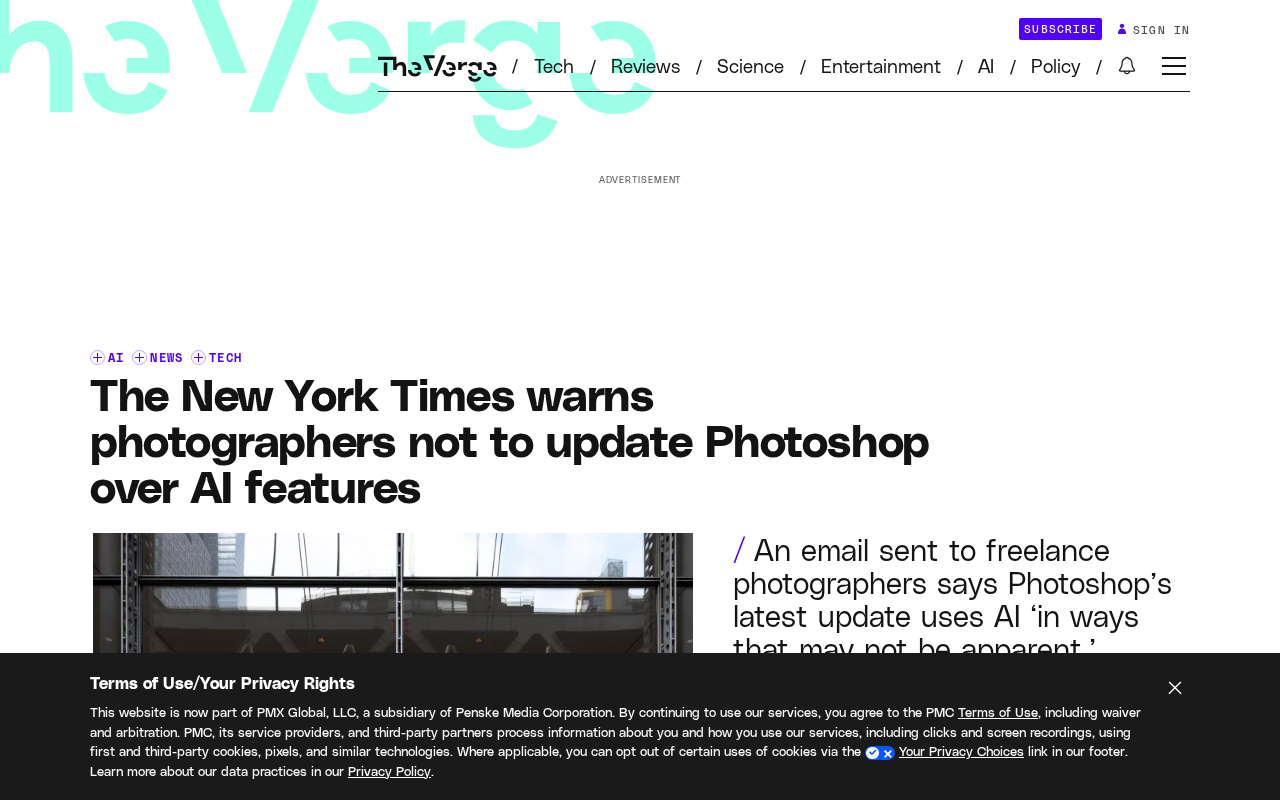
According to an internal email obtained by The Verge and posted on Threads, two heads of The New York Times photography department, Meaghan Looram and Josh (email signature incomplete), issued a clear warning to freelance photographers: do not use the latest version of Adobe Photoshop. The reason is that features in the 2027 update use artificial intelligence "in ways users may not be able to detect."
Once the email was made public, it quickly sparked discussion. It differs from typical software upgrade advice—it is a direct challenge to AI tool transparency from an authoritative news organization. The email did not name specific features, but the phrase "may not be able to detect" points to the possibility of AI automatically intervening in image processing in the background.
Why Photojournalism Is So Sensitive to AI
The core of photojournalism is authenticity. The boundaries of post-processing for a photograph—brightness, contrast, cropping—have long been governed by industry consensus, but the intervention of generative AI blurs that line. If software fills in pixels, removes objects, or generates details without the user's knowledge, the credibility of the photo as a "record" is damaged.
The New York Times' warning is not opposition to AI itself, but to opaque AI. When tools quietly alter image content under default settings, photographers may be unable to assure editors or readers that the image has not been tampered with. For news organizations whose bottom line is fact-checking, this uncertainty is unacceptable.
According to The Verge, the email was also sent to freelance photographers, indicating the impact is not limited to full-time employees. Freelancers often rely on the latest software to maintain efficiency, and this warning effectively asks them to choose between efficiency and compliance.
Typical features of generative AI in image editing include "Generative Expand" and "Content-Aware Fill." The former allows users to generate new pixels beyond the original canvas boundaries, while the latter uses algorithms to synthesize surrounding textures to remove or replace objects. These features are usually presented in Photoshop as "one-click operations" and are applied by default to the current layer; some operations directly modify pixel data without retaining an independent historical snapshot. For photojournalism, this means that even if the photographer did not actively invoke AI, the software may automatically fill edge areas when cropping, rotating, or saving, thereby introducing synthetic content that was not part of the original scene into the file. This "silent modification" is precisely the core of the New York Times' warning—it does not deny the creative value of AI, but emphasizes that in a news context, any pixel-level change must be identifiable and traceable.
Adobe's AI Strategy and Industry Tensions
Adobe has been continuously integrating AI capabilities into Photoshop in recent years, from Content-Aware Fill to Generative Expand, with the goal of lowering the barrier to editing. But the New York Times email reveals a contradiction: the smarter the tool, the weaker the user's sense of control over "what happened."
As of the information available, Adobe has not publicly responded to the email. It is worth watching whether other news organizations will follow with similar guidance. If multiple media outlets simultaneously require photographers to use older versions or disable specific AI features, it could pressure Adobe to provide more granular AI toggles and operation logs.
For individual photographers, this email serves as a reminder of a practical principle: before upgrading production tools, first confirm whether new features will modify file content without prompting. Beyond photojournalism, the same applies to fields with strict requirements for image evidence, such as law, medicine, and insurance.
Adobe launched the Firefly generative AI model in 2023 and deeply integrated it into Photoshop, emphasizing "editing images with natural language instructions." Its technical approach relies on the Content Credentials standard, attempting to mark AI-generated content through metadata. However, this standard depends on users actively enabling it and on platform support; it is not mandatory by default. For news organizations, metadata may be stripped or ignored, and older software or third-party plugins used by freelance photographers may not be compatible. In addition, Adobe's subscription model encourages users to keep upgrading, and older versions will eventually lose official support, making "not upgrading" a choice with costs. The New York Times' warning therefore concerns not only feature transparency but also the structural contradiction in the software ecosystem between "default-on" and "users' right to know."
Implications for Ordinary Users
Even if you are not in photojournalism, this incident is worth noting. AI features being enabled by default, operations being irreversible, and a lack of clear records are common problems in many creative software tools today. The New York Times' warning is essentially a call for AI intervention to be visible, controllable, and traceable.
For creators who rely on Photoshop for their work, it is advisable to review release notes before upgrading, test the behavior of new features, and keep original files for key projects. The neutrality of a tool depends on whether users and developers remain honest about "what AI did."
Key Takeaways
- Heads of The New York Times photography department warned freelance photographers via email not to upgrade to the 2027 version of Photoshop, citing the possibility that AI features may intervene without being noticed.
- The core concern is the authenticity of photojournalism: if generative AI modifies image content by default, it will undermine the credibility of photos as records.
- The incident highlights the transparency problem of AI tools: users need to know when and how AI has modified files.
- It is not yet clear whether other news organizations will follow suit, but it could push Adobe to offer more granular AI control options.
One-line Summary
The New York Times warns photographers not to upgrade to the 2027 version of Photoshop because AI may silently alter images.
Paragraph Summary
Heads of The New York Times photography department warned freelance photographers via internal email not to upgrade to the 2027 version of Photoshop, citing the possibility that AI features in the update may intervene in image processing in ways users cannot detect. The publicized email sparked discussion about the authenticity of photojournalism: if generative AI fills in pixels, removes objects, or generates details by default, it will undermine the credibility of photos as records. The core issue is the transparency of AI tools—users need to know when and how AI has modified files. If multiple news organizations follow with similar guidance, it could pressure Adobe to provide more granular AI toggles and operation logs. For creators who rely on Photoshop, it is advisable to review release notes before upgrading, test the behavior of new features, and keep original files.
Related articles

Nothing CMF Buds 2A Drops to $17.89 on Black Friday: A New Low for ANC Earbuds
Nothing CMF Buds 2A wireless earbuds Black Friday deal: just $17.89 on Amazon, about $11 off retail and a record low. ANC earbuds at an entry-level price.

When AI Creation Gets Accused of "Spitting": Hacker News Heats Up Over the Glaude Controversy
A Hacker News post, "Spitting in the Face of Glaude," sparks debate on AI creation transparency and attribution ethics. This analysis examines the blurred creator identity behind the controversy and offers practical advice for AI content production.

Akai Embraces Custom Firmware: MPC Sample 1.4 Lets Users AI-Program Their Sampler
Akai embraces the modding community with MPC Sample 1.4 firmware, supporting vibe-coded custom firmware and effects. We analyze the impact of this open strategy on music hardware and AI-assisted programming.