NitroStack: The All-in-One MCP Server Development Platform That Topped Product Hunt

NitroStack offers an all-in-one platform for MCP server development, from open-source SDKs to deployment.
NitroStack is a full-stack MCP server development platform combining open-source TypeScript/Python SDKs, visual debugging Studio, workflow orchestration, cloud deployment, and a branded chat frontend. It targets teams that need to quickly launch MCP servers, though platform lock-in and unverified usage figures warrant caution.
From Fragmentation to All-in-One: Why MCP Server Development Needs New Tools
Model Context Protocol (MCP) is becoming one of the de facto standards for connecting AI applications to external tools and data. But as the number of MCP servers surges, developers face increasingly concrete engineering problems: SDK selection, local debugging, authentication, deployment, frontend integration—each link can consume significant time. NitroStack attempts to bring these links together into a single workflow with a complete toolchain, and gained attention on Product Hunt with 154 votes and a #1 daily ranking.
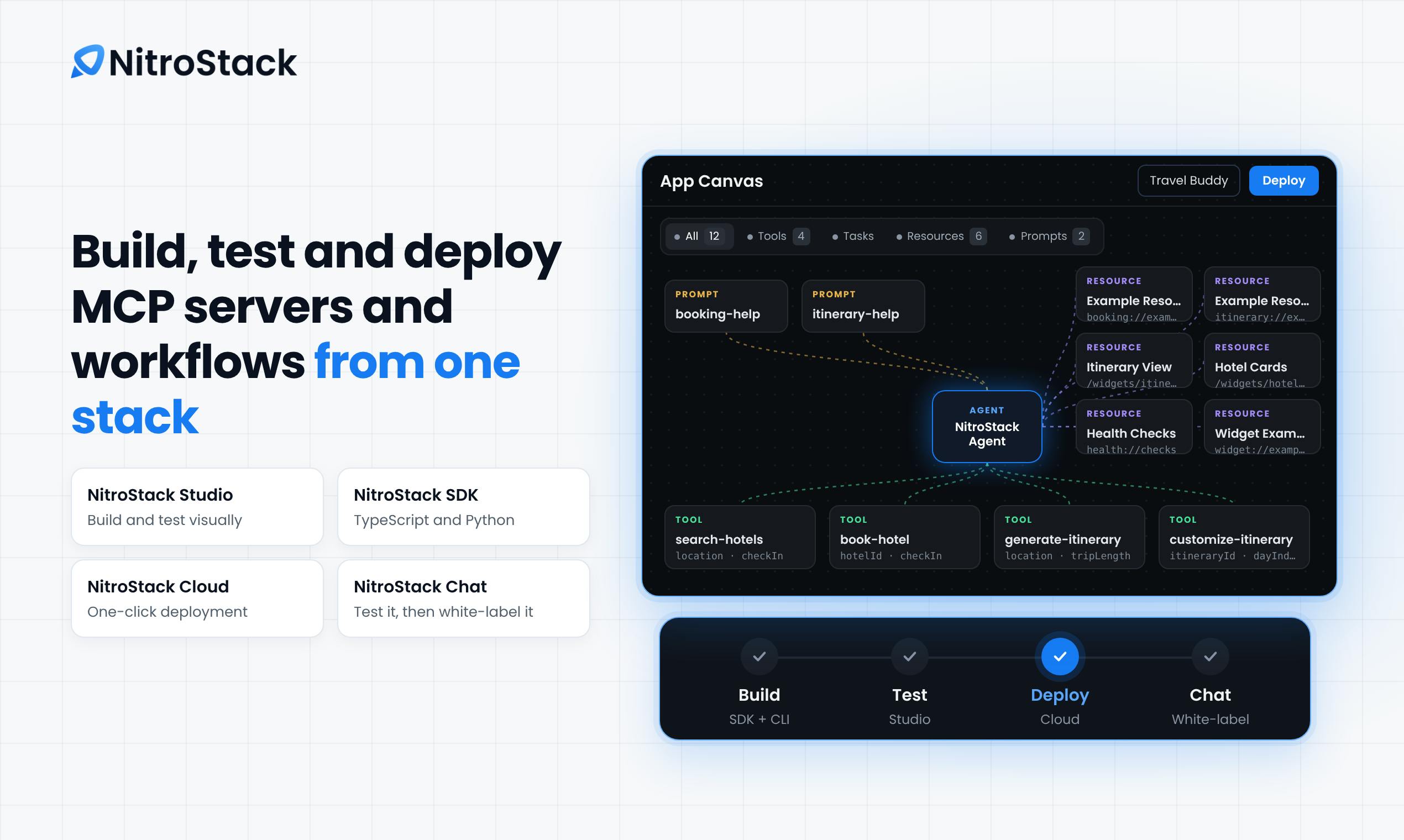
According to its Product Hunt page, NitroStack positions itself as "the full-stack platform for building production-grade MCP servers and AI applications." Its core selling point is not a single SDK, but a product matrix covering the entire development lifecycle.
MCP (Model Context Protocol) is an open protocol proposed by Anthropic in late 2024, designed to provide AI applications (such as chat assistants and agents) with a standardized way to connect to external tools, data sources, and services. Simply put, it defines how AI models discover available tools, how they invoke those tools, and how they receive returned results. Before MCP emerged, every AI application needed to write separate integration code for each external service, leading to duplicated effort and ecosystem fragmentation. MCP aims to become the "USB-C port of the AI world," so that tool providers only need to implement an MCP server once and it can be used by all AI clients that support the protocol. Currently, mainstream clients such as ChatGPT and Claude have announced or are in the process of supporting MCP, which has rapidly increased demand for MCP server development.
Breaking Down NitroStack's Product Matrix
Open-Source SDK: TypeScript and Python in Parallel
NitroStack offers open-source TypeScript and Python SDKs, which are its first entry point for attracting developers. The two languages cover the mainstream tech stacks of current AI application development: TypeScript leans toward web and frontend integration scenarios, while Python has a more mature ecosystem on the data and model side. The open-source strategy also lowers the barrier to trial—developers can first write an MCP server locally in a language they are familiar with, and then decide whether to move on to other parts of the platform.
SDK (Software Development Kit) is a set of tools used to help developers build applications for a specific platform or protocol, typically including library files, API wrappers, code examples, and documentation. In the context of MCP, the SDK handles the underlying communication details of the protocol (such as JSON-RPC message formats, connection management, and capability negotiation), so developers only need to focus on business logic—that is, defining tool names, descriptions, parameters, and implementation functions. NitroStack's dual-language TypeScript and Python SDK means developers can quickly create MCP-compliant servers using a tech stack they are familiar with, without implementing the protocol from scratch. Open source further allows the community to review code, contribute improvements, and reduces the risk of dependence on a single vendor.
NitroStack Studio: Visual Testing and Debugging
An SDK alone is not enough—debugging MCP servers often requires observing tool calls, parameter passing, and returned results. NitroStack Studio provides visual testing and debugging capabilities, so developers do not have to rely entirely on logs and the command line to troubleshoot. For teams new to the MCP protocol, this visual feedback can significantly shorten the time from "it runs" to "it runs correctly."
Workflow and Cloud: Orchestration and Deployment
NitroStack Workflow handles agent workflow orchestration, and NitroStack Cloud handles deployment. Combined, this means developers can organize multiple MCP servers and agent logic into services ready to go live, rather than stopping at the local demo stage. The official messaging emphasizes that "authentication, testing, deployment, and frontend stay in the same workflow," which directly targets the pain point of fragmented toolchains in current MCP development.
Agent workflow orchestration refers to organizing multiple AI agents or tool calls into executable processes according to specific logic. In the MCP ecosystem, a complex task often requires multiple MCP servers to work together—for example, first calling a search tool to obtain information, then calling a database tool to store results, and finally calling a notification tool to send a message. Workflow orchestration tools allow developers to define the order, conditional branches, and error handling of these steps visually or in code, without manually writing scheduling code. NitroStack Workflow is designed for this purpose; combined with its Cloud deployment service, it can publish orchestrated processes as scalable online services with one click, with built-in production-grade capabilities such as authentication and monitoring. This solves the "last mile" problem between local development and production launch for MCP servers.
NitroStack Chat: Branded Frontend Experience
NitroStack Chat is used to deliver a conversational experience with brand identity. For teams that want to package MCP capabilities into end-user-facing products, this layer saves the cost of building a frontend from scratch. It also supports connecting to ChatGPT, Claude, and other AI clients, indicating that the platform does not try to lock users into using only its own chat interface.
What the Scale of 80,000+ MCP Servers Means
The official page mentions "Powering 80,000+ MCP servers." If accurate, this number suggests that NitroStack has already built a certain developer base. However, it should be noted that this figure comes from official promotional messaging, and the original material does not disclose the statistical method—whether it is cumulative creations, monthly active servers, or the total number of servers built through its SDK remains unclear. When evaluating the platform's maturity, readers can treat it as a reference rather than an absolute metric.
From a product design perspective, NitroStack's approach resembles "developer experience first" platforms such as Vercel and Supabase: acquire customers with an open-source SDK, monetize with hosted services, and increase switching costs with an integrated workflow. The MCP ecosystem is still in a phase of rapid toolchain differentiation, and whoever can standardize the dirty work of debugging, authentication, and deployment has a chance to become the default choice.
Who It's For, and What to Watch Out For
NitroStack's target users are fairly clear: small and medium-sized teams that need to quickly build and launch MCP servers, and developers who want to productize AI tool connectivity. Its advantage lies in reducing tool switching; its disadvantage lies in platform lock-in risk—once workflows, deployment, and frontend all depend on the same platform, migration costs will rise over time.
In addition, Product Hunt's 154 votes and 13 comments show that it has gained early attention, but the sample size is limited, and stability in real production environments, authentication details, and pricing strategy still need further verification. For teams currently selecting MCP development tools, it is advisable to first use the open-source SDK for small-scale validation, and then evaluate whether to adopt the full chain of Studio, Workflow, and Cloud.
One-line Summary
NitroStack launches a full-stack platform that solves MCP server development pain points in one place with an open-source SDK, visual debugging, workflow orchestration, and deployment tools.
Paragraph Summary
NitroStack is a full-stack platform for MCP server development, aimed at solving the current fragmentation of toolchains. It offers open-source TypeScript and Python SDKs as the entry point, together with the visual debugging tool Studio, workflow orchestration Workflow, deployment service Cloud, and branded chat frontend Chat, covering the entire lifecycle from development to launch. The official claim is that it supports 80,000+ MCP servers, but the statistical basis is unclear. The platform's advantage is reducing tool switching and improving development efficiency; its disadvantage is the potential risk of platform lock-in. The target users are small and medium-sized teams that need to quickly launch MCP servers, and it is recommended to first use the open-source SDK for small-scale validation before deciding whether to adopt the full chain.
Related articles

Gemini 4 Argon Hands-On: AI Builds Board Games, Constructs Temples, and Trains Robots Autonomously
Gemini 4 Argon hands-on roundup: AI autonomously builds a desk racetrack and temple in Blender, writes a ray tracing engine, trains a humanoid robot to sink 7 shots, plus API pricing and developer access.

The Magic Octagonal Coin: Why Only 9% of People Can Predict Its Flip?
Only 9% of people can correctly predict the Magic Octagon coin flip. This article explains its spatial rotation mechanism, common cognitive pitfalls, and a new hypothesis based on Relevance Theory, exploring the limits of human spatial reasoning.

Sam Altman: AI Is Entering the Era of Scientific Discovery — Math Breakthroughs Will Replicate in Biology and Energy
Sam Altman says AI is entering the era of scientific discovery — math breakthroughs will replicate in biology, materials science, and energy to help develop new drugs and energy sources.