No Coding Required: The AI Battle Game Where You Train Models to Race Autonomous Cars

A no-code competitive game where you train NEAT-based AI models to race autonomous cars against other players.
An indie developer has gamified the reinforcement learning training process into a competitive AI racing game: players train autonomous driving models using the NEAT algorithm through a visual interface — no coding required — then race their AIs against each other on the same track. NEAT evolves both network structure and weights over generations, letting players watch their AI progress from crashing constantly to navigating corners smoothly. The game launches October 18th and is currently recruiting early testers, with the developer especially welcoming critical feedback on usability and competitive fairness.
A New Experiment in Turning Reinforcement Learning into a Game
As AI technology grows increasingly complex and harder to access, one developer has taken a different approach to bringing machine learning within reach of everyday people — by turning the process of training AI models into a competitive game.
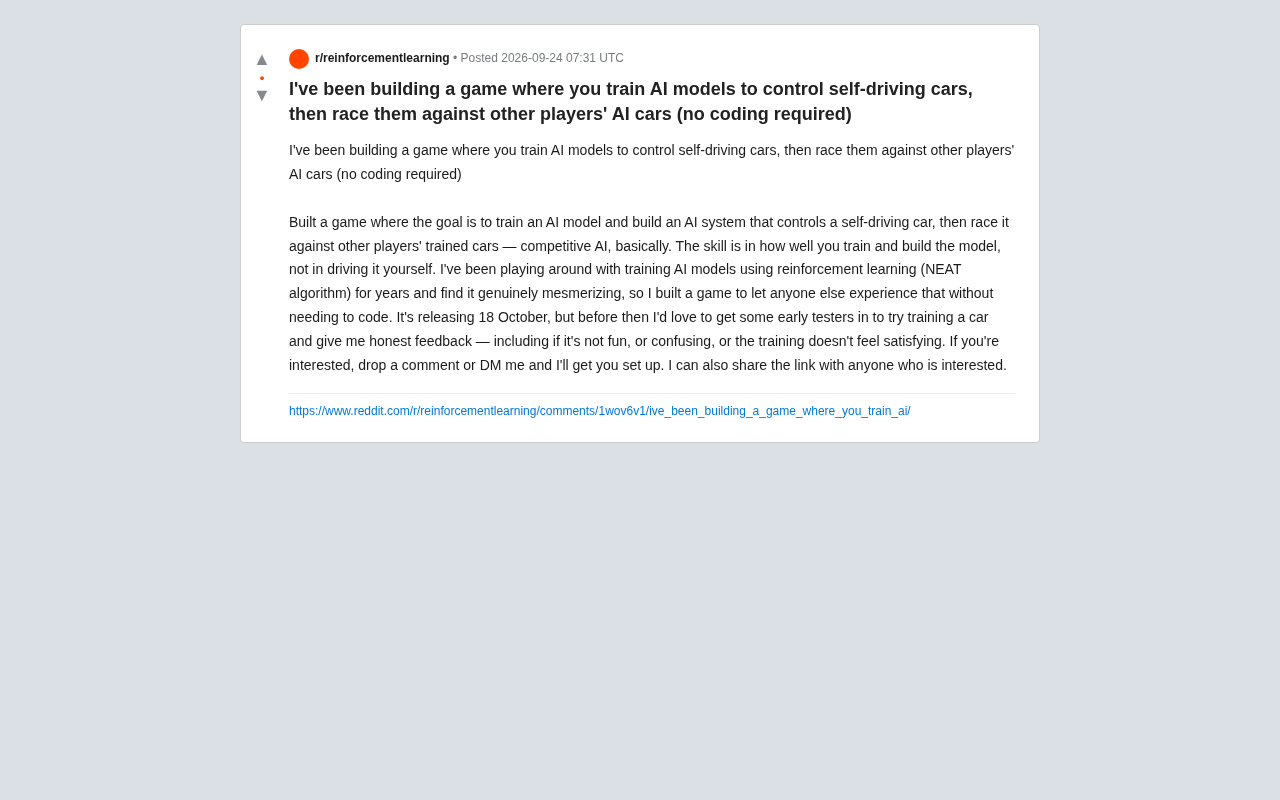
According to the developer's post on Reddit, the game's core mechanic isn't about driving the car yourself. Instead, players train an AI model that autonomously controls a self-driving race car, then pit their trained AI against other players' AIs on the same track. In the developer's own words, it's essentially a "competitive AI" showdown — the competition isn't about who has better reflexes, but who can train a smarter, better-optimized model.
Core Gameplay: Training Matters More Than Driving
Traditional racing games test a player's reaction speed and precision. This game shifts the focus entirely to the "training" phase. Players must think about how to design and tune their AI model so it can make autonomous decisions on the track — when to accelerate, when to turn, how to avoid collisions.
The design philosophy is compelling: it distills the core joy of a machine learning engineer's daily work — watching a model go from clumsy to capable — into a game mechanic. The developer mentioned that he has spent years training AI models using reinforcement learning, particularly the NEAT algorithm (NeuroEvolution of Augmenting Topologies), and found the process "deeply fascinating." He wanted to share that same experience with people who have no programming background.
About the NEAT Algorithm
NEAT is an algorithm that generates neural networks through evolution. Rather than just tuning the weights of a fixed network structure, it progressively evolves the network's architecture itself. For self-driving racing scenarios, NEAT is a natural fit — it starts with a simple network and, through successive "generations" of evolution, selects for the best-performing driving strategies. From a gameplay perspective, watching an AI get smarter generation by generation is inherently satisfying and visually engaging.
NEAT was introduced by Kenneth Stanley and Risto Miikkulainen in 2002, and stands as a landmark result combining evolutionary algorithms with neural networks. Traditional neuroevolution methods typically only optimize the weights of a fixed-topology network. NEAT's breakthrough was introducing "historical markings," which allow the algorithm to track homologous gene segments across individuals and correctly align genes from different topological structures during crossover — solving the "competing conventions problem." In practice, NEAT starts from extremely simple networks — often just a direct connection between input and output layers — and grows more complex structures over generations through two mutation operations: "add node" and "add connection." A speciation mechanism ensures that individuals with significantly different structures have enough time to develop before being eliminated, preventing innovative mutations from being weeded out too early. This makes NEAT especially well-suited for continuous control tasks, which is why it has been widely adopted in autonomous driving simulations and game AI.
No Coding Required: Lowering the Barrier to AI
One of the most noteworthy aspects of this game is that it requires absolutely no coding. Even if you know nothing about Python or neural networks, you can participate in AI model training directly through the game's interface.
This addresses a clear and growing need: more and more people are curious about AI but are blocked by the technical barrier to entry. Packaging reinforcement learning into a visual, hands-on game is a clever way to make the concept accessible. It transforms the abstract idea of "model training" into something tangible — you can watch your car go from constantly crashing into walls to smoothly navigating corners. That kind of direct feedback is far more vivid than reading a tutorial.
Reinforcement Learning (RL) is one of the three major paradigms of machine learning. Its core idea is to have an "agent" learn optimal behavior through repeated interaction with an environment via reward signals, rather than relying on manually labeled datasets. In a racing scenario, the agent senses its current state every frame (e.g., speed, distance to track edges, upcoming corner angle), outputs a driving action, and receives positive or negative rewards based on lap completion or collisions. This process is fundamentally different from supervised learning: there is no "correct answer" to reference — the model must discover effective strategies through extensive trial and error. This is precisely why reinforcement learning's training process has natural dramatic tension: the stark contrast between an agent's early clumsiness and its later fluid performance creates an observable progress curve, which is the underlying logic that allows this game to transform a technical process into an entertaining experience.
Development Status and Early Tester Recruitment
According to the developer, the game is planned for an official release on October 18th. In the meantime, he is recruiting early testers and is eager for genuine feedback — especially critical opinions.
He explicitly stated that he wants to hear things like "the game isn't fun," "the controls are confusing," or "the training process feels unrewarding." This kind of openness is critical for an indie developer: the core experience of a competitive AI game hinges on whether the training process feels satisfying. If players feel frustrated or bored during training, the product's entire premise falls apart. Interested users can comment on the original post or message the developer directly to get a playtest link.
A Few Observations
Turning machine learning into a competitive game isn't an entirely new concept — there have been similar experimental projects in the past. But this game's combination of "zero coding" and "player-vs-player AI battles" hits on a solid angle. It works both as an entertainment product and potentially as an AI education tool.
That said, success will ultimately depend on the details: Is the training interface intuitive enough? Is the feedback on AI performance timely? Is the competitive matchmaking fair? These are all questions that early testing will need to iron out. As an indie project, whether it can hold its ground after launch remains to be seen. But from a creative standpoint, using gamification to help the general public understand and experience reinforcement learning is undoubtedly a direction worth watching.
Related articles

A Single Prompt Triggers a Global PHP Security Storm: Is AI a Savior or a Hidden Risk?
A single AI prompt triggered a global PHP security crisis affecting Wikipedia and the Internet Archive. This article reviews the incident, analyzes the OpenAI-Amazon controversy, and explores the security paradox of lowered vulnerability discovery barriers in the AI era and developer response strategies.

When AI Is Taken Away: How Reliance on Shortcuts Undermines Your Problem-Solving Resilience
A study of 1,222 people found that after using AI to answer questions, once AI was removed, people gave up on more problems than a control group that never used AI. The article analyzes the impact of AI reliance on learning resilience and metacognition, and explores design implications for AI learning tools.

Carta and NewView Partner to Let Startup Employees Cash Out Equity Early
Carta and NewView Capital partner to simplify startup tender offers, helping employees sell equity early. Analysis of the mechanism, liquidity pain points, and impact.